
Written by: Stephanie Palmer
Edited by: Chloe Rybicki-Kler, Emily L. Eberhardt, Sarah Bassiouni, and Jennifer Baker
Hey there, reader! This is the first blog post in a two-part series about factors influencing children’s physical activity decisions and behaviors. This post will explore the developmental factors that influence children’s physical activity decisions. To learn more about practical steps caregivers can take to support children’s physical activity behaviors, read part 2 here!
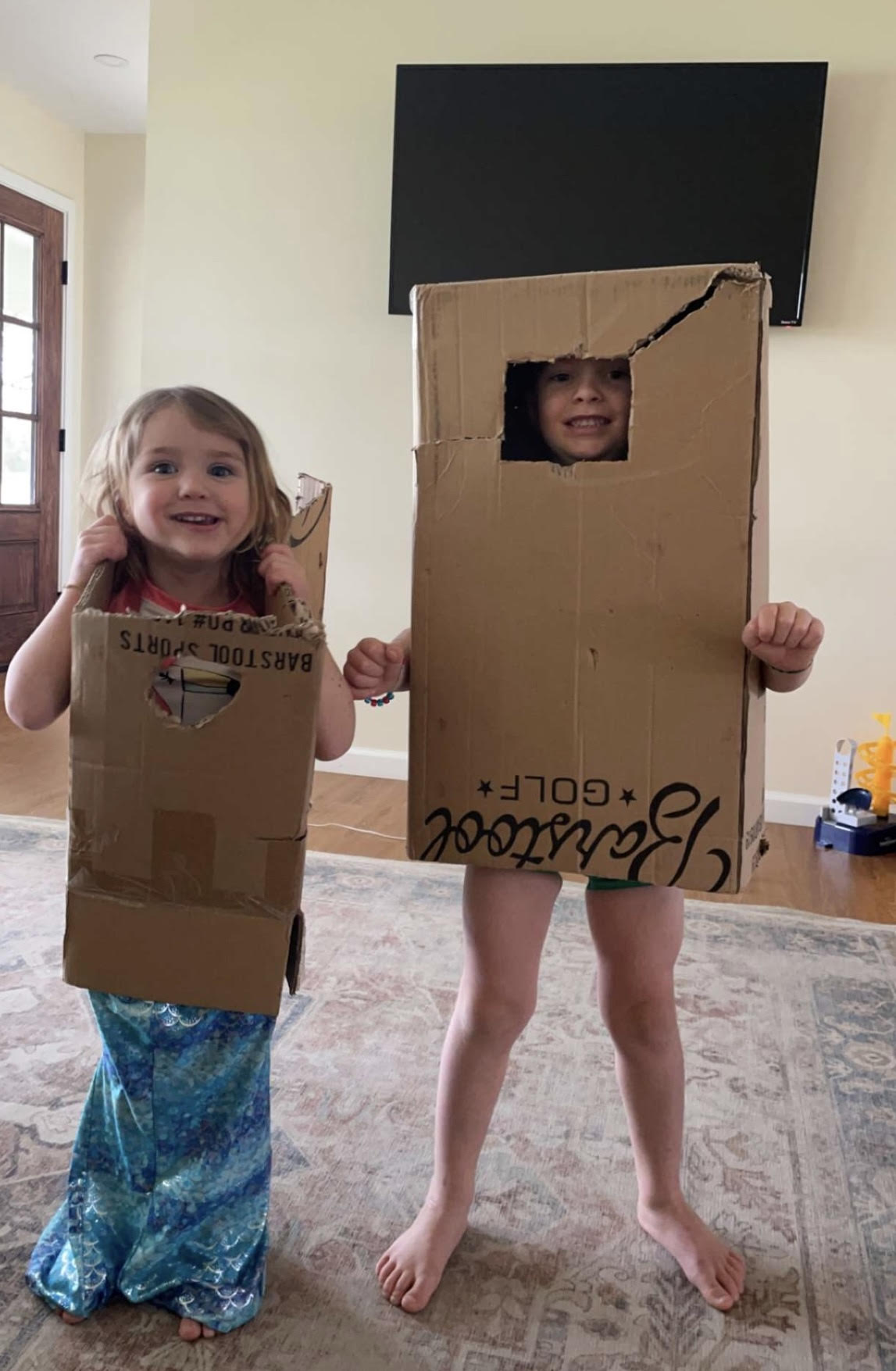
As I write, my three year old niece and five year old nephew are outside madly chasing chickens while wearing cardboard boxes that they have fashioned into robot armor. The vigor and stamina on display–by both the children and the chickens–are impressive and remind me of my childhood escapades. Once, I hosed down my family’s garage with two inches of water to make a more difficult (i.e., dangerous) rollerblade obstacle course for myself and my siblings. Another time, my sister and I duct-taped large exercise balls to our bodies so that we could run into each other repeatedly.

Credits: Stephanie Palmer
Maybe you, like me, have fond memories of your childhood antics and play; if so, you were likely a physically active child. Unfortunately, children today may have different opportunities for active play or choose not to participate when given a chance.
Physical activity is defined as any body movement that is produced by the skeletal muscles and results in energy expenditure above resting metabolic state (i.e., raises your heart rate and makes you feel warm). A child is considered physically active if they engage in the recommended amount of daily physical activity: three hours of active play for children under 5 and 60 minutes of sweat-inducing activity, daily, for children ages 5–17, according to the World Health Organization (WHO). A child is considered physically inactive if they fall below these targets. For context, my niece (Elliot “Bean” Claire, 3) and nephew (Wesley “Boo” James, 4) tired out after 20 minutes chasing chickens, accumulating only 11% of their daily physical activity quota. Despite temporarily exhausting themselves, they will need to wreak havoc on the hen house approximately five more times to meet the WHO guidelines, which might surprise any adult looking at their sweaty little faces.
Credits: Natalie Reinhart
Physical inactivity is a global epidemic and public health crisis among children today. The World Health Organization estimates that 81% of children 11–17 are not meeting the current physical activity guidelines. Among U.S. children, the estimated prevalence of physical inactivity is 76% and 50% for 6–17 year old and 3–5 year old children, respectively. The high prevalence of childhood physical inactivity is worrying because (1) physical activity patterns are established during childhood and (2) low activity levels contribute to chronic illnesses and premature death, with 7.2% of all deaths directly attributed to physical inactivity. To address physical inactivity among U.S. children, the Centers for Disease Control and Prevention (CDC) released recommendations to increase park access, neighborhood walkability, and social support for physical activity, among other things, in communities nationwide. However, the onus to implement physical activity support falls on communities, schools, and individuals who are frequently overwhelmed by more pressing issues. For example, in Wayne County, Michigan, 23.1% of adults engage in no leisure time physical activity; at the same time, roughly 33% of third graders are not proficient in English or mathematics, and 19.7% of adults experience depression. Perhaps such contextual evidence explains why current data suggest that children are not engaging in physical activity. With other more pressing issues at stake, where would you devote resources as a community leader, member, or parent?
While it is undoubtedly true that socio-environmental contexts influence childhood (and adulthood) physical activity, there are critical individual factors to consider, too. Given its proximity to the issue, one factor that has received shockingly little attention is an individual’s ability to move.
We often take for granted that physical activity requires physical skills, otherwise known as motor skills. Motor skills are learned sequences of musculoskeletal actions that combine to produce goal-directed movement. They are made possible by complex neural processes that tell our bodies which muscles to use to perform activities like running, kicking, or running and kicking at the same time. The neural processes underlying motor skills are refined through movement or practice. For example, babies are born with a step reflex, which causes the funny dance infants do when you touch their feet to a solid surface while holding them upright. This reflexive dance is associated with the development of walking. Indeed, fascinating studies show that parents can stimulate earlier independent walking by, for example, holding their baby upright in the tub so that they can step and kick their legs without being constrained by the weight of their legs as they grow. More complex motor skills (i.e., those beyond the infant motor milestones) are refined through movement and deliberate practice, which brings us to fundamental motor skills and the need to master them during childhood.
Childhood physical activity is made possible by fundamental motor skills (FMS). FMS are the ABCs of movement, encompassing basic locomotor (e.g., run, gallop, slide, skip, hop), object control (e.g., throw, catch, kick, toss), balance, and coordination skills. Most children develop an elementary level of skill in FMS by participating in ample and diverse physical activities during early childhood (3–5 years). After that, a sufficient level of FMS enables children to learn and participate in novel and increasingly complex physical activities, entraining healthy activity patterns and fostering advanced FMS through play and practice. By the time children reach 9–12 years of age, they should exhibit mastery level FMS performance. Mastering FMS enables children to learn complex motor skills in sports and recreational activities, which require the ability to combine one motor skill with another (e.g., running and dribbling a ball at the same time) or fluently string skills together (e.g., dance or karate). In research, children who demonstrate age-appropriate FMS skills are deemed “competent” in motor skills, and data supports that these children are more likely to live active, healthy lives. Those with poor FMS skills are at risk of physical inactivity, obesity, and low self-perceived competence in the exact motor skills that support physical activity and serve as the foundation for future physical activities.
Presently, many children do not demonstrate a skill level in FMS sufficient to support basic or advanced physical activities. One recent, particularly alarming study reported that 77% of typically developing preschoolers do not possess age-expected levels of competence in FMS, with 33% of the U.S. representative sample exhibiting a skill level low enough to qualify them for physical therapy. This finding effectively means that a large number of preschoolers cannot perform up to 36 (out of 50) critical elements of FMS, like swinging their arms opposite their feet while running, maintaining rhythm while galloping or skipping, using two hands to catch a tossed ball, or throwing a ball overhand with proper form. On a deeper level, these findings suggest that preschoolers are not developing critical elements of coordination or perception-action coupling necessary for further motor development.
Unsettlingly, these results are not limited to early childhood. A study examining FMS in over 20,000 children from 25 countries found that 32% of children ages 6–10 are not sufficiently skilled in FMS. Further, recent data indicates that some teenagers have not mastered FMS. Low-level skill in FMS is a significant issue considering a child’s skill level influences their ability to successfully participate in age-appropriate activities. Moreover, children’s FMS performance affects how their peers view them and, consequently, how they view themselves. A child who cannot throw as well or run as fast as their peers will generally be chosen last to participate in games, sports, or after school activities, and the consequence of being selected last, or not at all, negatively impacts children’s physical and emotional self-concept and motivation to be active.
Few children in the U.S. are physically active, and it’s possible that many do not possess the skills to be physically active. However, adults can support children’s motor development by teaching and helping them to be physically active, effectively killing two birds with one stone. Part two of this blog will discuss how parents and other caregivers can create a home environment that supports children’s FMS skills by teaching them to value and participate in physical activity, to the best of their ability.

Stephanie Palmer is a Ph.D. candidate in Movement Science studying how the home physical activity ecosystem influences children’s competence in fundamental motor skills. Stephanie holds a B.S. in Psychology from Southeast Missouri State University (SEMO) and MS.Ed. in Exercise Science from Southern Illinois University, Carbondale. Before moving to Michigan, Stephanie helped people engage in exercise and physical activity through her roles as an assistant soccer coach, personal trainer, behavioral therapy implementer, teaching assistant, and volunteer researcher in the Strong Survivors Cancer Rehabilitation Lab. Stephanie is passionate about helping people of all ages and abilities learn to love movement; she enjoys doing the same in her spare time. Stephanie competed in swimming, gymnastics, and Division I soccer at SEMO, plays for the University of Michigan Women’s Club Soccer Team, and is training to compete in the National Women’s Soccer League. Outside organized sports, she loves to read, chase chickens with her 13 nieces and nephews, and develop wild new backyard games.

 misciwriters.com
2 thoughts on “When you move, I move: Exploring the science behind childhood physical activity”