
Written by Jennifer Baker and Christina Del Greco
Hi there,
Thanks for picking up a copy of EquilibriUM edition 2! We’re so excited to finally share what we’ve been working on.

The brainchild of former editor-in-chief Sarah Kearns, EquilibriUM started as a special project to commemorate the 5th anniversary of our organization, Michigan Science Writers. The first edition of any project always faces challenges. Ours was attempting to distribute a tangible product in December 2020, when all non-essential activities were pushed into the virtual realm due to COVID-19. I (Jenn) remember stopping by Sarah’s house on a snowy night, the eerily quiet kind, to pick up magazines for distribution. For the first time during the project, Sarah and I chatted – in person – in the quiet darkness. It wasn’t clear then how wide-reaching our words, stacked in boxes lining the porch, would be. However, I knew that this project had awakened something in me that would stick.

And I (Christina) remember seeing the printed first edition one day sitting in an office and thinking to myself, I sure hope I can get involved with that the next time they do it. Fast forward to August 2022 — Jenn and I were setting up for an uncomfortably warm recruitment event under a tent on the Rackham lawn, stacking copies of the first edition of EquilibriUM to give away to incoming students. The magazine had been on my mind since I first got involved with MiSciWriters, but previous leadership teams seemed (rightfully) daunted by the task of restarting it. Once Jenn and I — two humans notorious for over-involving ourselves in this organization — joined the leadership board, it felt like the time was right. Individually, we were nervous about taking on such a big task alone. But since we were both excited about this magazine, we thought, well, what’s one more project, and decided to take it on together, starting with learning where that sneaky “s” goes in the correct plural form of our position: editors-in-chief.
The following months that ensued were full of imagining — what could this project be, if it wasn’t an anniversary project? How could we expand our team of authors, editors, and illustrators into as many scientific disciplines as possible? And how could we learn from our prior experiences to make the second edition into something that could become a third, and a fourth? You’ll see from these pages that we have kept all the best things about the first edition — most importantly, integrating science, technology, engineering, art, math, and medicine (STEAMM) for a rich reader experience that engages the creative and analytic alike. We’ve also brought our own ideas, like the cohesive style curated by our graphic designer, and a tendency to lean literary, as exemplified by the addition of poetry and speculative fiction to this edition.
Perhaps most prominent in this encore edition is the addition of a theme, “The Future of Science.” As scientists early in our careers, our team has so many ideas for what the coming years of innovation might look like. We see much work to be done with respect to gender equity in medical device engineering (Rodríguez-Calero) and the social contract between scientists and the public (Shannon). We see the next iteration of immunotherapy as integral to equitable access to cancer treatment (Jungles) and artificial intelligence as a game-changer for patients and physicians alike, if it can be mastered (Han). We see the potential for technology to enhance our lives – beautify, even – and the inherent risks that come with this type of innovation (Giffin). And we see how the human urge for exploration of a world beyond what we can observe directly will remain intact, whether it’s focused on the forces holding the universe together (Amarasinghe) or the molecular structures within our cells (Roberts).
Despite the wide range of topics our authors chose to write about in this edition, all of their pieces encompass the balance between disciplines — between science and art — that inspired the title of this magazine. The word “equilibrium” comes from the Latin aequus for “equal” and libra for “balance,” and Sarah named this project EquilibriUM to remind readers to seek balance between science and art throughout everyday life. This idea of equilibrium only becomes more relevant when thinking about what our world might look like in the future.
You can probably tell from this letter that, while this magazine is about science, it is also about people. It is impossible to think about the future of science without also thinking about the humans who do the science, direct and fund the science, and are impacted by science — simply put, everyone. To create the best possible future, scientists must seek balance between striving for progress and accounting for what their work means for society at large. Finding this equilibrium will not be easy, but it is essential for keeping our goals for science aligned with our goals for society.
For us, this experience has solidified our own vision of the future of science — an expansion in the understanding that interdisciplinary engagement with and communication between scientists and the public is critical. This future, as with the re-launch of this magazine and the visions described on these pages, is not without its challenges. But we think this future is worth the work, and, after reading this, we hope you agree.
-Christina and Jenn
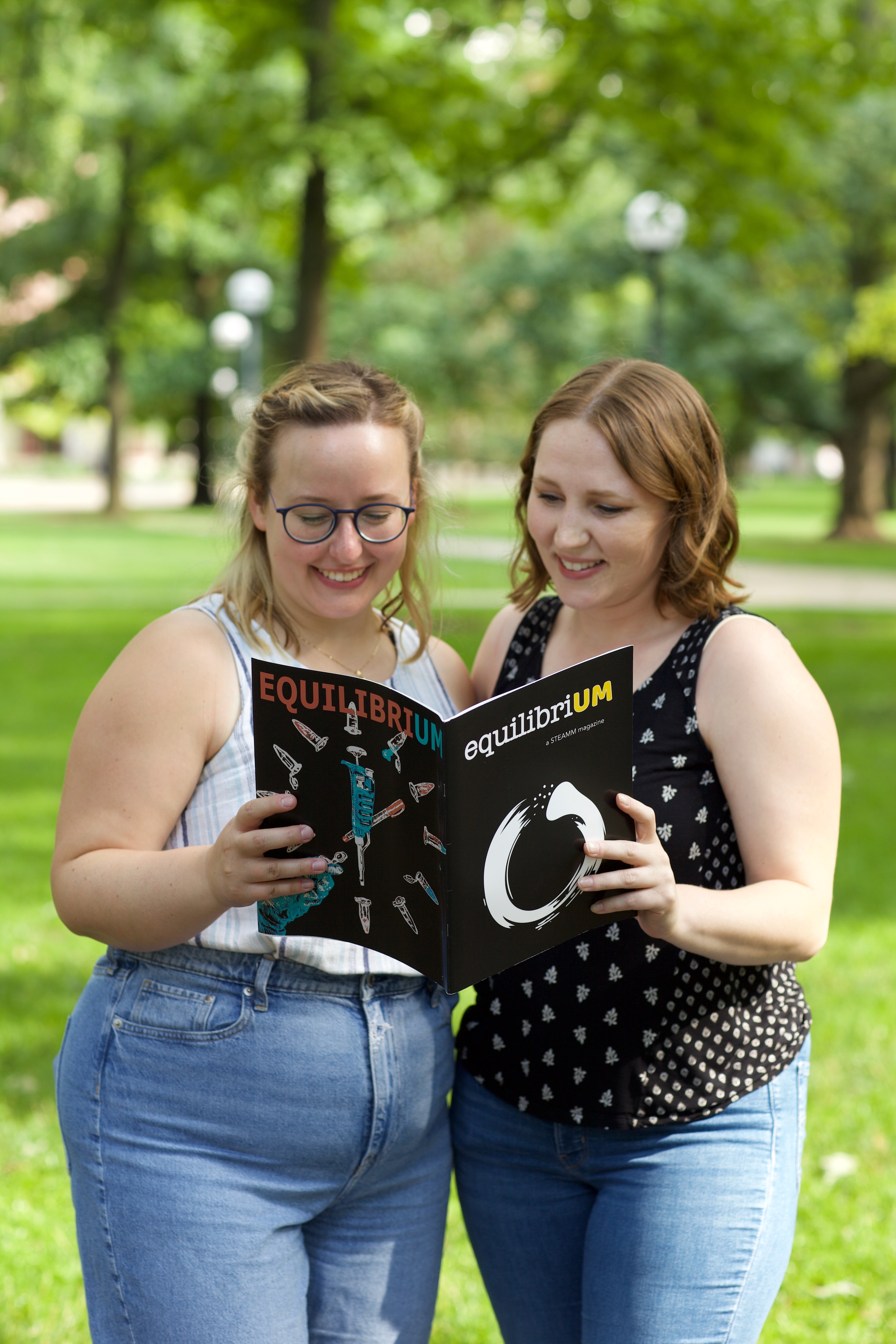
Jenn (right) is a grad student in microbiology and immunology at UM and editor-in-chief of the MiSciWriters blog. Her research seeks to understand how bacteria in the lung and gut affect – and are affected by – acute lung injury. When she’s not in the lab, you can find her doing Zumba or taking care of her indoor jungle of plants.
Christina (left) is a grad student in genetics and genomics at UM and logistics coordinator for MiSciWriters. She studies rare disease caused by genetic mutations that prevent cells from performing protein synthesis. Christina is keenly interested in the intersection between biomedical science and policy, especially how improved science communication can bring scientists and policymakers together more effectively.

 misciwriters.com