
Kate Giffin (1), Katie Bonefas (2), Chami Amarasinghe (3), Frances Gu (4), Jennifer Baker (5)
1. Author 2. Illustrator 3. Peer editor 4. Content editor 5. Senior editor
Abstract
There is light beyond light: above and below. The smallest, most ancient parts of us know this. In summer, freckles proclaim communion with this light. DNA twists in its presence. We all know of this light. But we do not, can not, see.
Introduction
To see the world through the eyes of another — is that not the great human endeavor? To know what the birds know. To look through the million eyes of an insect. “What is it like to be a bat?” (1)
How far can we push the body?
A kitten with a patch over a healthy eye will be blind in that eye as a cat (2). Even the bones will mold, will stretch, given the pressure of shaping boards (3) and neck rings (4). We do not have to accept that which we are given. We are, after all, dirt. And dirt may be dug.
Hypothesis
I plunge my hands into the still-warm compost, grit my teeth against the naysayers. What use is all my scientific training if I cannot apply it, cannot change the world? The knowledge gained in this wild endeavor will far outweigh the risk. I trust my science, I trust the tangle of electricity between my ears and behind my eyes. I believe the testimony of creatures who have seen the world this way since before we moved into caves. I will see for myself and then, I will see for you.
Methods
Roots will grow towards the sound of water (5). So too, will the brain crawl towards the information it receives. It is an easy enough connection to make: ultraviolet sensor to electrical signals to the sensory centers of my brain. With this sensory prosthesis, the eyes are entirely unnecessary, though to keep things consistent, the sensor is placed on the small pink membrane in the corner of my eye, this vestigial remnant of reptilian years (6). I let the bandages fall away gently, as a child taking a step, and the world is a soap bubble.
Results
The world as it is, the world as it could be — there is no definition, only subjective perception (7). We learn as children that white light is made up of all colors, all rainbows a gift hidden within each sunbeam. Now, I have shattered the visible spectrum, blown a shimmering bubble around my mind. Nothing is white anymore. There are no pure tones. The universe is a glittering, clashing thing, and I grow so full of awe I am not sure this body can hold it all.
It is discordant, too many overlapping pitches. The desire to gouge out my eyes grows as the headaches increase. I had forgotten how painful growth is, how the body howls as it stretches. Closing my eyes is no relief as my brain struggles to integrate all that is new with the familiar. Even the sand tracked in on my shoes is brilliant, is loud, is overwhelming. At night, as in day, I walk the line of dream and nightmare and wake exhausted. Sometimes, a scientific breakthrough is more like an erosion.
Only my stubborn faith in the plasticity of the human brain keeps me going. I train this new vision on art: shadow-wrought masterpieces of the Renaissance, expressionist swirls of color, Indigenous thick lines and patterns. On a pilgrimage to the modern art museum I encounter a red Rothko (8) canvas and suddenly it shatters before me, expanding and contracting into a million colors beyond red, a bold, exhilarating universe stretched over a few feet. I weep, and the tears themselves glitter.
Discussion
Have you ever looked closely at the grackle, black bird from afar? The feathers morph into a black iridescent mother-of-pearl: the purple of mulberry stains in the summer, the green of pond algae, the speckled yellow and white of wildflower seeds scattered across the ground, a dark rainbow.
I was interviewed by every major newspaper. In each story, they manipulated images to show what I see, but it is the saddest of funhouse mirrors. Here is the Truth: you will never see what I see, never know what I know, never feel what I feel. And I am no closer to that for you, or for the grackle, or for the mantis shrimp (9). All these colors are merely perceptions: “such stuff as dreams are made on,” (10) indescribable in the graphs and tests of science that attempt to distill the patterns of the world into bite-sized headlines.
Ultimately, the true risk was not to my physical health. Such are the limitations of this study — I cannot see for you. Imagination will have to suffice:
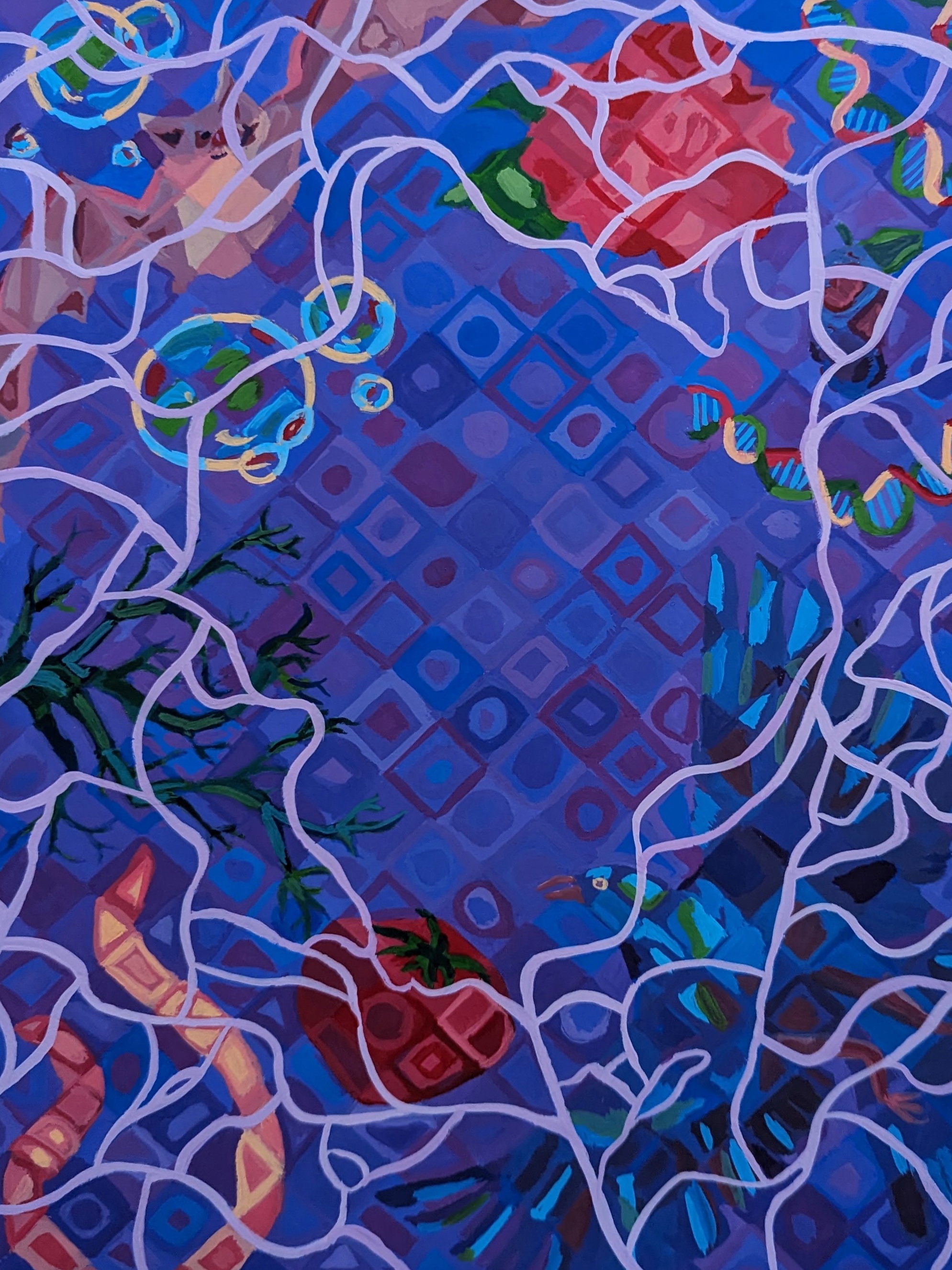
This soap-bubble world is expansive, beauty beyond beauty. Snow becomes a mirror, a prism, light broken and put back together again as foreign rainbow. Here is the color of tears on your best friends’ face, here the warmth of sunshine hanging onto a garden tomato, here the deepness of loneliness — the closest to black.The brightness of a child’s footsteps, the blurriness of your grandmother’s, the ever-evolving Jackson Pollock of strangers’. There are patterns on every flower (11), every songbird (12), even the bones of the chameleon glow (13).
I have passed from the cave into the jungle (14).
Conclusion
There is light beyond light, and color beyond color. There are no words for what I see.
Author Disclosure
As science progresses, I believe people will continue doing what they have always done: pursue their curiosity, attempt to understand themselves and the world better, and use science to solve both personal and societal problems. The biggest difference will likely be technology. This piece imagines a future where technology used in rodents is applied to humans. In “Embedding a Panoramic Representation of Infrared Light in the Adult Rat Somatosensory Cortex through a Sensory Neuroprosthesis,” (15) researchers gave rats the ability to “see” infrared light by connecting an infrared sensor to their brains. This study highlighted the remarkable ability of the brain to change in response to new information (neuroplasticity (16)) and suggested that sensory prostheses could enhance existing senses. Sensory neuroprostheses already exist to improve hearing (cochlear implant (17)) and vision (visual prothesis (18)). Would it be possible to use a visual prosthesis to see ultraviolet light, too?
–Kate

Kate is a poet, mandolinist, and professional nerd. In the lab, she studies how severe infections can lead to long-term brain issues like dementia. When Kate is not marveling at the brain, she is probably outside marveling at some strange plant.

 misciwriters.com