
Written by: Christa Ventresca
Edited by: Christina Del Greco, Andres Rivera Ruiz, Kate Giffin, and Jennifer Baker
Illustrated by: Saaj Chattopadhyay
This is part one of a three-part blog series on genetic testing and its impacts on personal identity. Parts two and three are coming soon!
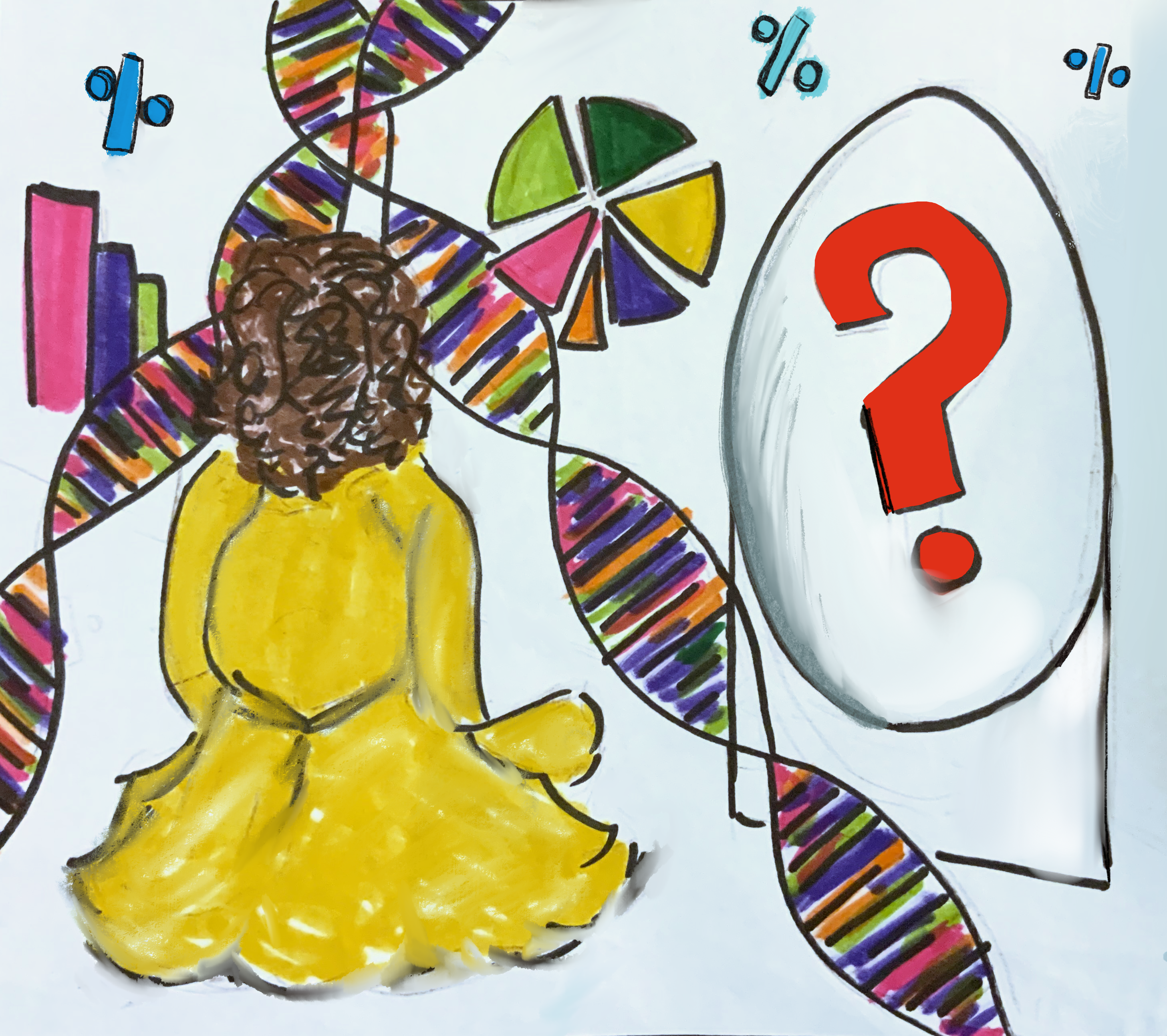
If you are curious about what information is hidden in your DNA, the technology exists to start exploring your genetics. Maybe your family always told a story about where your ancestors come from that you want to verify, or maybe there is a history of genetic disease in your family. To find out more, you decide to send a spit swab to the popular DNA testing company 23andMe for analysis. What comes back is a lot of information, numbers, and statistics all centering around your DNA. How do you make sense of the results? How much of the results do you even believe are accurate?
Since the completion of the Human Genome Project in 2003, genetics has become increasingly popular in scientific research and the public’s understanding of biology. A common way people interact with genetics is through genetic ancestry companies that emphasize how genes can give insight to health and ancestry to attract customers. Through their results, customers are classified based on their supposed country of origin, which can have a large impact on identity formation and sense of self.

In this three-part blog series, I will review recent research on genetics and objectivity, genetics’ impact on identity, and how genetics is being integrated into global policies.
The Public Perception of Genetics
Genetics, like most other fields of science, is frequently seen as objective because it uses quantification (Porter, 1995). Numbers have an inherent assumption of objectivity: “There are three glasses on the table” is hard to refute. Once the genetic data is generated, statistical analysis can create associations between individuals with similar DNA sequences. This is how companies describe a person’s genetic data as “80% European, 20% African,” or as “having a 60% risk of disease.” However, these numbers are constantly in flux – any new individuals or populations participating can influence the estimates – and are based on a small subset of individuals whose genetic information we already have, which is not representative of everyone.
As scholars have described it, genetics has an “allure of objectivity” (Benjamin, 2015). But because genetic associations can change based on the individuals within the dataset, genetics is not truly objective. This can lead to an overreliance on genetic data when faced with difficult decisions, for example in immigration policy. However, the power of genetics also lies in its flexibility and how it can be used both for marginalized groups to gain acceptance and for majority groups to reinforce power structures. This flexibility makes it hard to critique genetics as a field since it has the potential to be used by almost anyone for any purpose, and those interested in using genetics to further their own goals are put into a difficult position when critiquing others.
Because we view genetics as objective, we end up using our genetic data to classify ourselves and others, which directly impacts who can claim membership of different communities. This is true of both ancestry and disease categories. In fact, genetics has created the entirely new category of “at risk” individuals, or people who appear healthy but have several markers for disease in their genome (Bharadwaj, Atkinson, and Clarke; 2014). This represents a shift from defining “patients” by purely symptomatic categories to including individuals with specific DNA sequences as patients as well. This also shifts our understanding of disease from biological processes going wrong to the potential for biological processes to go wrong.
Through this understanding of genetics, individuals come to be classified in multiple ways. The result of this genetic classification is that the original premise of genetic testing – that every individual is unique – becomes overlooked as we categorize each other according to our similarities (Venkatesan, 2014). These categories are not neutral, as separating out groups of people allows for discrimination against certain categories and identities through practices like eugenics. In addition, “classification systems are often sites of political and social struggles” and we can think of genetic categories similarly as groups use genetics to gain support and be recognized (Bowker and Star, 2000). All these classifications have an impact on how we see and conceive of ourselves.
Genetic Ancestry Companies
Genetic data and increased awareness surrounding new identities is a strong factor in creating and maintaining these identities (Panofsky and Donovan, 2019). Many for-profit companies are using this desire to make money off people’s interest in genetics. For better or worse, people are interested in classifying themselves into concrete categories. One company that offers genetic ancestry testing has stated on its website that “you could say that DNA is a new kind of GPS – a Genealogical Positioning System” (Nash, 2014). This comparison to a Global Positioning System implies that through genetics, you can both know exactly who you are and where you come from. This effectively overlooks any limitations in the data in favor of being seen as objective to customers.
This portrayal of objectivity is seen in other companies as well, regardless of how much “expertise” companies provide their customers with to interpret their data. Previously, a comparison was made between the design of products and their respective companies for two genetic analysis companies. One of them was 23andMe, whose design relies heavily on the users to interpret their own results. 23andMe allows consumers to select their own test and gives access to testing at any location in the DNA that has been associated with a specific trait, regardless of how strong that association is. In contrast, Navigenics gives consumers access to experts that can help to interpret the findings. However, the experts are from the company that performed the test, creating a potential conflict of interest if the results are incorrect or inconclusive (Parthasarathy, 2010).
Despite these differences, both companies portray their work as conclusive fact and rely on users to figure out the limitations independently. This essentially is a claim to objectivity through omission. While never claiming that their findings are unshakable, these companies do not give easy access to critiques or alternative interpretations of their results, making it hard for users without a background in genetics to navigate their results. Customers inherently trust this genetic data because it is quantitative, despite a lack of transparency surrounding how that data is generated (Porter, 1995), resulting in portrayal as an objective science and hiding its shortcomings.
Aside from disease risk, another way that genetic companies classify individuals is through ancestry testing. This is a highly normalized way for individuals to quantify and categorize their identity. There are many factors that led to the dominance of ancestry testing and desire for these categories, including companies that capitalize on a desire for identity, community boundaries that are defined by genetics, and national genome projects that create a narrative of national identity (McGonigle and Benjamin, 2016).
However, the methods different companies use can vary widely. Many companies do not observe standards for data or use proprietary databases that are hidden from scrutiny. In fact, an arm of US Congress conducted an investigation including sending the same samples to multiple companies and got wildly different results from each company (Nelson and Robinson, 2014). This calls into question the categories that the companies are assigning each person to. If the categories can change from company to company, that indicates that these categories cannot be as immutable as they are portrayed. The result is that ancestry testing companies seem scientific while ignoring all the limitations of the technology, allowing business to boom.
Conclusion
Ancestry testing has become a powerful way to categorize genetic data, and by extension the individuals behind the genetic data. While these categories are not entirely objective, the companies retain this belief through the way their procedures are framed. By focusing on the promise of objectivity in their analyses and limiting access to limitations or critiques, genetic ancestry companies maintain this illusion with their customers. All of this has an impact on the conception of an individual’s identity, which will be explored in the next blog post.

Christa Ventresca (she/they) is a fifth year PhD student in the Genetics and Genomics program at UMich while also getting a Master’s in Bioinformatics and a certificate in Science, Technology, and Society (STS). This is their first time writing for MiSciWriters!

 misciwriters.com
One thought on “Genetics and the Illusion of Objectivity”