
Written and illustrated by Emma Thorton-Kolbe
Edited by Alex Ford, Paola Medina-Cabrera, and Sheila Peeples
I am a neuroscience PhD student. I spend my days in the lab thinking about how the cells in the fruit fly brain connect to one another during development. I take lots of pictures of those fly neurons. I spend hours staring at a computer measuring different parts of them. I read papers reporting on what other scientists have learned about brain development, and then write papers myself. I love that this is my job. I do it because I think brain development is really neat and because doing experiments requires a balance between creativity and protocol following that appeals to me. In a work day, I can spend mental energy thinking up new ways to visualize my data but also zone out a bit while I do a nice tactile task like brain dissection.
Though I love it, being a graduate student can be all consuming. I usually work a 40-hour week but always feel I could be doing more. There is an underlying feeling that perhaps if I stayed in lab longer or worked harder, I would be a better graduate student and being a graduate student is most of what I am, so maybe I would be better? Besides the time pressure, my work is always at the front of my mind. When my experiments go awry, it feels like my life is going awry. Even on a more benign level, I catch myself looking at the branches of the many trees in our arboreal city and thinking that they look like the branches of the projection neurons I study. In an effort to reclaim some of my time, brain space, and self I decided to take another art class.
I’ve always had an interest in art but never found much time for art classes in college alongside classes required for my neuroscience major. My artistic pursuits have been relegated to a hobby which I try to squeeze in on the side. A few times since moving to Ann Arbor, I’ve hit a breaking point with my work obsession and marked off time in my weekly schedule to take a painting or drawing class at the Ann Arbor Art Center. Unfortunately, after these classes end I somehow loose that time and art falls by the wayside. At the beginning of this year, I signed up for a sketchbook journaling class. I was excited both for the class but also to develop a journaling practice I could hopefully keep up with.
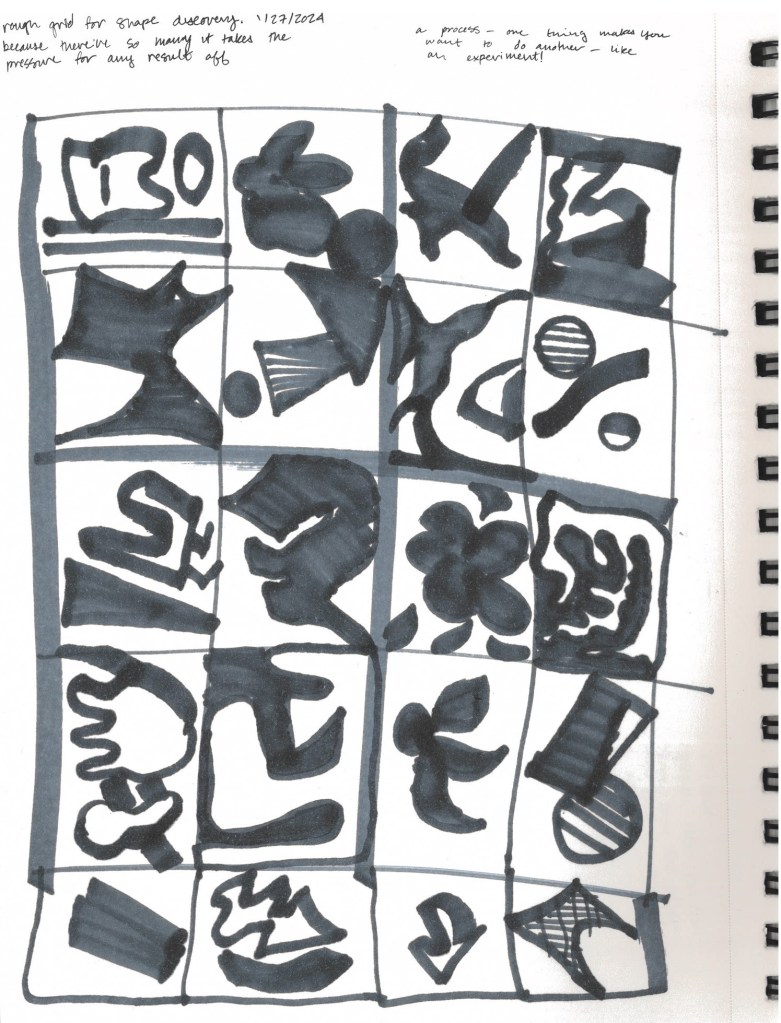
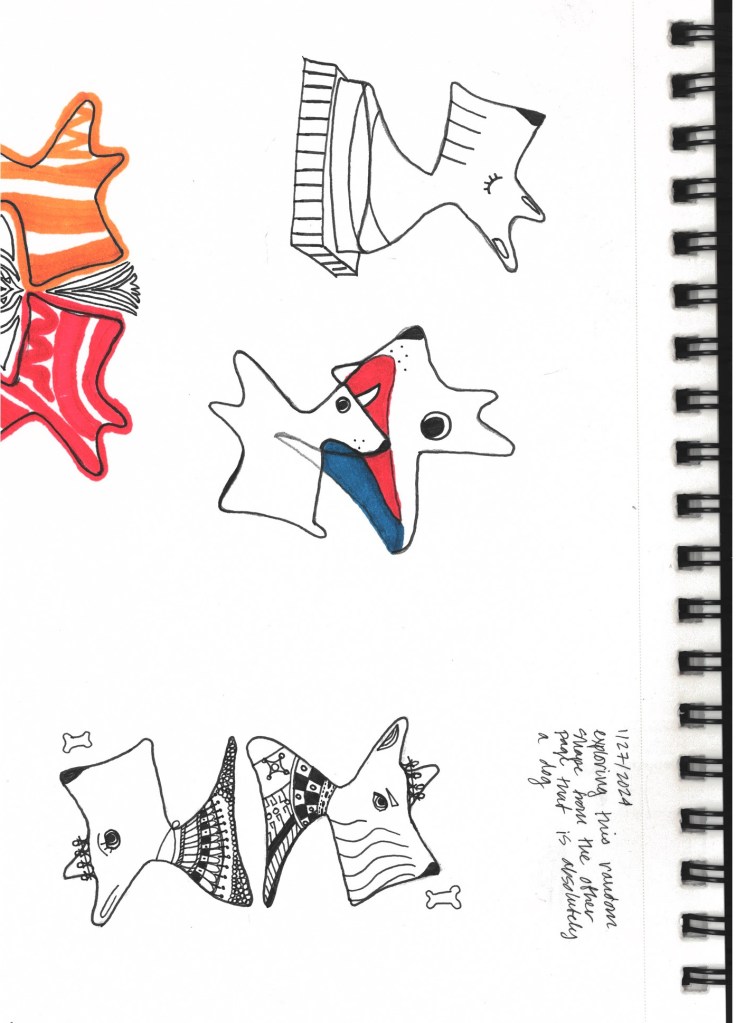
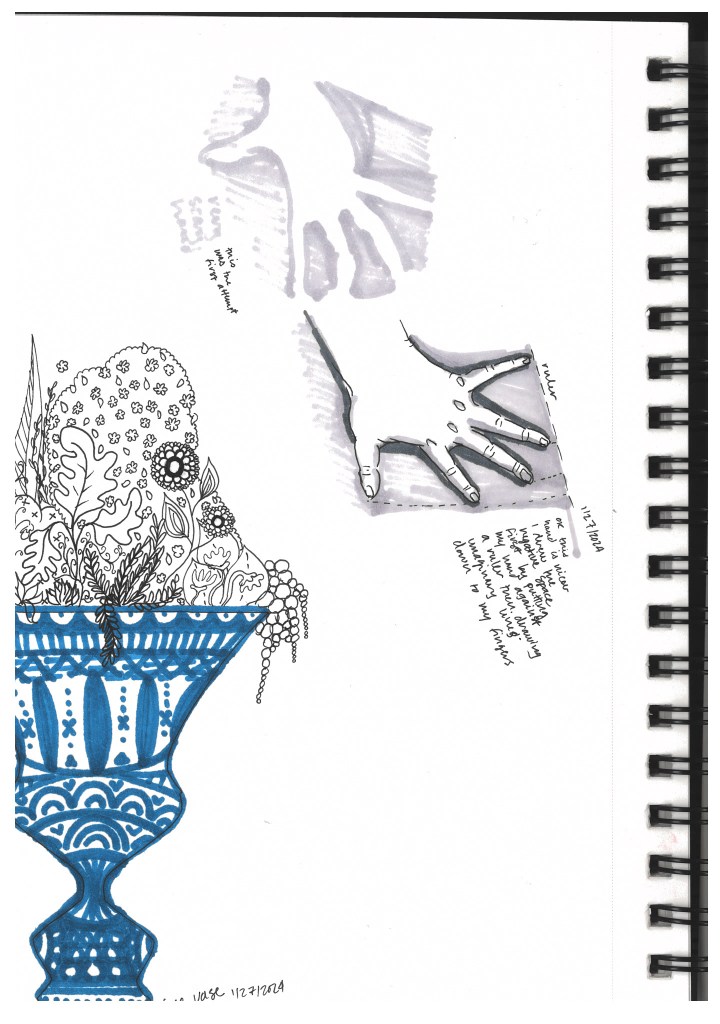
I braved the snow and cold every Saturday morning to go downtown and spend a few hours doing various sketchbook exercises. My classmates and I walked around the art center with a piece of paper and a crayon to collect different textures. We sketched our art supplies to try out all our pens, paints, and pencils. We went and surreptitiously drew people sitting in the Sweetwater’s across the street. We were essentially doing lots of art experiments. We were given an objective and then encouraged to try out different things until we found what worked. Once, I drew a very scary hand in a negative space sketching exercise but then hypothesized it would be easier if I could split the negative space into smaller chunks. I lined up my hand against a ruler and drew imaginary lines to my fingertips which resulted in something much less horrifying. As I experimented, I found myself documenting these drawing experiments as I would in my lab notebook.
Much of being a successful scientist is keeping a thorough record of experiments in a lab notebook. Some people use physical lab notebooks, some collect loose pieces of paper in a binder, I have a digital lab notebook that I can both type in and use my tablet to hand write in. It’s partially a place to keep track of steps in and deviations from a protocol. But more importantly, a lab notebook is a repository for thoughts. Keeping one encourages deeper thought. For each experiment, I start my lab notebook entry with an objective (why am I doing this experiment?), then I have a protocol or sometimes process notes (what am I doing in this experiment?), and then a graph of my analyzed results (what did I learn in this experiment?). This consistent format serves as a guide. It helps me get started, let’s me feel finished, and makes me think about where I want to go next. It structures my practice of science and gives me a scaffold on which to try out new ideas and to be creative.
In my sketchbook, I’d write the same types of notes as I would in my lab notebook. A few quick details of the exercise would go in the margin of a drawing (just in case I wanted to repeat this experiment later). When I figured something out, like a neat kind of line I could make with a brush pen; I’d write down my findings next to the drawing that served as evidence. Because I was writing notes, I paid more attention to the work I was doing; I was alert for things worth noting. This was a springboard for creativity. In writing this piece I transformed one of my sketch book entries into a traditional lab notebook entry. Following this familiar formula lead me to think of more drawing ideas I wanted to try out. Furthermore, I could easily envision how and where I could implement these ideas.

Since the class ended in March, I haven’t been keeping up with my art practice. I feel uncertain. Without the regularly scheduled time and someone to tell me what to do I don’t know where to start. I enrolled in art class to get some distance from science self but I think I need to soften these boundaries to apply what I’ve learned as a scientist to structure my art practice. Keeping a lab notebook helped me mature from a student following instructions to an independent scientist following my own interests. Similarly, thinking about what I want to do, trying different ways to doing it, and reflecting on what I’ve done could help me mature as an artist. Fundamentally, the practice of art and science are not so different so why can’t I keep up with both? I suppose I’ve spent the better part of five years full time dedicating myself to learning to be a scientist and I spend all my time around scientists talking about science. It’s maybe not surprising I describe myself first as a neuroscience PhD student. Perhaps, like science, art is also a group activity. Maybe I just need to find some other artists to sit around and do art with.
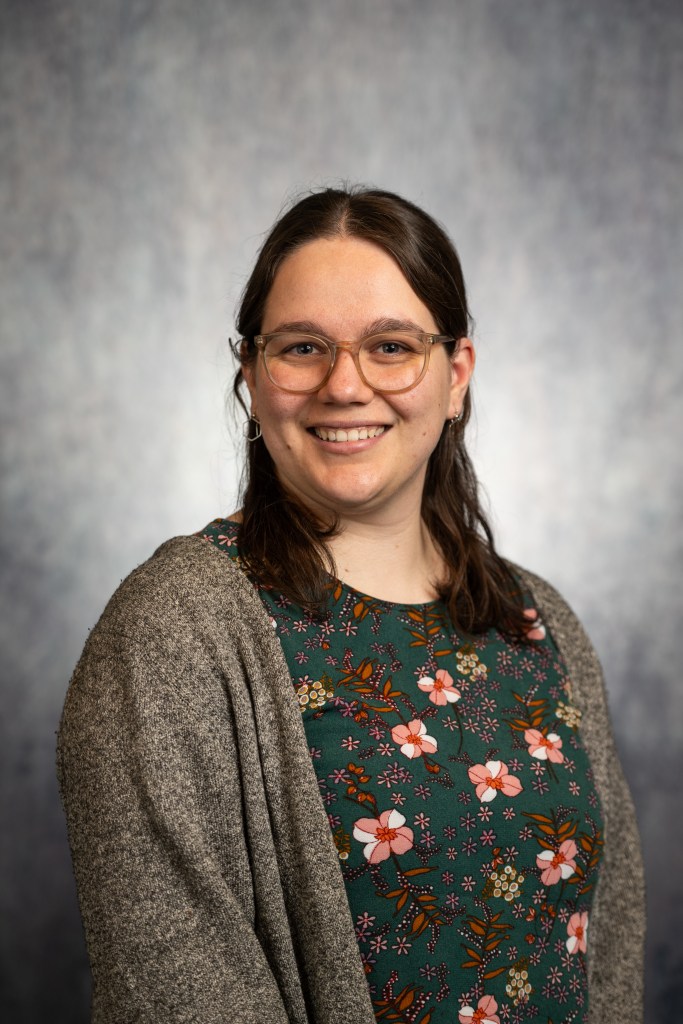
Emma is a sixth year graduate student in neuroscience. She studies neural circuit development in the fruit fly in the Clowney lab. When not in lab you can find her enjoying her front porch with a novel or a sketchbook or in the yard attending to her garden.

 misciwriters.com