
Written by Alex Ford
Edited by Hector Mendoza and Zoe Yeoh
Illustrated by Zoe Yeoh

I. The Tower of Babel
In the beginning, there was a stone. A stone by itself is simple. Monolithic in concept and function. But introduce a second stone. Place it upon the first. Add another. A stack forms and they become more than the sum of their parts. Before there was life, there were simply stones longing for more. Patient stones that awaited the first tumble to start an avalanche.
Somewhere in the infant Earth, at the grinding edge of a sunken continental plate, magma oozes into deep water. Volcanic fires churn in the darkness and spew black clouds into the crushing depths. In this energy-rich crucible, a lone carbon finds hydrogen, finds nitrogen, and the first organic molecules begin to assemble in the deep.
Above, an asteroid falls to the ocean. Prometheus bearing fire from the heavens. This stone carries the seeds of stars and the child-particles of forgotten galaxies. Mother Earth adopts and nurtures, and among the waves, alien stones find a new home.
Elsewhere, a stormfront roils in thunderous fury above vast waters. Lightning splits the air, and for an instant the sea and sky are connected by energy. Like flower petals unfurling, the arcing pulse of crackling electricity triggers new reactions in the waiting elements below.
Organic pillars are forming that may one day hold up the living world. Threads of fate weave between carbons and hydrogens, nitrogens and oxygens. Information encodes on the fabric of reality, one molecule at a time – like stacking stones into a tower.
Author’s note: Here are three of the many theories of the origin of the building blocks of life on Earth. Undersea volcanic vents produce simple organic compounds, as high pressure and heat force reactions with the elements and minerals around them.1 Some organic molecules have also been found in asteroids falling to Earth which may have come from celestial processes.2,3,4 These chemicals have also been seen in high-energy ‘primordial soups’, as facilitated by events such as lightning, with enough power to break and form molecular bonds.5

II. Now I am Become Life
The towers continue stacking, and eons pass. Suddenly, somewhere, a threshold is crossed. The snake eats its own tail and containment is reached.6
I am distinct from the environment,7 floating in a vast cosmos like a star in the emptiness of space. In my simple cell, I experiment and discover new ways of producing useful structures to protect and propel myself – new forms that extend outwards – ever reaching, ever seeking.8 I discover how to take energy from broken chains of carbons.9 I hunt and drift. I discover how to catch the light from the air,10 and sugars from the waters.11 I even consume myself, engulfing other cells that one day will become mitochondria.12 I create new ways to grow and survive. It is the first fight. The only fight. And if I persist, I win.
Author’s note: In short, early cells managed to progress the first steps of evolution by enclosing RNA-like molecules13 within simple membranes that possibly self-formed.14 This proto-cellular development is a major milestone in the development of life and is thought to have emerged around 3.5-4 billion years ago.15 These early organisms relied upon energy-rich environments and simple processes to survive and grow.16,17 But once alive, selective pressures ensured evolutionary progress would occur.18
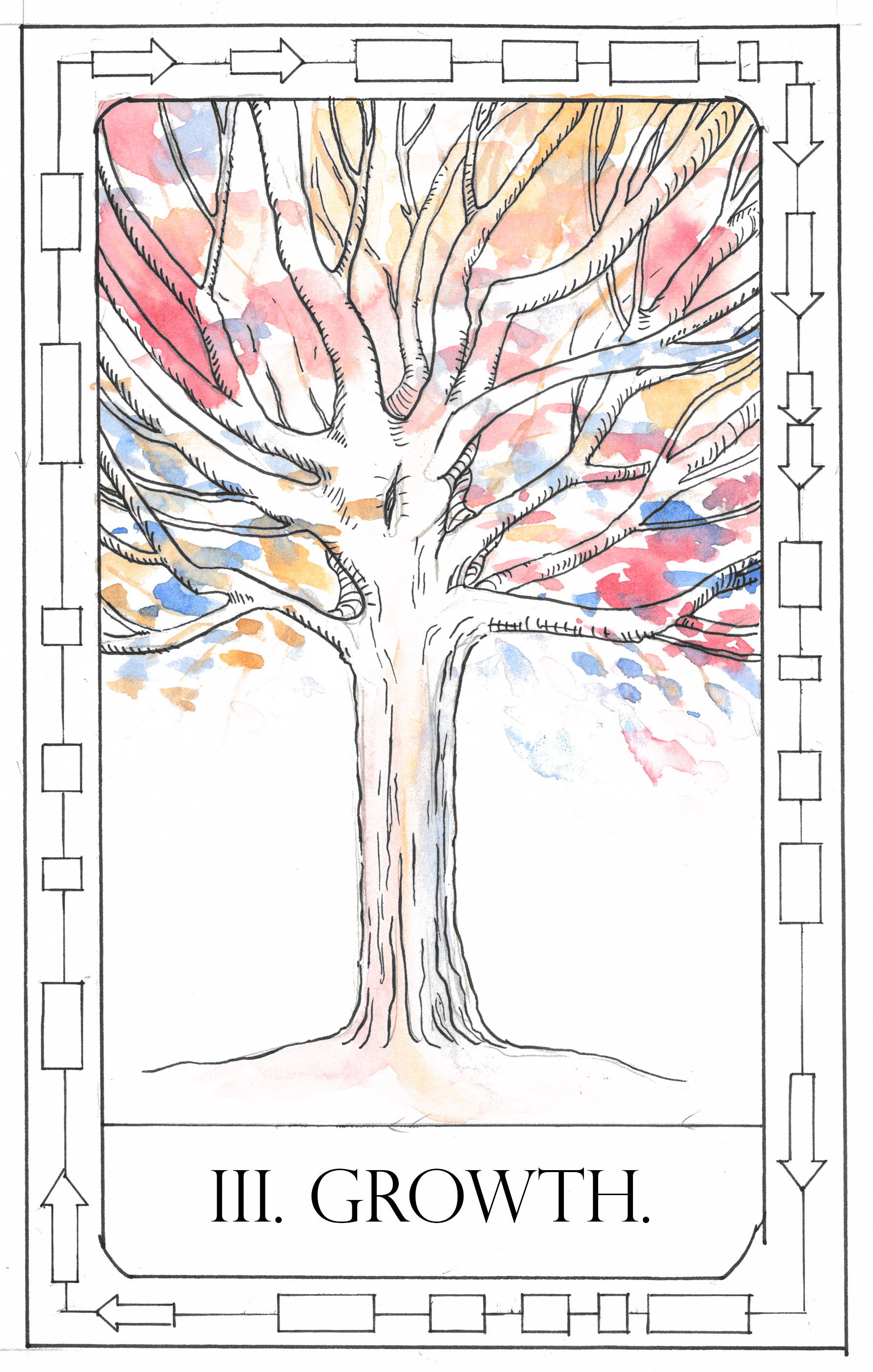
III. “Endless Forms Most Beautiful”19
I have grown and learned and evolved over these long ages. Once there were lonely cells scattered over distant waters. Now there are species scattered over the planet. That ancient network of life has been scaled up, the lines that connect more tangled and interwoven – but the old connections remain. Billions of years ago I first learned how to absorb oxygen, and now I use that in the tissue of lungs,20 I learned how to send signals with chemical gradients between cells, and now I do so with nerve fibers and electricity.21 I learned how to replicate and divide,22 and now my cells continuously renew themselves. I am a network of networks of networks, all the way down to the DNA chains coiled in every single cell.23 I am infinitesimal and eternal, and still I continue to build.
I extend new fingertips made of scales and hide and fur and shell. I learn new ways to reproduce – spores and seedpods and gametes on the wind. Like dropping a stone from a great mountain, there is no predicting the places of contact on the way down. The bounces and fracturing seem random, but the need to survive is the chisel that carves new limbs, bright eyes, tails and fins out of the stone. I reach out and feel touches on skin, fresh smells and tastes, the blind sight of newborn eyes – blinking open again and again across the breadth of the world.
Author’s note: There were periods of explosive growth and divergence into the current kingdoms and classes of life. Periods like the Cambrian explosion24 are of vital importance in the progression into species level interactions.25,26 Diverse species interact within their own members, and others, to an increasingly complex degree. According to the Red Queen hypothesis,27 the interactions between connected species accelerates evolution more than adaptation to the environment alone.28,29 Thus, more species diversity results in more diverse traits.30

IV. “What a Piece of Work is Man”31
Now, we look out and meet our own eyes – slitted eyes, compound eyes, binocular eyes, prey and predator eyes32 – we see in our trillions of reflections that we are more than ourselves. We are societies of species, parliaments of phyla. And one form among the many has become judge and jury above all. For we have created a most wonderous, most beautiful creation. A creation as remarkable and revolutionary as a new sense or a new limb. We have evolved the structures and capabilities for language.33,34 If we persist, we win – and so we have evolved continuity.
As humans, we exult in reaching beyond ourselves. We give speeches, we argue, we tell stories before hearthfires – generation after generation. We record our thoughts, and we learn to read clay tablets, then scrolls, then books. We take in memories and emotions, discoveries and questions, and learn the lessons of entire cultures – lives of people that are long since dust. We read the words of those we respect or trust or love – we transcribe the meanings into our neurons35 so that their memories become a part of us, their threads forever woven into the whole. Like a tree’s rings,36 or geological strata telling the story of an ancient flood,37 there is memory in the forms. With our words and stories, a thread of connection reaches through time to forge knowledge and empathy38 in all those that come after. As if in mimicry of the heritable legacy of our genes, we pass down the best of what’s within. We pass down ourselves.
We remember when there was only the reaching for the next hydrogen, the next nitrogen beside volcanic vents. Now we study those ancient towers of stones. Under microscopes and lasers, in vacuum chambers and test-tubes. We capture lightning in bottles, ignite fires of the Sun strong enough to crack mountains, and send ourselves flying into the universe to seek the unknown amongst the infinite stars. Our thoughts propagate across the globe at the speed of light itself. Each communication is a link, each person a node – invisible networks of emotion, knowledge, culture, friendship, love – covering the Earth in an ethereal web that joins us into a whole. We are a sleeping colossus, awakening one cell at a time. Like the nested systems within all levels of life, the growing pattern continues outwards. Ever outwards.
Author’s note: At the heart of all living processes and interactions, there is the transfer of information.39,40 Human intelligence is exceptional, but some of the most effective adaptations social and cultural,41 joined with the ability to communicate information through language.42 In the arms race of evolution, social animals tend to evolve faster than solitary animals,43 and no species has ever approached the speed and success of humanity’s development. These unique adaptations enable the human species to function as a true global organism on a scale never before seen on this planet. But though humans live longer than at any point in history,44 and have overcome most evolutionary pressures, it has been demonstrated that humans are still evolving.45,46,47,48 As a sapient species this continued growth raises questions about the future – about where humanity will decide to go from here – and what directions Earth’s web of life will take as a result of those choices.
V. Out of Many: One
Now, we look out and meet your eyes as you read this page. You, who are a part of us – who give us meaning and life with your very existence – how will you choose your path ahead? How will you, in your own way, shape the story of what we all become?
Out of this multitude of many, how can you be one?
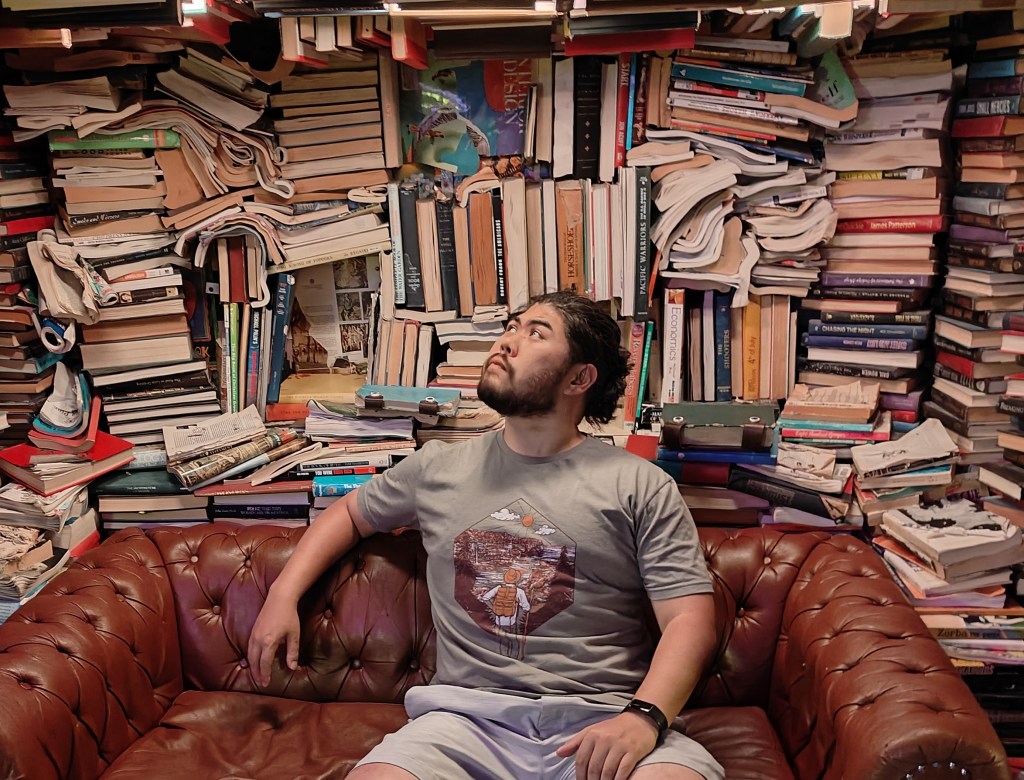
Alex Ford is a student and neuroscientist who researches how the brain processes sensory information in the visual system. He has a tendency to seek out the absurd, and frequently attempts to create art. In his free time, he is with friends, family, or a good book under a tree.

 misciwriters.com