
Written by Ian McCue
Edited by Paris Riggle and Jeremy Chen
Illustrated by Satabdi Mohanty
We are surrounded by glass. From eye glasses to computer screens to church windows, the world is projected through its transparent panes. The projection of life that glass informs, either through windows or screens, profoundly shapes our perception of reality as a whole. While we have transformed our lives with this powerful transparency, the world we shaped with glass was first shaped out of quartz. To become glass, the predictably ordered molecules of quartz fall away and become locked in a state of frozen chaos, unlocking new properties in the process. This new disorganized arrangement creates space for light to pass through, turning an opaque geode into a transparent jewel. Transparency is how we have improved our lives with glass, bending light to illuminate what we cannot see. First bringing light into our homes, we then turned the clarifying power of glass upward and brought closer the light of our once hidden planetary neighbors. By turning our magnified gaze downward, a new universe emerged, much closer than any heavenly body, and boiling with life.
Beyond its modern conveniences, glass has facilitated our view of life for hundreds of years. Magnifying the secrets of biology, glass transformed microscopic life from a miasmic fog into a clarified ecosystem. Over the centuries, as we came to understand the simpler forms of life swirling around us, our perspective on the origins of life evolved in parallel. Glass, as it turns out, would be more than a mere lens for that understanding. In fact, as we crystallize our understanding of life and its origins, glass may have been shaping that journey far longer than we have been shaping it.
The history of life’s beginning was first written about 70 years ago. It begins with Stanley Miller, a chemistry graduate student. Stanley wondered about life’s origins after a seminar from Harold Urey about the “primordial soup” hypothesis, which suggested that the molecules of life may have emerged from simpler precursors. While the fossil record provided the ingredients for this idea, the recipe for converting molecules like ammonia into amino acids was unknown. Stanley thought he was the chef for the job, and convinced Harold to pursue this question. To simulate the conditions of an early Earth, Stanley needed a vessel that could contain an ancient atmosphere. He also needed something that would not influence the reaction by reacting with the ingredients. Ultimately, glass was the ideal material, being mostly inert to the components of the reaction and highly malleable when melted. From molten quartz, Stanley molded a chamber that could circulate the precursor gaseous, introduce the electric catalyst, and retain the potentially life-forming products. After several days, the translucent walls of his device revealed the colorless gas began to grow a brown residue in his collection flask. That somewhat underwhelming film, he would later learn, was made of amino acids, among other molecules of life.
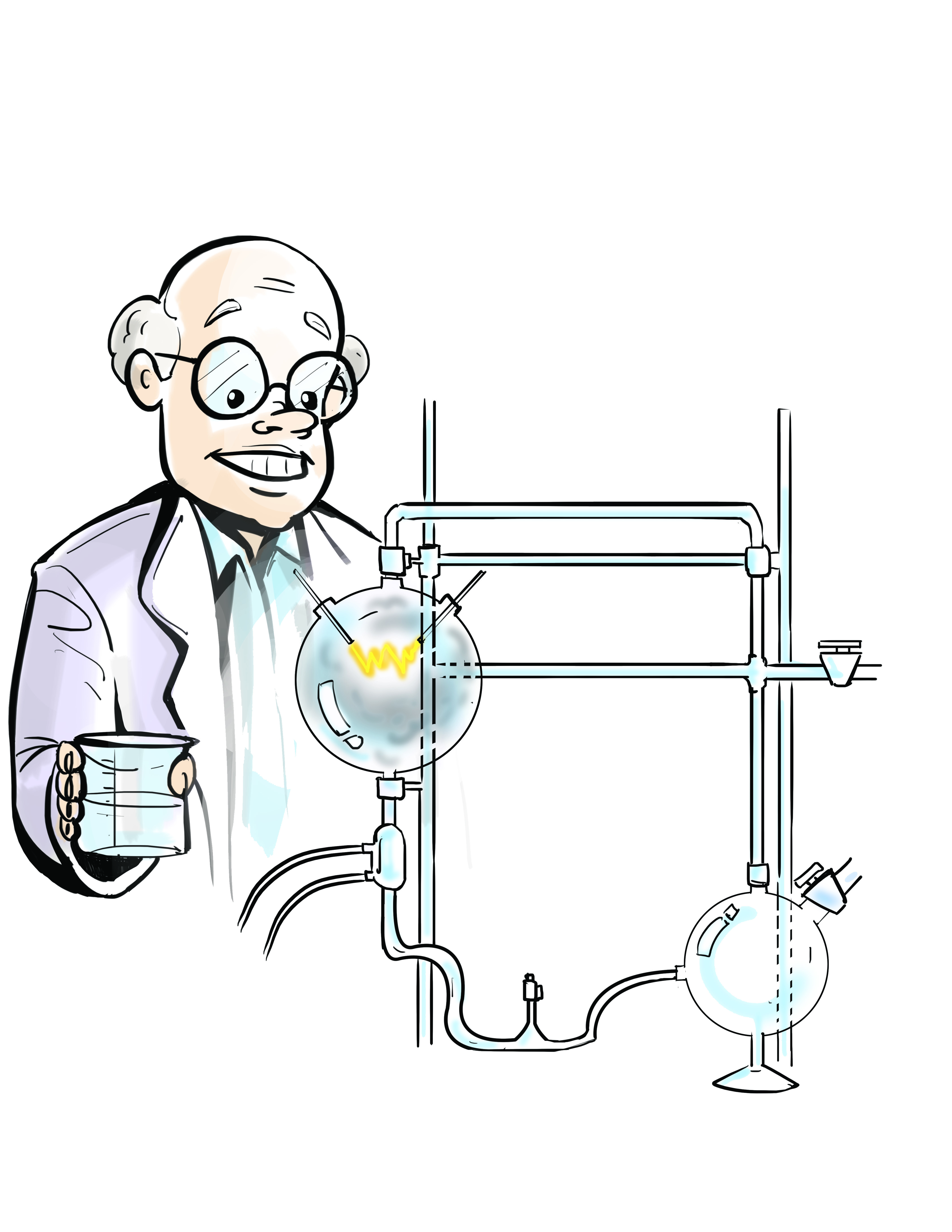
In a glass bottle, Stanley Miller had turned non-living soup into the ingredients of life and provided a missing link between us and a lifeless universe. The versatility of transparency that glass provides, inert to both light and reactants, was the bedrock from which this discovery grew. Curiously though, this was not the first time in history that a new vision of life would peek out from behind a glass wall. It would have been difficult for Stanley to justify this experiment if he did not know life could exist on a simpler scale. What basis could he have that a primordial brew could lead to something more than the sum of its parts? It would have to be something simpler, and much, much smaller.

Stanley knew life came in a variety of sizes, the smallest of which happened to be the simplest. These simpler creatures were the most likely candidates to emerge from the chemicals pooling in Stanley’s flask, and presumably, our ancient Earth. His awareness of these creatures came from a similar revelation, insofar as it was dependent on glass. Roughly 300 years prior, Antonie van Leeweunheok, a fabric trader, took an interest in the magnifying power of glass to build a tool capable of viewing individual fibers of fabric. Antonie looked at more than textiles, however, and set his magnifying lens on pond scum and his own blood. Across the English Channel, Robert Hooke, a titan of scientific discovery, was doing the very same thing using a magnifying microscope of his own design to look at living materials like cork. Despite the similarity of their approach, history would remember them differently for what they revealed through their microscopes. Van Leeuwenhoek looked at pond scum and within it saw creatures whirling and colliding with each other. The dynamism he saw launched the study of microbiology to understand how this tiny life operates. Hooke, meanwhile, saw the periodic and identical ordering of holes in cork, and coined the term we still use today to describe the structure of life: cells. Through a glass lens two different kinds of scientists observed the same phenomenon yet saw something different in the images. This duality of Hooke’s and van Leeuwenhoek’s observations mirrors the fluidity of glass. Like the chaotic yet rigid arrangement of atoms in a glass lens, there is chaos and rigidity in life, both equally true. These parallels extend beyond the physical, for in the same way that Robert and Antonie saw different visions of life through a glass wall, Miller’s own view of life’s origins would also draw different perspectives. In fact, it was by looking through the glass walls of his flask that he missed their influence.

When Miller designed his flask, there were compromises he had to make by using glass as a material. Specifically, glass was not perfectly inert to the chemicals it would house. The high pH of reaction, he reasoned, would be capable of leaching silica from the glass into the reaction mixture, a contamination concern that did not hold his gaze for much longer after his first publication. In 2021 however, Joaquín Criado-Reyes and his colleagues wondered how much this played a role in Miller’s findings. This is because if life emerged from a primordial soup on our ancient planet, it would have done so from a bowl with ample quartz, which would also leech silica into the reaction. To test if silica derived from glass was important for turning gases like ammonia and methane into amino acids, Criado-Reyes et al. recreated Miller’s experiment in a vessel made of Teflon. This allowed them to isolate the effect of glass on the product. The results were clear: Teflon made a poor substitute for glass when it came to recreating the origins of life. Not only was glass more effective, adding chunks of glass to a Teflon container improved yields compared to no glass at all, isolating glass as a critical ingredient for Miller’s primordial recipe. These experiments revealed the possibility that the abundant quartz covering our planet had a role to play in the potential origins of life. That same quartz, refined billions of years later into a Miller’s flask, may have been influencing his results long before he dreamed of them. While Stanley saw glass as the set piece in a larger story, Joaquín and his colleagues saw the star of the show. Like the work of their predecessors, Hooke and van Leeuwenhoek, glass provides perspectives that require more than one pair of eyes to see. Throughout these histories, glass has been a means to an end. Whether it’s magnifying a hidden universe or illuminating the history of life, it’s just an ingredient in a much bigger recipe. The history of glass from this perspective is one that values transparency, and indeed is the quality we seek from glass as a tool for viewing. But Criado-Reyes et al. reveals another history of glass, one that illuminates its essentiality in that history. Miller’s flask is a product of his design and influence, while his results are a product of the design and influence of glass. There is no primordial soup experiment without the right vessel, shaped in the right way. This is the grand irony of Miller’s experiment: he both shaped, and was shaped by, his glass tools. He is not alone in that experience. We are all shaped by the glass around us. It connects our homes to the outside world, our palms to the virtual world, and our inquisitive gaze upon new horizons, be they heavenly bodies or hidden universes. The transparency of glass is both inert and active; it facilitates viewing through its passivity. In transforming quartz into glass tools, we are transformed by the insights glass reveals. Born out of quartz, we are nurtured by an invisible cradle of mutual design.

Ian McCue is a first year Ph.D. student in the Cell and Developmental Biology
program. He is a member of the Jillian Pearring lab where his research is focused on uncovering protein trafficking dysfunction in rod photoreceptors, using a variety of microscopy techniques. Ian received his Bachelor’s and Master’s degrees in Biochemistry from the University of Nebraska – Lincoln, where his thesis work investigated the potential of ultrasound as a mechano-therapy for heart disease. Outside of the lab, Ian enjoys cooking all manner of cuisines, going for long walks, and dancing!

 misciwriters.com