
Written by: Elena Renshaw
Edited by: Courtney Myers
This piece was written in collaboration with the 2025 ComSciCon-MI Write-A-Thon.
Natural selection is happening all around us, shaping the living world and our future; we just need to observe. When Charles Darwin published The Origin of Species in 1859, he proposed a revolutionary idea: organisms within the natural world actually change over time, through a process he called adaptation by natural selection. What made his work so groundbreaking was not any specific discovery, but how he applied what he saw to explain how species adapt and diversify. Darwin demonstrated that by carefully observing the natural world, we can trace how small differences in individual beings accumulate into significant transformations over generations.
Almost a century later, in the 1940s, the evolutionary biologist Ernst Mayr organized Darwin’s findings into five observations and three inferences, now known as adaptation by natural selection.
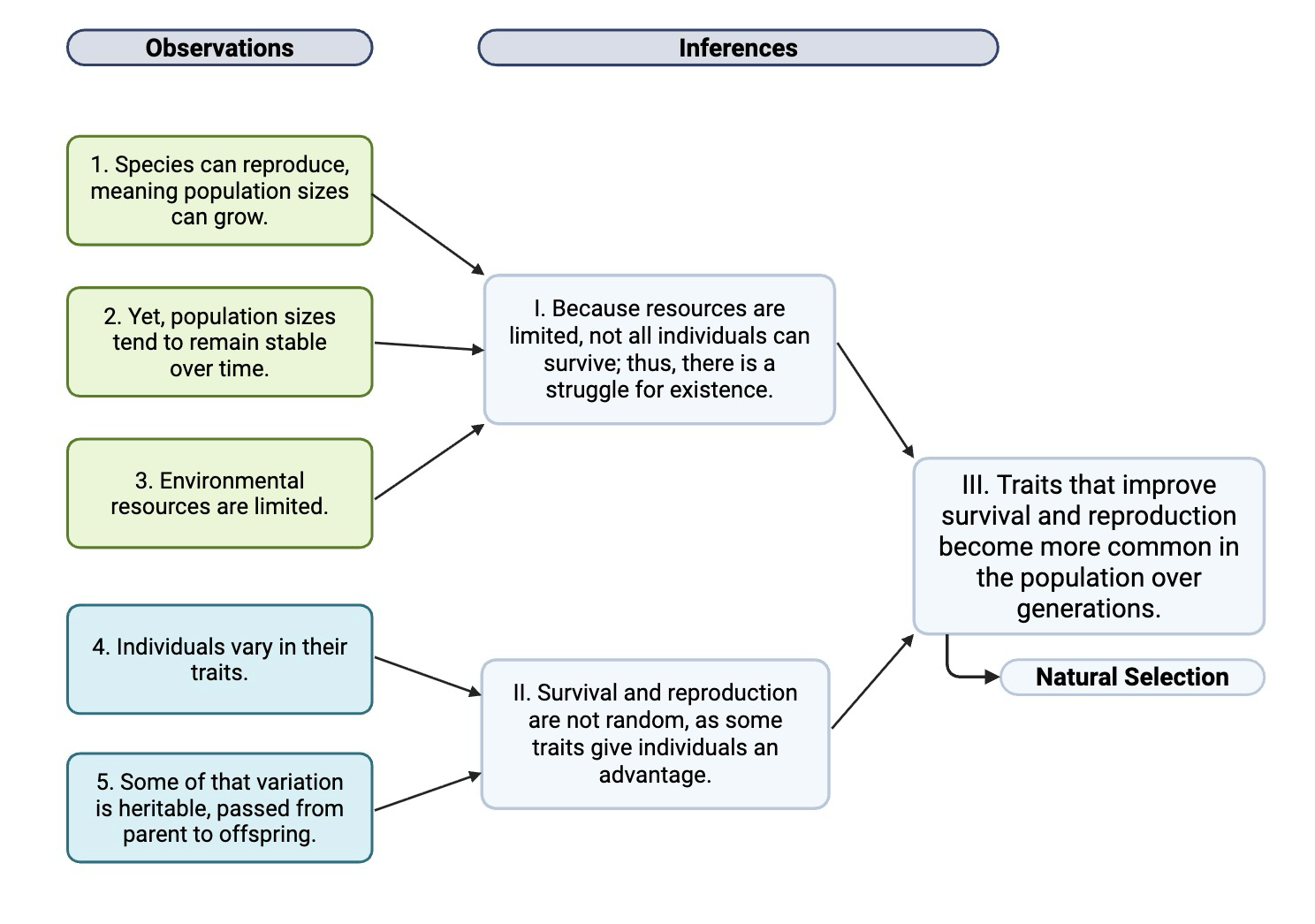
You don’t have to be a pioneer of biology, discovering new species, to use this guide—it can be used with organisms you commonly encounter, such as butterflies. You can look at the underside of leaves and see dozens of eggs laid by a single butterfly (Observation 1). If every egg laid became an adult butterfly, there would be a dramatic increase in the number of butterflies each year. However, there are typically the same number of butterflies year to year (Observation 2). Now consider how animals need food and other resources to live. Butterflies need nectar to survive, but there is a limited amount of nectar in the environment (Observation 3). Because not every butterfly survives, there is a struggle for existence (Inference I).
Now you can look even closer and see that butterflies, even within the same species, have different traits. For instance, there may be differences in the length of the butterflies’ tongue, called the proboscis (Observation 4). Across generations, the offspring often resemble their parents, meaning that these differences can be inherited (Observation 5). This is where the framework comes together: when nectar is hidden deep inside flowers, only butterflies with longer proboscises can reach it. Those butterflies have more food, allowing them to survive longer and lay more eggs than other butterflies of the same species. Thus, in this environment, long proboscises are an advantage, as these butterflies are more likely to survive than other butterflies without shorter proboscises (Inference II). Since those offspring are more likely to survive and reproduce, their offspring will be more likely to survive and reproduce, and so on. Over time, more butterflies within the population will carry these advantageous traits (Inference III). This is natural selection, and the same reasoning applies to wing patterns, body size, or any other inherited trait that affects an organism’s ability to survive and reproduce.
These butterflies are an example of natural selection in action, demonstrating that small differences between individuals add up to long-term change. Natural selection is just one mechanism by which evolution works. However, evolution is never finished. Selective pressures can simultaneously change the flower’s traits. Perhaps a bee species moves into the area due to deforestation, and shallower flowers are favored for this new pollinator. Suddenly, the trait that once protected butterflies may become a disadvantage, and the flowers become shallower. As a result, environmental changes can affect what traits are advantageous, and thus affect the course of evolution. The balance shifts, and natural selection continues its quiet work.
Natural selection is not just limited to butterflies and flowers; its logic explains how all forms of life adapt and change. This occurs even on a microbial level, as mutations in a bacterium’s DNA can become advantageous to the bacteria’s survival and make the bacterium resistant to a certain antibiotic. Now, if they are exposed to antibiotics, only the bacteria that are resistant can survive. The survivors are the bacteria that reproduce to make more resistant bacteria. This is the case with the deadly antibiotic-resistant bacterium Clostridioides difficile, commonly known as C. diff, that can create a deadly infection in humans.
Natural selection can apply to certain behaviors as well. Meerkats exhibit altruism, a trait where one meerkat will alert other members of the group to predators—while it may lead to the alerting meerkat being attacked, the other members can escape, which allows this trait to evolve. By studying natural selection, scientists gain insight into many fields, such as medicine, psychology, and conservation. The same logic that explains a butterfly’s proboscis also informs how we study antibiotic resistance, animal behavior, and the protection of species affected by climate change.

 misciwriters.com