
Written by: Carly Blaire
Edited by: Charukesi Sivakumar
This piece was written in collaboration with the 2025 ComSciCon-MI Write-A-Thon.
Almost every cell in the human body contains around two meters (or 6.5 feet) of DNA, encoding the complete instructions for all of your body’s functions. Hair, stomach, brain, skin; each part so vastly different, but all stemming from the same base instructions. So what stops a skin cell from producing stomach acid, or the brain from producing hair? The answer lies in epigenetics.
Epigenetics encompasses all of the chemical modifications to a cell’s DNA that then impact expression of encoded genes. Put simply, epigenetics act as a switch making genes available to be turned on or off without changing the DNA sequence itself.
How does this work? For genes to be expressed, they need to be turned from DNA to RNA to be expressed through a process called transcription, requiring several proteins that interact with and bind to your DNA. Therefore, if those proteins can’t physically reach the gene or bind to the DNA, that gene will not be transcribed. Inversely, genes that are accessible and have recognizable binding sites are turned on.
Functionally, there are two main ways that cells can change the accessibility of DNA; this can be done either through chemically changes to the DNA itself, or making changes to the DNA’s storage in the cell. Both of these methods are useful under different conditions, and one cell uses a combination of both methods to maintain proper function.
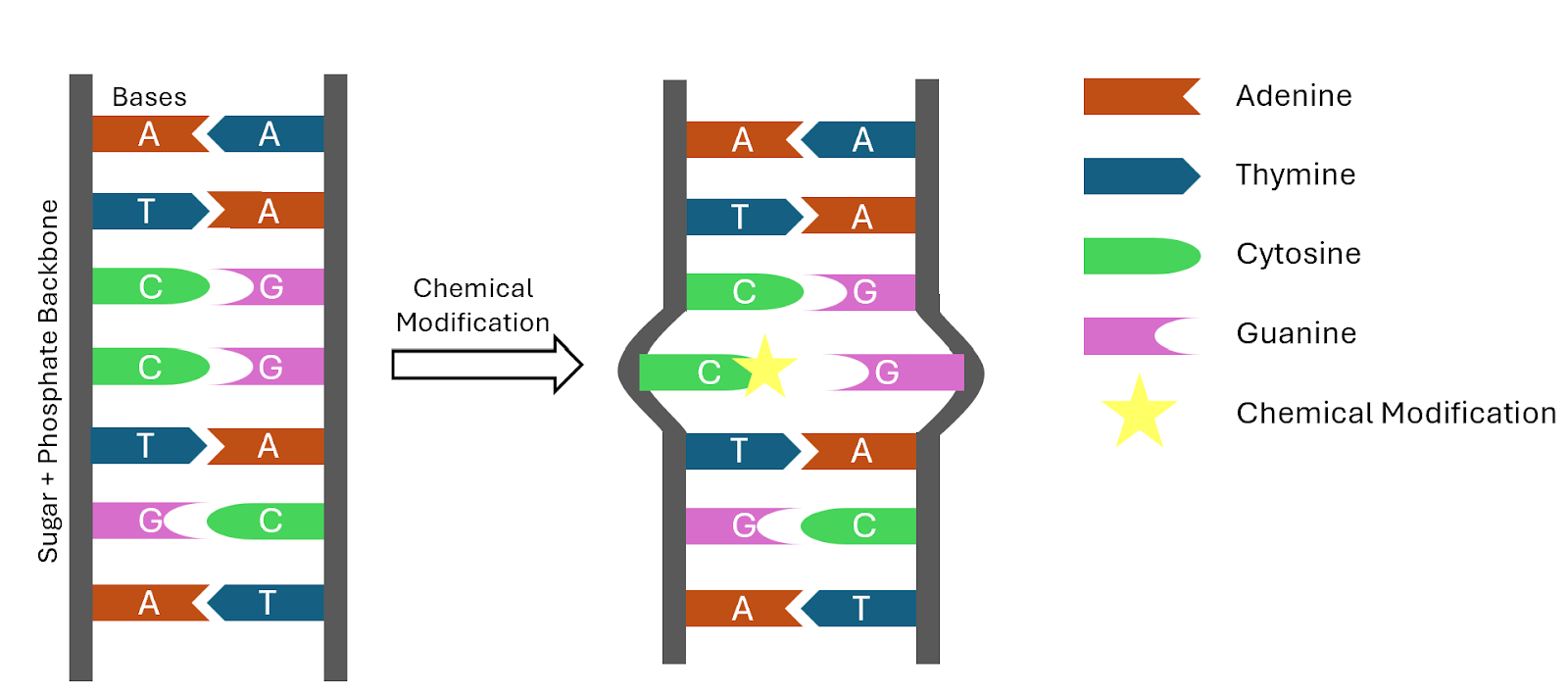
How can a cell chemically modify its DNA without changing the sequence? DNA is made up of molecules called nucleotides, containing two functional parts, the base (adenine, cytosine, guanine, or thymine), and a sugar attached to a phosphate group. The base determines the sequence of the DNA molecule and the sugar-phosphate group serves as the backbone holding the bases in order. Together these groups help to form the double helix structure of DNA. When a cell needs to turn a gene on or off, it can add a chemical group to the base portion of the nucleotide, distorting the shape of the DNA molecule. This distortion changes which proteins are able to bind the modified DNA, turning the gene on or off. This method is useful if one gene needs to be turned off in the middle of several genes that need to be kept on. For larger sections that are all on or off, cells can change the storage of DNA in 3D space.
In humans, the two meters of DNA in a cell fits into the nucleus, which is only a few micrometers in diameter. Considering that the average strand of hair is seventy micrometers in diameter, the nucleus is very small. You could imagine the nucleus to be like an open box full of items. The items close to the top of the box are easily accessible, whereas the items at the bottom of the box are much harder to reach. The 3D arrangement of the items inside the box changes what is available at any given time. You could also imagine unpacking and repacking the box to change what items are easy to grab. This repacking of the box is essentially what cells do to change the gene expression of large sections of DNA.
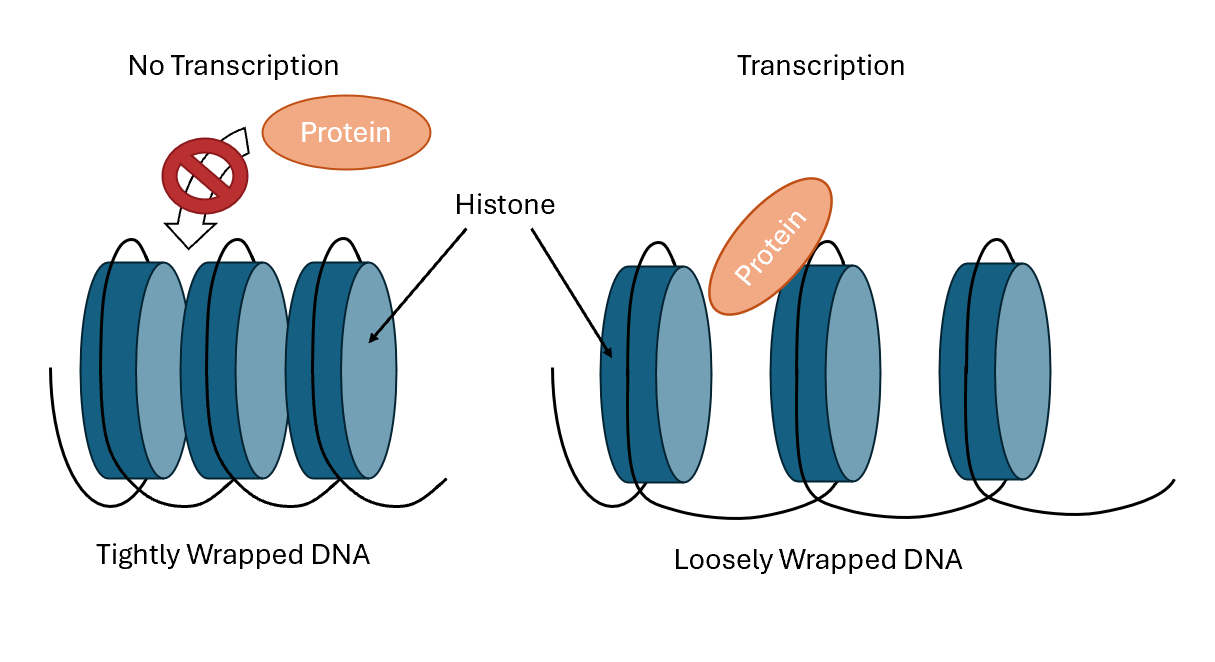
To arrange DNA in the nucleus, DNA is wrapped around a group of proteins called histones, and these DNA-wrapped histones are coiled on each other until the DNA is properly condensed. Imagine if you twisted a string in one direction over and over, until it turned into a tightly coiled rod- that’s what a lot of DNA looks like in the cell. These histone proteins can be chemically modified to promote either packing the DNA tighter or loosening it up to allow for access. Tightly bound and compacted DNA results in transcriptional proteins being unable to access the DNA, leading to genes being turned off. If the DNA is loosely packed, these transcriptional proteins have the space to bind and the genes are turned on.
These epigenetic pathways are shared amongst eukaryotes, not just humans, and are critical for proper development and adaptability to changing environmental conditions. Despite this, there are still many unanswered questions about how a cell knows where to make these epigenetic changes, how these modifications are maintained as the cell divides, and what environmental factors impact the number and type of these modifications. There is tons of ongoing research into these topics, with widespread applications from increasing crop yield to treating human diseases.
Overall, while the genetic sequence of an organism is important, epigenetics allow for cells to functionally control what genes are turned on or off within a single cell. This can be done to modify expression of large clusters of genes, or individual genes using chemical modifications of histones or DNA. On a grand scale, epigenetics allows for the development and maintenance of specialized cell types with specific functions as well as the ability of these cells to turn genes on or off under different circumstances.

 misciwriters.com