Dr. Shelley Berger: Epigenetic pathways as targets in human disease

Live Blogger: Camila Gonzalez Curbelo

Editor: Paola Medina-Cabrera, Ryan Schildcrout

This piece was written live during the 10th annual RNA Symposium, “RNA Frontiers: From Mechanisms to Medicine” hosted by the University of Michigan’s Center for RNA Biomedicine.

Doesn’t everyone want to increase their memory?” asks Dr. Shelley Berger. 

Understanding the mechanisms that drive memory loss and aging is precisely the motivation for Berger’s ongoing and exciting research. Dr. Shelley Berger is a scientist in the epigenetics field – the type of science that studies how genes can be regulated without altering the DNA sequence. Authoring high-impact publications in Nature, Science, and Cell, Dr. Berger is undoubtedly a world-renowned expert who has advanced our understanding of many basic biological pathways and has worked to translate this knowledge into applications in medicine and beyond. 

Continue reading “Dr. Shelley Berger: Epigenetic pathways as targets in human disease”

Dr. Nils Walter: Life in Flux: Dynamic RNA:Protein Complex Assembly Shapes Biomolecular Function

Live blogger: Ryan Schildcrout

Editor: Brenna Saladin

This piece was written live during the 10th annual RNA Symposium, “RNA Frontiers: From Mechanisms to Medicine” hosted by the University of Michigan’s Center for RNA Biomedicine.

Dr. Nils Walter opens his keynote speech by acknowledging the 10th annual RNA symposium. As a co-founder of the Center for RNA Biomedicine here at the University of Michigan, his excitement for the innovations proposed here is palpable. We feel similarly here at Michigan Science Writers for our 10th year celebration. Walter goes on to say that RNA biomedicine is unique–it offers the fastest path from fundamental discovery to medicine. He emphasizes that this symposium is all about collaboration in working towards swift translation from discovery to medicine. 

Continue reading “Dr. Nils Walter: Life in Flux: Dynamic RNA:Protein Complex Assembly Shapes Biomolecular Function”

Dr. Erik Sontheimer: Prime Assembly with Linear DNA Donors Enables Large Genomic Insertions

Live Blogger: Paola Medina-Cabrera

Editors: Camila Gonzalez Curbelo, Ryan Schildcrout 

This piece was written live during the 10th annual RNA Symposium, “RNA Frontiers: From Mechanisms to Medicine” hosted by the University of Michigan’s Center for RNA Biomedicine.

What if doctors could fix a genetic disease the same way we fix a typo? All cells in our bodies contain DNA–an instruction manual that tells our cells how to function. But that manual contains mistakes. For decades, scientists could read these instructions but struggled to change them effectively. This changed with the discovery of CRISPR, a revolutionary gene-editing technology that allows researchers to identify and edit specific DNA sequences. At the 10th Annual 2026 RNA Symposium at the University of Michigan, Dr. Erik Sontheimer, a biomedical researcher at the University of Massachusetts Chan Medical School, discusses an exciting new step forward in this field: a technique called Prime Assembly, which allows scientists to insert large pieces of DNA into the genome more efficiently. 

Continue reading “Dr. Erik Sontheimer: Prime Assembly with Linear DNA Donors Enables Large Genomic Insertions”

Dr. Karla Neugebauer: Co-transcriptional RNA processing yields unexpected versatility in gene regulation

Live Blogger: Lauren Heinzinger

Editors: Ryan Schildcrout, Brenna Saladin

This piece was written live during the 10th annual RNA Symposium, “RNA Frontiers: From Mechanisms to Medicine” hosted by the University of Michigan’s Center for RNA Biomedicine.

The flow of genetic information is a fundamental concept in biology, and it’s one of the first major topics that most biologists learn in school. DNA is first transcribed into RNA and then RNA is translated into protein. However, the process is far more complicated than this simple framework suggests. Dr. Karla Neugebauer begins her talk by diving into the hidden complexities of this process. She asks us to recall that the average human gene contains 30,000 base pairs and each gene typically takes 30 minutes to transcribe. As RNA transcripts become longer, more RNA-binding proteins (RBPs) can bind and other activities (e.g., RNA editing, RNA splicing) can occur. This means there is roughly a 30-minute window of opportunity to influence nascent RNA, or the newly synthesized immature RNA transcripts, making them dynamic moving targets for regulation. This is an important step in translation, as RNA processing can have far-reaching biological consequences.

Continue reading “Dr. Karla Neugebauer: Co-transcriptional RNA processing yields unexpected versatility in gene regulation”

Dr. Sarah Woodson: Slip stick folding of CAG repeat drives aggregation of expanded HTT RNA

Live Blogger: Lauren Heinzinger

Editors: Ryan Schildcrout, Brenna Saladin

This piece was written live during the 10th annual RNA Symposium, “RNA Frontiers: From Mechanisms to Medicine” hosted by the University of Michigan’s Center for RNA Biomedicine.

Huntington’s Disease (HD) is a fatal hereditary neurodegenerative disorder that typically emerges between the ages of 30 and 50. It’s a progressive disease that damages neurons in the brain that control voluntary body movement, resulting in uncontrolled dance-like movements called chorea and abnormal postures. Other symptoms of HD include changes in behavior, emotion, personality, and thinking. Despite modern medicine and all of our amazing medical advancements, there is still no cure for HD. This makes it especially important to understand the mechanisms underlying how HD damages these important neural cells. 

Continue reading “Dr. Sarah Woodson: Slip stick folding of CAG repeat drives aggregation of expanded HTT RNA”

Dr. Madeleine Oudin: A splice-switching antisense oligonucleotide approach for pediatric epilepsies

Live Blogger: Brenna Saladin

Editor: Ryan Schildcrout

This piece was written live during the 10th annual RNA Symposium, “RNA Frontiers: From Mechanisms to Medicine” hosted by the University of Michigan’s Center for RNA Biomedicine.

Michelle Hasting introduces the third Keynote Speaker at the RNA symposium by saying Madeleine Oudin has an incredible story to tell. While Dr. Oudin is well known for tumor resistance and tumor microenvironment research, her lab recently switched gears to an entirely new subject matter. Michelle concludes her introduction noting that she believes Oudin qualifies as one of the strongest scientists she knows in terms of the rigor she exercises within her research.

Continue reading “Dr. Madeleine Oudin: A splice-switching antisense oligonucleotide approach for pediatric epilepsies”

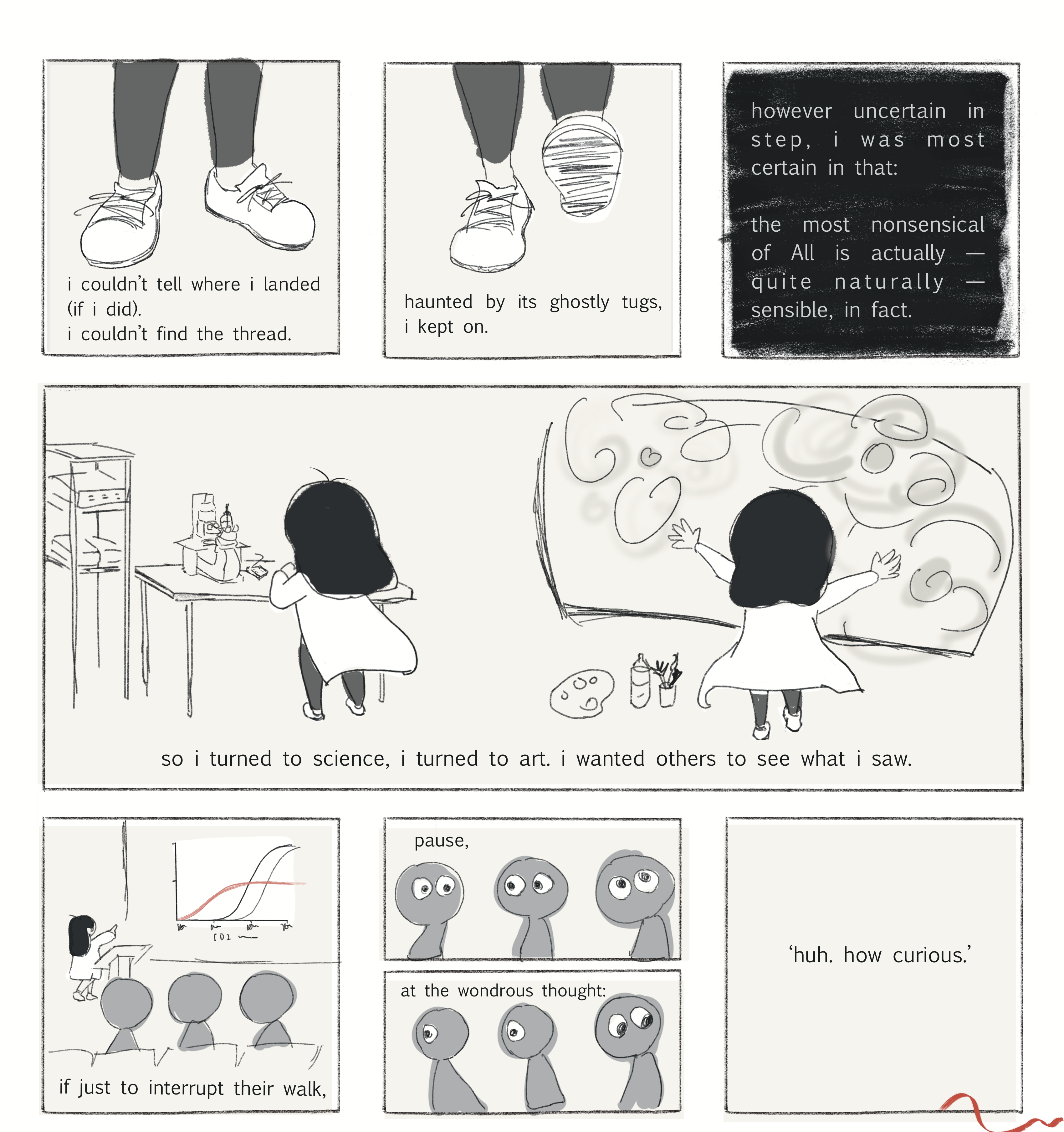
Natural Lines of Fracture

Written and Illustrated by Oanh Luc
Edited by Alex Ford and Deanna Canizzaro

Some inspirations:

  • Title: B. F. Skinner (1935) in The Generic Nature of the Concepts of Stimulus and Response.
  • Thread (pg 2): Top: An ode to our laboratory friends. Left: Cardiac action potential. Middle: Graphs of platelet aggregation (e.g., Michael Holinstat lab in Pharmacology). Right: Ionic current trace. Bottom left: Cumulative records for fixed ratio and fixed interval schedules of reinforcement.
  • ‘the most nonsensical of All…’ (pg 4): Albert Einstein wrote in 1936, “The very fact that the totality of our sense experiences is such that by means of thinking (operations with concepts, and the creation and use of definite functional relations between them, and the coordination of sense experiences to these concepts) it can be put in order, this fact is one which leaves us in awe, but which we shall never understand. One may say ‘the eternal mystery of the world is its comprehensibility.’”
  • Bottom left panel (pg 4): Dose-response curve

Oanh Luc is a graduate student in pharmacology. She is keeping on.

Unlikely Allies: Using Viruses to Improve Human Health

Written by Matthew Blacksmith
Edited by Emily Januck and Alex Ford
Illustrated by Danny Cruz

Imagine you are in a classroom, sitting at your desk, and it is the middle of winter. The teacher is giving a lesson and as you look around, you see red noses and tired eyes. As you listen, you hear sniffles and coughs. These sniffles and coughs represent a battle occurring on a scale too small to see. The cells of your body fight to keep you healthy, while viruses, bacteria, and other germs fight to use your cells to reproduce. Viruses exist on the spectrum between being alive and dead. Unlike living creatures, they are not able to reproduce on their own. Instead, they inject your cells with virus DNA and proteins. These viral components hijack the ordinary functions of your cells to turn them into a viral factory. Much like a double agent, these cells will copy virus genetic code, produce virus proteins, and assemble them together to generate new viral copies that are every bit as infectious as the original. From there, viruses can cause the cell to rupture, releasing the newly produced viral particles in a chain reaction to infect nearby cells.1

              Off the top of your head, you can probably think of various diseases caused by viruses. The viruses that cause smallpox, chicken pox, and most recently, COVID-19 make humans sick as part of their viral “life” cycle. These and other viruses have been an enormous burden to society and human health across history. Smallpox alone was responsible for over 300 million deaths during the 20th century, and was considered such a public health emergency that the entire world banded together to eliminate smallpox entirely.2 Thanks to vaccine technologies developed to fight it, there have been no naturally occurring cases in nearly fifty years, making the smallpox virus the first and only human disease that has been eradicated from face of the planet.3,4

Human ingenuity may have utilized vaccines to eradicate smallpox, but there are many other diseases for which vaccines may not be effective that still require time, attention, and resources to combat effectively. One such example is the bacterium Mycobacterium tuberculosis, which is responsible for the disease tuberculosis.5 While it is frequently thought of as a disease of the past, over 10 million people contracted symptomatic tuberculosis in 2023. 6 Even more astoundingly, approximately one out of four people are infected with tuberculosis at some point in their life.6 While tuberculosis can be cured with antibiotics, the treatment is extensive and requires continuous medication for months or even years.7 Unfortunately, 450,000 people in 2021 were infected by strains of tuberculosis immune to the antibiotic rifampicin, a first-line anti-tuberculosis treatment.8 As more and more diseases grow resistant to antibiotics and other medicines, new treatment avenues must be explored.

Drug resistant tuberculosis is only one example of the growing wave of infectious diseases that are developing antimicrobial resistance. When they do, treatment becomes more difficult and the human cost of disease increases.9 Over a million deaths worldwide can be directly attributed to disease variants that are antimicrobially resistant. In addition to the loss of life, it is predicted that by 2050 between $330 billion and $1 trillion of additional healthcare costs will be incurred annually.10 The fighting of antimicrobial resistances is a priority worldwide, and many standard practices are being adopted, such as maintaining good hygiene, prescribing antimicrobials judiciously, and taking the full course of antibiotics.11 However, none of these factors matter when someone already has a disease caused by a pathogen with antimicrobial resistance. This conundrum has left scientists around the globe to ask: in this microscopic arms race, what new treatments can be developed to fight disease?

Enter: the bacteriophage. Unsurprisingly, not all viruses prefer human cells as targets. Some selectively infect animals, plants, fungi, and even bacteria. The scientific name for a virus that infects bacterial cells is a “bacteriophage.” Bacteriophages represent an important part of the microscopic world around us. Just as the varicella-zoster virus infects our cells to yield chicken pox, bacteriophages infect and kill bacteria such as tuberculosis. If it seems like a strange idea to weaponize viruses against disease causing bacteria, it may be worth remembering the saying: the enemy of my enemy is my friend.

Let’s put you in the shoes of a scientist looking for bacteriophages to treat tuberculosis. How would you start? One thing to remember is that most bacteriophages only infect a single species of bacterium, so not just any bacteriophage will do. A good first step is to take a Petri dish covered in a layer of bacteria food and cover it with purified Mycobacterium tuberculosis. This will create a bacterial “lawn”. You can then drop small amounts of bacteriophages onto the lawn until you find one or more that kill the bacteria on the plate. However, just because the bacteriophage works on cells in a dish doesn’t mean that they will work in the human body. In a 2024 study, two bacteriophages were found to kill Mycobacterium tuberculosis on bacterial lawns. When progressing to later experiments, one bacteriophage strain called DS6A showed continued promise in the testing of human immune cells. Even more interestingly, after exposure to Mycobacterium tuberculosis mice treated with bacteriophage DS6A showed more weight gain than those with no treatment, a sign that the treatment was at least partially successful.12 The DS6A bacteriophage makes an excellent candidate for further testing to improve human health.

While the FDA hasn’t yet fully approved any bacteriophage therapy, that isn’t to say that bacteriophages have never been used in humans. In 2015, Tom Patterson was enjoying a cruise while traveling with his wife, Dr. Steffanie Strathdee. While abroad, he became sick and ultimately developed a large abscess which was infected with a strain of antibiotic-resistant Acinetobacter baumannii. In a stroke of luck, his wife worked as an epidemiologist and used her expertise to acquire bacteriophages which might work against Tom’s condition. After receiving emergency special permission from the FDA, custom bacteriophage “cocktails” were prepared. Tom was on the verge of death when the bacteriophage cocktails were injected into his bloodstream and abscess. In a near miraculous turn of events, he awoke from his coma and has lived for years after being treated.13,14 Despite being only a single case, Tom’s amazing recovery serves as an example that bacteriophages can be used to treat infections, improve outcomes, and save lives.

Tom’s case is representative of a growing number of bacteriophage therapies that are personalized to the needs of a single patient. A review of one hundred patients who received personalized bacteriophage therapies found that over 75% of infections showed clinical improvement after bacteriophage treatment. Interestingly, bacteriophage treatments used in combination with antibiotics were more likely to be successful than bacteriophages alone, showing that bacteriophages can be used with existing treatments rather than solely as a replacement.15 However, before being ready for widespread use, bacteriophage therapies will have to pass through clinical trials. Clinical trials exist to prove that new treatments are safe and effective at treating a condition.16 Numerous trials are investigating if bacteriophages can treat ventilator associated pneumonia, diabetic foot osteomyelitis, urinary tract infections, acute tonsillitis, infections of prosthetics, and many other conditions. 17-18 In fact, over 40 clinical trials of bacteriophage treatments are currently underway in the United States and another 50 are ongoing around the world.19 Time will tell how many of these treatments will be successful enough for widespread use.

As with all medical treatment, bacteriophages have some limitations and potential side effects to consider as well. Bacteriophages do not infect human cells but our immune systems can still identify and attack them, potentially leading to inflammation.20 Furthermore, just as bacteria develop resistance to individual antibiotics, they can become resistant to one or more bacteriophages.15 And not all bacteria have known bacteriophages which can infect them.21 This means that at least for now, bacteriophage therapy has room to develop before it’s ready for the big leagues.

Keeping both the pros and the cons in mind, bacteriophages show great promise as an unlikely ally against bacterial diseases. In addition to being injected into the bloodstream, they may be used topically to treat skin infections and burn wounds, orally to treat gastrointestinal illnesses, or inhaled to treat respiratory diseases.22 In the arms race between humans and disease, bacteriophages represent a new weapon that may be available soon to continue the fight against bacterial infections. Medical treatments that haven’t been discovered or approved yet have the potential to keep kids healthy, combat antibiotic resistant diseases far into the future, pair with existing treatments to enhance their effectiveness, and ultimately save lives. What was a miraculous cure for Tom Patterson may one day be an everyday wonder in our medical arsenal against bacterial diseases.


Matthew Blacksmith is a PhD student in the Department of Human Genetics studying canine mobile elements in the labs of Drs. Jeffrey M. Kidd and John V. Moran. In his free time he enjoys board games, video games, and walking his dog at local parks.


References:

  1. Virus Definition. Scitable by Nature Education, Nature website
  2. Simonsen and Snowden. Smallpox. National Center for Biotechnology Information website (2023)
  3. About Smallpox. Center for Disease Control website (2024)
  4. Smallpox. World Health Organization website
  5. Delogu et al. The Biology of Mycobacterium Tuberculosis Infection. Mediterranean Journal of Hematology and Infectious Disease (2013)
  6. Tuberculosis. World Health Organization website (2025)
  7. Treating Tuberculosis. Center for Disease Control website (2025 )
  8. Global tuberculosis report. World Health Organization (2022)
  9. Antimicrobial resistance. World Health Organization website (2023)
  10. Drug-Resistant Infections: A Thread to Our Economic Future. World Bank (2017)
  11. Antibiotic Resistance. National Foundation for Infectious Diseases website (2024)
  12. Yang et al. Bacteriophage therapy for the treatment of Mycobacterium tuberculosis infections in humanized mice. Communications biology (2024)
  13. Lamotte. No antibiotics worked, so this woman turned to a natural enemy of bacteria to save her husband’s life. CNN website (2023)
  14. Schooley et al. Development and Use of Personalized Bacteriophage Based Therapeutic Cocktails To Treat a Patient with a Disseminated Resistant Acinetobacter baumannii Infection. Antimicrobial Agents and Chemotherapy (2017)
  15. Pirnay et al. Personalized bacteriophage therapy outcomes for 100 consecutive cases: a multicentre, multinational, retrospective observational study. Nature microbiology (20 24)
  16. Clinical Trial (Clinical Study). Cleveland Clinic website (2024)
  17. Sawa et al. Current status of bacteriophage therapy for severe bacterial infections. Journal of Intensive Care (2024)
  18. Hitchcock et al. Current Clinical Landscape and Global Potential of Bacteriophage Therapy. Viruses (2023)
  19. Balthazar. Phage therapy: Researchers sharpen another arrow in the quiver against antibiotic resistance. Statnews website ( 2024)
  20. Phage Therapy for Multidrug Resistant Bacterial Infections. Cleveland Clinic website (2019)
  21. Bacteriophages and their use in combating antimicrobial resistance. World Health Organization website (2025)
  22. Vila et al. Phage Delivery Strategies for Biocontrolling Human, Animal, and Plant Bacterial Infections: State of the Art. Pharmaceutics (2024)

It Gets Better: A Sensory Tale of Spice

Written by Kayla Moehn
Edited by Deanna Canizzaro and Amanda Bekkala
Illustrated by Danny Cruz

Growing up, I loved visiting local restaurants with my family, and these shared meals were usually quite eventful.

In New Mexico, the start of most meals is marked by the waitress placing a basket of freshly baked tortilla chips and red serving dishes filled with salsa on the table. It’s understood that the salsa is for adults because it can be very spicy. However, that doesn’t always deter kids from wanting to be like the grown-ups, and I was no different.

As a child, I remember bravely taking a chip and submerging it in salsa before my parents could move it away.

“Oh no! Be careful, KK. That is very hot and for grown-ups only,” my mother warned.

I wanted to be like my parents, though. I may have only been five, but I wanted them to know that I was not a baby. Against my mom’s advice, I shoved the salsa-soaked chip in my mouth. Tears streamed down my face as an intense burning pain filled my mouth. “Ouch! Mommy, this hurts,” I sobbed. I didn’t understand why she and my dad could enjoy something that caused such discomfort in my mouth.

My parents both chuckled while my dad handed me the bottle of honey on the table. Quickly, I squeezed a dollop of honey onto a new tortilla chip and shoved it into my mouth. I kept shoveling honey-coated chips into my mouth until the sweetness of the honey overpowered the unpleasant spiciness of the salsa. Finally, my mouth felt normal again, and a smile found its way to my face as I savored a New Mexican staple for children who are deemed unready for spice.

Eventually, the waitress returned to our table to take our orders. “Red or green?” she inquired. Every New Mexican understands the meaning of this question.  She wanted to know if I wanted red or green chile smothered over my meal, a New Mexican tradition.

“She will have neither,” my mother chuckled. 

As a child and then adolescent who struggled with eating like a “New Mexican”,I wondered why chile induced such profound pain in my lips and tongue while sparing others. Were others just pretending to like it?

This question continued to simmer in my mind until college, where I majored in genetics at New Mexico State University – home to the Chile Pepper Institute (CPI). The CPI is an international leader in the science of spicy foods. During a class field trip to the CPI’s teaching garden, I first started to uncover some of the answers to my burning questions.

There, surrounded by rows of colorful, sun-soaked peppers, I discovered how scientists carefully breed chiles to craft unique flavors and heat profiles. The diversity of chile was evident in the 150 varieties throughout the garden that varied in size, color, and flavor. Some peppers had small purple fruits packed with high levels of spicy capsaicin – the chemical responsible for inducing the burning sensation that haunted me at family dinners – while others had larger and sweeter fruits with no traces of capsaicin.1 The most commonly grown chile varieties in New Mexico belong to the Capsicum annuum species, which includes New Mexico chile pepper varieties, along with paprika, jalapenos, and cayennes.2 These varieties contribute to the trademark smokey, spicy, and sweet flavor of New Mexican cuisine and differentiate it from the spicy cuisine of other cultures.

My field trip to the CPI teaching garden left me with much to contemplate. Chile peppers were more than just the red and green spicy nuisances of my childhood dinners – they were carefully cultivated and culturally sacred.

Still, knowledge of the wondrous diversity of chile peppers didn’t erase the sting.

One morning in college, I remember sitting outside with my friends at a restaurant under the sunny New Mexican skies. A basket of chips and a variety of green and red salsas sat on the table. To an outsider, this looked like the perfect day, however, I was feeling a little nervous.

My friends quickly started to snack on salsa-covered chips. Before I knew it, everyone was sharing their opinions on the four different salsas that sat on our table. I grew increasingly anxious that everyone was about to discover my sensitivity to spice. In that moment, I was transported back to being the five-year-old who wanted nothing more than to fit in with the others around the table.

“Kayla, you’ve been awfully quiet…which salsa is your favorite?”

My heart was racing. I desperately wanted my friends to think that I could handle the heat. I grabbed a chip and dipped it in the green salsa. “I think I like this one,” I said shakily as I shoved the chip in my mouth. Almost instantaneously, an alarm sounded in my mouth as the tiny capsaicin molecules in the jalapenos dispersed onto my tongue.

Against my better judgment, I grabbed a cold glass of water and tried to feign nonchalance. This only made the pain more intense as capsaicin – which does not dissolve well in water – spread more widely around my mouth.3 Sensory neurons throughout my mouth began to fire nonstop, inducing this uncomfortable sensation.

Unlike neurons in the brain, sensory neurons are packed with special detectors that enable them to sense hot/cold, chemical compounds like capsaicin, and touch.4 Surprisingly, the identity of the capsaicin-detecting receptor remained a mystery to scientists for a long time. It was not until 1997 that Dr. David Julius and his research team discovered the molecular blueprint and structure of the detector and later named it TRPV1 (pronounced trip-VEE-wuhn).5,6 Since its discovery, researchers have found that TRPV1 can detect more than just capsaicin, including hot temperatures and acidic pH.7,8

When capsaicin binds to TRPV1, the detector changes shape, similar to a key (capsaicin) unlocking the door (TRPV1) to your home (neuron). Instead of letting people through, TRPV1 opens to allow positively charged ions like calcium and sodium to rush into the neuron. This influx of positive charge causes the neuron to send an electrical signal to the brain that is interpreted as a painful, burning sensation.9

As a college student, I was unaware of the details of this molecular dance, and frankly, all I was concerned with was fitting in with my friends. Throughout the meal, I did my best to hide my pain, as I continued to cautiously eat just enough salsa-coated chips to deter any suspicion that I was an impostor.

Towards the end of my meal, I noticed something strange.

As I continued to eat more salsa, the alarm bells in my mouth lessened. I still felt uncomfortable, but the bite of the salsa stung less. Slowly, I started to notice the earthy and somewhat citrusy flavors of the jalapenos and tomatillos in the salsa. Is this why my family and friends enjoyed eating spicy foods?

It was not magic that made the burning sensation slowly fade. This phenomenon – called neuronal desensitization – occurs when sensory neurons that express TRPV1 become less responsive to capsaicin after repeated exposure.10 This is similar to when you enter a cold pool. At first, you might feel a lot of discomfort, but eventually your body becomes accustomed to the temperature and your cold-sensing neurons stop firing.

It remains an open question about how desensitization to capsaicin occurs, but scientists have some ideas.6,9 One hunch is that continued capsaicin detection and neuronal firing are taxing on the neuron and deplete its resources. As a consequence, the neuron may either become less responsive to replenish its supplies or die.

As I left the meal with my friends, I felt newly empowered to take on the spicy world of New Mexican food. With each spicy encounter, the sensory neurons in my mouth that detect capsaicin began to change. They gradually became less sensitive to the heat, allowing the complex and rich flavors of New Mexican food to shine through more clearly. Increasingly open to trying spicy foods, I left college not only with a tolerance for spice but also a larger appreciation for my culture’s cuisine.

Motivated to learn more about sensory neuroscience, I moved to Michigan to pursue my PhD and serendipitously joined the lab of Dr. Joshua Emrick, who trained under the mentorship of Dr. Julius, the scientist who uncovered the identity of TRPV1 (and later won a Nobel Prize for the discovery). My passion for understanding sensory receptors and neuroscience as a whole has allowed me to explore a new perspective of New Mexican cuisine, even far from home.

Here, I often find myself with new friends from the Midwest who have yet to be accustomed to spice. As we enjoy a meal together, they eye a bowl of salsa with suspicion. I dip a chip generously, smile, and say, “This isn’t spicy at all!” A glimmer of courage flashes in their eyes as they take a chip and give it a try. They try to hide their wince.

“It gets better. I promise.”


Kayla is a neuroscience PhD student on a quest to understand how the nervous system lets us sense the world. In the lab, she develops novel ways to study tooth and other orofacial pain in rodents. Outside of science, she enjoys golfing, watching Breaking Bad, and spending time with her boyfriend and two adorable cats, Dewey and Peanut Shell.

Fighting in the Fields: Plant Immunity, Crop Diseases and the Battle to Feed the World

Written by Colter Giem
Edited by Amanda Bekkala and Paris Riggle
Illustrated by Adriana Brown

     Let’s take a drive.

We’ll start downtown. Somewhere in the Midwest – on the shady lawns and gridded streets of Indianapolis, or below the brick warehouses of East St. Louis. We drive in any direction; as in the rest of America, the sprawl goes wherever the cities do.1 We zip by tidy townhouses and hulking apartment complexes, which yield to cookie-cutter tract housing and gaudy McMansions, which give way to the sparse, suspicious exurbs of suburban flight. Before you know it, the road opens into the rolling fields and low hills of America’s breadbasket. Everything from the high prairies of western Nebraska to the lush foothills of the Appalachians is an almost unbroken plain of farmland.2 This is one of the most productive agricultural regions on Earth, fed by arterial rivers, hundred-mile aquifers, and the stunningly productive loess soil left behind by retreating glaciers.2 This region produces a third of the world’s soybeans and corn,* and the annual harvest can be seen from space, in great continental brushstrokes of green and brown.2,3 This expanse, along with similar stretches in Ukraine and Argentina and China, fulfills the basic goal of human civilization – providing our food.** We stop at the side of the road, by a large cornfield. It’s mid-August, and the corn isn’t ripe yet. The air is brisk and sweet, and the green stalks ripple in the light breeze.

In modern parlance, this is classic flyover country. But in truth, this is a dynamic, vibrant land, where trillions of tiny battles are waged minute by minute, where the food supply of the planet hangs in the balance. Pathogens – fungi, bacteria, parasites – are as much a scourge to plant life as animal life.4,***  The U.N. estimates that 20-30% of all food produced on farms is lost to disease every year.5,†  But as with all nature’s battles, this is a two-sided fight. Plants have evolved alongside pathogens for millennia, and they possess robust immune systems.6 It’s different from animals; plants don’t have our mobile, flexible, adaptive immunity, with its ability to detect and remember its vanquished foes. Instead, each plant cell operates an innate immune response.6 Generally, this is a two-branched system – receptors on the plant cell’s surface recognize bacterial molecules and activate first-line defenses, like deploying toxic reactive oxygen species (ROS) to kill pathogens, or depositing new material to thicken cell walls.6,7 If that fails, they switch to the second line of defense. Specialized R proteins†† recognize the effector molecules that pathogens emit and go full scorched-earth on the cell, releasing more ROS, deploying corrosive salicylic acid, or (if all else fails) initiating cell suicide.6,8 After infections, some can even acquire a kind of epigenetic immune memory (albeit much less robust than we vertebrates enjoy) and remain in a state of hyper-vigilance for life.10 Immune responses are observed across plant species – in corn, entire groups of cells commit simultaneous suicide to deter pathogens,11 while many tree species grow hardened tissue around wounds to wall them off from surrounding healthy wood.12,††† In general, these systems work; the fact that our planet wears a global coat of greenery shows that plants thrive amid nature’s onslaught.


* And 7% of global wheat – which is lower than I’d expect, given Kansas’ reputation.1
** But not for all of us. UNICEF and the WHO estimate that 2.33 billion people faced food insecurity last year, exacerbated by the COVID pandemic and the war in Ukraine.2
*** Even more so, given that plants don’t have the luxury of walking away from funny-smelling water or ominous spores.
It’s very hard to measure this, though – other global estimates range anywhere from 10% to 40%.
†† The “R”, with the creativity that scientific naming is known for, stands for “resistance.” 9
††† This process, called CODIT (compartmentalization of decay in trees) is why you sometimes see big brown blotches in old tree rings – these are areas that got walled off.12


But even with these strategies, honed for millennia by evolution’s ruthless scalpel, our crops still need help. When you look out across these fields, shading your eyes from the late-summer sun and watching the cornstalks wave, you may notice a chemical tang hanging in the air. This is just a whiff of the more than one billion pounds of insecticides, herbicides, and fungicides that U.S. agriculture consumes every year.13 Throughout the world, the chemical warfare we inflict on our food is merciless and total. The environmental impact alone is enormous: wildlife dies, rain acidifies, and coastal waters from the Gulf of Mexico to the Ganges River are contaminated for decades.14-17 But then, you might remark while watching carpenter bees flit lazily from one leaf to another, if plants have such robust immune systems, why do our crops need all these pesticides? That’s a good question,* one that has received a lot of research attention.18-21 One explanation is that modern farming practices make plants less able to resist disease. Traditionally, agriculture was focused on smaller family farms, which rotated crops out during different growing seasons – wheat one year, clover the next, letting the soil cycle nutrients and recover.22 Today, the landscape is dominated by larger farms, which produce over 80% of U.S. agricultural output.23 Overwhelmingly, the fields at these larger farms are monocropped: they grow only one crop, over and over.24,25 These plants are all genetically similar, and herbicide use lowers biodiversity even further.24 Evidence suggests that pathogens are more abundant in monocropped fields, as soils acidify and beneficial microbes die off.26-28 As a potato farmer in 1800s Ireland could tell you, this is dangerous – disease moves through monocropped fields like wildfire.


*One answer: maybe we don’t need all these pesticides, or at least not in the quantities we use them.


And the problem is getting more urgent. In recent years, as temperatures rise and globalization links different bioregions together, diseases once confined to specific areas have begun spreading worldwide.29 Maize lethal necrosis virus, first observed in Peru, now infects up to 70% of corn seeds in parts of Africa.30 Coffee leaf rust, a fungus endemic to Sri Lanka, has popped up in Brazil and Nicaragua, upending decades of confident predictions that it would never cross the Atlantic.31 Warm-weather insect species, previously held in check by the sterilizing effects of winter, are marching toward the poles as temperatures warm, threatening temperate zones.32 As they spread, these diseases change and shift: much as MRSA and E. coli develop antibiotic resistance in hospital ICUs,33 our constantly-sterilized farmland provides great selective pressure to create agricultural superbugs. One Brazilian study found that a common citrus fungus can develop immunity to fungicide in just two years.34 The coffee leaf rust that jumped the Atlantic? It’s wiped out entire farms, evading local farmers and coffee multinationals’ best efforts.31,35 Only two species of coffee plants*account for nearly all the world’s coffee, and rust kills both.35 Their identical immune systems are ripe for takeover by a disease specialized to attack them. Farmers (and their pesticides) simply can’t keep up.

The clouds are darkening on the western horizon, and a faint promise of rain hangs in the air. You look out at the cornfield, taking in the greenery. Then you notice – it’s not just corn. Interspersed with the ripening stalks are rows of low soybean plants, their pods spilling over the dark soil, and in the distance, you can see a few orderly patches of sedge and ryegrass. This farm is intercropping – growing multiple crops together on the same land. Intercropping is an ancient practice. For centuries in pre-Columbian America, the “Three Sisters,” corn, beans, and squash, were grown in the same fields, each plant strengthening the others.36-38 Today, intercropping is gaining traction among many farmers – it raises productivity, improves nitrogen fixation, and strengthens the soil microbiome, making it harder for pathogens to spread.39-41 One study from the University of Florida found that intercropping even reduces crop loss to insects.41 It’s not entirely clear why, but one hypothesis is that most destructive species are “specialists” in one crop; in multi-cropped fields, less destructive “generalist” insects are at an advantage.42 Intercropping may also provide a level of “biological control,” allowing the natural enemies of pests, like predatory insects, to keep them at bay.43 This process is key to regenerative agriculture, farming practices that mimic natural ecosystems. It works hand-in-hand with a new high-tech solution – plant immunotherapy. Derivatives of CRISPR, the Nobel Prize-winning gene editing technology, can be used to target viral DNA when it enters plant cells, or splice out the genes that viruses and fungi use as footholds to enter.44 Early results are promising – in crops as diverse as cucumbers, rice, and tomatoes, these methods induce resistance to common pathogens.44 Another strategy uses tiny interfering RNA molecules that mediate viral resistance,** engineering them into plant genomes to recognize and attack viruses as they try to replicate.45 Crops can even be modified to produce animal antibodies,46 which our immune systems use to recognize viruses.***


* Coffea arabica and Coffea canephora, or as your friend with a $300 French press will call them in his monologue about acidity and floral undertones, arabica and robusta.
** This process, called RNAi, is fascinating, complicated and still being unraveled in many systems. In humans, small interfering RNA molecules have potential applications in everything from genetic diseases to cancer research. These tiny strings of molecules can be powerful.
*** They’re called “plantibodies.” I take back what I said about scientific naming, that’s gold.


It’s raining now. One of those late-summer storms, heavy drops punctuated by bouts of low thunder, blowing through fast and hard from the west. Already, the crops look refreshed; leaves a little greener, stalks standing thirstily at attention. You get back in the car. The dirt roads turn muddy fast, and it’s best not to get caught out here for long. All around, a sea of green stretches past the horizon, a constant cycle of life and death, threat and promise. This land is a battlefield in the endless fight to feed the world. Time will tell who wins it.


Colter is a first-year Ph.D student in Molecular and Cellular Pathology, studying nuclear protein dynamics and regulation in neurodegenerative disease. In his free time, he enjoys painting and hiking around Ann Arbor, board games with friends, and trying (and mostly failing) to like running.