What separates a chortle from a snicker is your history. Your culture, your experiences, and your unique personality inform whether you interpret the little laugh as benign or mocking. Mocking, or ridicule, has always been one of laughter’s facets across eras and cultures. Such cruel laughter is embedded in human folklore: in the Greek myth the goddess Demeter was searching for her kidnapped daughter, Persephone. When she collapsed exhausted at the edge of a town and was offered a flask of barley-water to drink, she seized the flask and chugged it down. As she drank, she heard a local boy, Ascalabus, laughing at the sight of the goddess gulping greedily. Her inner turmoil sharpened into the need for revenge, and Demeter wiped her mouth and turned Ascalabus into a lizard.1
Bacterial transformation is the process of inserting a foreign plasmid (a small, circular DNA strand) into bacteria, such as bacterium Escherichia coli. Harmless E.Coli strains are commonly used in a scientific laboratory to store DNA sequences and produce proteins because of how easy and fast these cells grow in the laboratory setting. During transformation, bacterial cells uptake the foreign plasmid, replicate the plasmid, transcribe the DNA into RNA, and eventually translate these RNA strands to produce an enormous amount of proteins of interest. This process of replication, transcription, and translation is known as the central dogma of biology. Not every bacterial cell takes up a foreign plasmid during the transformation process. Therefore, scientists use a foreign plasmid that also contains an antibiotic-resistant gene, so a bacteria cell that uptakes the plasmic can be selected on antibiotic plates or media.
Written by Virginia Ju Illustrated by Katherine Bonefas
Poverty-based performance gaps take root during the earliest stages of children’s lives and fail to narrow in the following years. Students who start disadvantaged are less likely to equal their non-disadvantaged peers. As such, lower socioeconomic status (SES) correlates with lower academic achievement creating performance gaps between the lowest and highest SES quintiles. These performance gaps reflect extensive unmet need and thus untapped talents among low SES children. Introducing diverse and involved mentorship could increase interest and performance of students in our local communities.
Written by Jennifer M. Baker Illustrated by Katherine Bonefas
What does it mean to be a scientist? Though the daily activities of researchers from diverse scientific disciplines may appear unrelated, all scientists fundamentally do the same thing: ask questions that lack answers over and over until an answer takes shape. This description may seem like an oversimplification of the highly technical work that scientists do, but I have yet to encounter a scientist that serves as a counterexample to this assertion. As a researcher who is still early in my career, the responsibility of answering life’s answerless questions can feel overwhelming as I struggle to develop my scientific skills while attempting to answer research questions, a process that seems a little more daunting on some days than others. Despite the challenges that accompany my identity as a still-developing scientist, there is also a part of me that knows I am going to be okay. This self-assured perspective might sound like unfounded optimism, but this confidence comes from being trained by one of the best minds I have ever met. This person, my first scientific mentor, taught me the most important lessons I’ve learned about being a scientist. Oh, one more thing—she is not a researcher, she’s my grandmother.
Written by Patricia DeLacey Illustrated by Catherine Redmond
It was a cloudless morning in the Simien Mountains National Park in northern Ethiopia. “There,” said Esheti pointing down the cliff, spotting the geladas1 with an expert eye. Through my binoculars I saw a line of geladas amble up the sheer cliff. Once they reached the grassy plateau, I collected behavioral data. Talisman, the dominant male of a unit, was groomed by the adult female, Coco, while he puffed out his chest. His bright red chest patch and golden-brown mane looked particularly impressive juxtaposed to Tecate, the subordinate adult male in the unit. Tecate’s mane was short, his shoulders sloped inwards, his chest patch noticeably pale pink instead of red. Looking at the surrounding geladas, I noticed the variation in chest patch color across male dominance status.2 What could be the purpose of exposed red skin in a cold, high-altitude environment, and why is there variation in red color? This puzzling unique trait is putatively linked to reproductive success and sexual selection.
A male gelada in Ethiopia, named Fabio. Courtesy of Patricia DeLacey
Natural selection, proposed by Charles Darwin, is the most well-known and most taught theory regarding evolutionary biology. By exploring and observing nature, Darwin noticed species change over time by exhibiting variations in particular traits. In response to harmful environmental stressors, those that survive get the chance to reproduce and pass on their traits to the next generation.3 However, not all variations enhance survival; he noted a trait that did not fit into his theory of natural selection: a peacock’s tail. The tail’s vivid, iridescent colors and five-foot length make it nearly impossible to hide and escape from predators, such as tigers and leopards. What pressure could have selected for such an extravagant tail? One word – females. The peacock’s tail does not aid in survival, but it instead helps the peacock “woo” choosy females in a flashy mating display.
Traits for my mate
Sexual selection focuses on traits that give an individual an edge for mating opportunities over the competition with members of their own sex. Charles Darwin first postulated the theory of sexual selection in The Descent of Man, and Selection in Relation to Sex in 1871 to explain ornamentation traits, such as the peacock’s flashy tail, and weaponry traits, such as a ram’s horns. These sex-specific physical traits appear at sexual maturity and are secondary to biological sex-specific traits of genitalia. To name a few examples: lions have manes while lionesses do not; male mallard ducks sport a bright green head while females are brown; wild male gorillas weigh up to 400 pounds while females only weigh up to 200 pounds. The more intense the mating competition, the more disparate the appearance between males and females.
However, Darwin focused on male traits that females lack, such as the weaponry for male-male competition or ornamentation traits used for attracting females. As such, he had a very male-centric focus and stated that traits arise from a “struggle between the males for the possession of the female.”4 Darwin was on the right track, though it’s not as simple as competitive males and coy females. But can we blame him for his observations and conclusions?
Science prides itself in being objective. Scientific discoveries are based on evidence, systematically collected information gained through carefully conducted experiments or observations. This pursuit of objectivity has a caveat: science is conducted by humans. Each person brings a unique perspective to scientific research, but these perspectives can carry bias, unconscious or otherwise, that shape how they approach a question. An individual’s biases determine what questions are asked, how they are asked, what methods are chosen, and what methods are excluded. The larger scientific consensus can further distort this goal of objectivity.
To approach questions, scientists form testable explanations for a phenomenon, based on preliminary evidence. Evidence they choose to collect is rooted in observation. Observations are rooted in the collective consensus or perspective resulting from previous experimentation. Like all things in science, theories are challenged, tested, and revised where necessary as additional evidence comes from new investigations. Theories sometimes have room to expand as data accumulates, and the theory of sexual selection is no exception. Darwin did the best he could interpreting the data available and creating his theory of sexual selection, but the true diversity of sexually selected traits go beyond what he could have imagined.
Stay at home dads and flashy females
Before we delve into sexual diversity, we must ask: what defines male and female? Biological sex is defined by the size of the reproductive cell (gamete) the organism produces (Table 1).5
In sexual reproduction,6 a small and large gamete must be brought together to form a zygote which develops into an egg or fetus. The union of two dissimilar gametes, called anisogamy, is nearly universal in sexual reproduction. The sex contributing the smaller gamete (male sperm) has a smaller initial investment in reproduction than the sex contributing the larger gamete (female egg). Males can produce hundreds of thousands of sperm with little energetic investment while females are rate limited in the amount of viable eggs. Unequal investment in gamete production often corresponds to unequal investment in offspring care. Typically, this looks like males competing with each other, males mating with as many females as constraints7 allow, and females choosing high quality males to produce strong offspring.
Are males always competing for choosy females? In the Wattled jacana, a wading bird native to Panama, females are larger than males and have sharp spurs on their wings that females use to compete with one another to establish a territory and a harem of males.8 Within each female’s territory, one to three or more males defend a nest and incubate eggs laid by the singular female. In the broadnosed pipefish, a saltwater fish species in the same family as seahorses, females are again larger than males, develop brighter colors than males, and court males with a mating dance.9 One female will lay her eggs in several male’s brooding pouch where they will carry the eggs until they hatch. As such, Darwin’s theory that males always compete does not hold up with these more recent observations where females compete for mates.
What dictates which sex competes? In the case of the jacana and pipefish, females produce eggs faster than males can care for them. Thus, males are tied up with reproduction while more females are ready to mate at any given time and must compete with one another for mating opportunities. In mammals, females are responsible for offspring after birth10 because they provide milk for infants. This time commitment for them means that more males are available to mate, and males must compete with one another for mating opportunities. As such, the ratio of time it takes to reproduce between males and females in a given species largely determines who competes for mates.11
Expanding the theory
Not only are sex and reproduction important in mating, but also (non-sexual) social interactions between members of the same species. In some songbird species, when a parent returns to the nest with food, the offspring open their mouths wide and stretch up to solicit food. The color inside their mouth, called a gape, indicates immune function, where in barn swallow nestlings, red correlates to a better immune system.12 As such, parents are more likely to invest in deep red, healthy chicks because they have a stronger chance of survival. This would be an example of a non-sexual signal between parent and offspring. In 1983, evolutionary biologist Mary West-Eberhard expanded the use of weaponry and ornamentation traits in non-sexual interactions between parents and offspring or among siblings. Her theory of social selection13 suggests that interactions between individuals of the same species are chosen, both in sexual and non-sexual contexts, based on the ability to attain limited resources. Thus, sexual selection exists as a subset of social selection as a part of a species’ means of survival.
Darwin’s original theory of sexual selection has been challenged and altered over time, reflecting the impact of society’s shifting views on sex and reproduction, along with more evidence collected from species Darwin did not survey. A unique human trait, as far as we know, is to justify, validate, or approve behaviors in human society. Humans often make the misguided assumption that because something exists in nature, it is morally “good”.14 A behavior exists in wild animals because it either improves reproductive success or increases the chance of survival.
Stepping back from our perceptions and moral structures, scientific exploration should strive to identify an objective framework to discover explanations for the things we observe in the natural world. This provides a significant challenge since our experimentation is conducted under a social and cultural context, much like Darwin. Nevertheless, we should be aware of how our views impact the science conducted that our views can limit our perspective; we must remember the goal of science is to understand the natural world.
1 A monkey species endemic to the highlands of Ethiopia 2 In male geladas, dominance status is determined by mating access to reproductive females. Dominant “leader” males mate with a group of 2-12 adult females, subordinate “follower” males spend time with this group but rarely mate, “bachelor” males spend time with only other males and do not mate. 3 The theory of evolution by natural selection has continually been supported by evidence from the fossil record, biogeography, embryology, genetics, antibiotic/pesticide resistance, and even direct observation in experimental and natural settings. 5 This should not be confused with gender identity, gender expression, or sexual orientation. 6 Some species of fruit flies that have multiple sperm sizes and a few fungi have one gamete size. (Roughgarden J (2004). Evolution’s Rainbow: Diversity, Gender, and Sexuality in Nature and People. Berkley: University of California Press.) 7 Environmental and social 10 Some mammals like the california mouse practice biparental care where both parents raise the offspring; Gubernick D J & Teferi T (2000). Proc. Biol. Soc. 267(1439): 147-150. 11 Of course, the distribution of food, predation risk, environmental harshness, population density, and the required level of paternal care also impact these structures: it’s never a simple rule of males compete and females decide. 14 This is formally known as the naturalistic fallacy
Scientific ideas are always changing, updated by new observations and models. Tools and instruments are invented and perfected to push the boundaries of the observable world. Better telescopes allow us to see farther out into deep space and image black holes, while improved microscopes zoom into the atomic structures of proteins and inorganic compounds. These instruments augment and expand our five senses and let us ‘see’ what would otherwise be impossible. Using research equipment in this way not only changes science but also impacts how scientists wrap their heads around data and, in turn, form models and hypotheses that drive future research. Scientific findings impact not just thoughts and feelings but also actions and narratives about the world; for example, climate research permeates conversations about lifestyle, politics, and how individuals evaluate and face crises.
Neuroplasticity allows the nervous system to adapt to changes. Like muscles, the brain is a dynamic use-it-or-lose-it system. The building of new synapses, the strengthening and breakdown of existing synapses: neuroplasticity allows us to learn and remember. The enso is symbolic of “suchness”, the essence of zen. It is entirely empty, yet entirely complete. Combined in art, these equilibriums fine-tune to the situation.
Welcome to EquilibriUM, a science, technology, enginering, art, math, & medicine (STEAMM) magazine brought to you by MiSciWriters! This print magazine project started as a way to celebrate MiSciWriters’ fifth anniversary (in September 2020) and explore the interesting ways that science fits into other disciplines. I’ve had the immense honor of being a part of the MiSciWriters community during my entire graduate school career and have served as the editor-in-chief the past almost two years. But there’s so much more in this world beyond science – even just within UMich research – and I wanted to bring the team’s expertise in editing and storytelling to a more interdisciplinary space. This magazine serves as a sort of test bed, exploring what we could be doing and what stories we should be sharing.
Written and illustrated by Emma Thorton-Kolbe Edited by Alex Ford, Paola Medina-Cabrera, and Sheila Peeples
I am a neuroscience PhD student. I spend my days in the lab thinking about how the cells in the fruit fly brain connect to one another during development. I take lots of pictures of those fly neurons. I spend hours staring at a computer measuring different parts of them. I read papers reporting on what other scientists have learned about brain development, and then write papers myself. I love that this is my job. I do it because I think brain development is really neat and because doing experiments requires a balance between creativity and protocol following that appeals to me. In a work day, I can spend mental energy thinking up new ways to visualize my data but also zone out a bit while I do a nice tactile task like brain dissection.
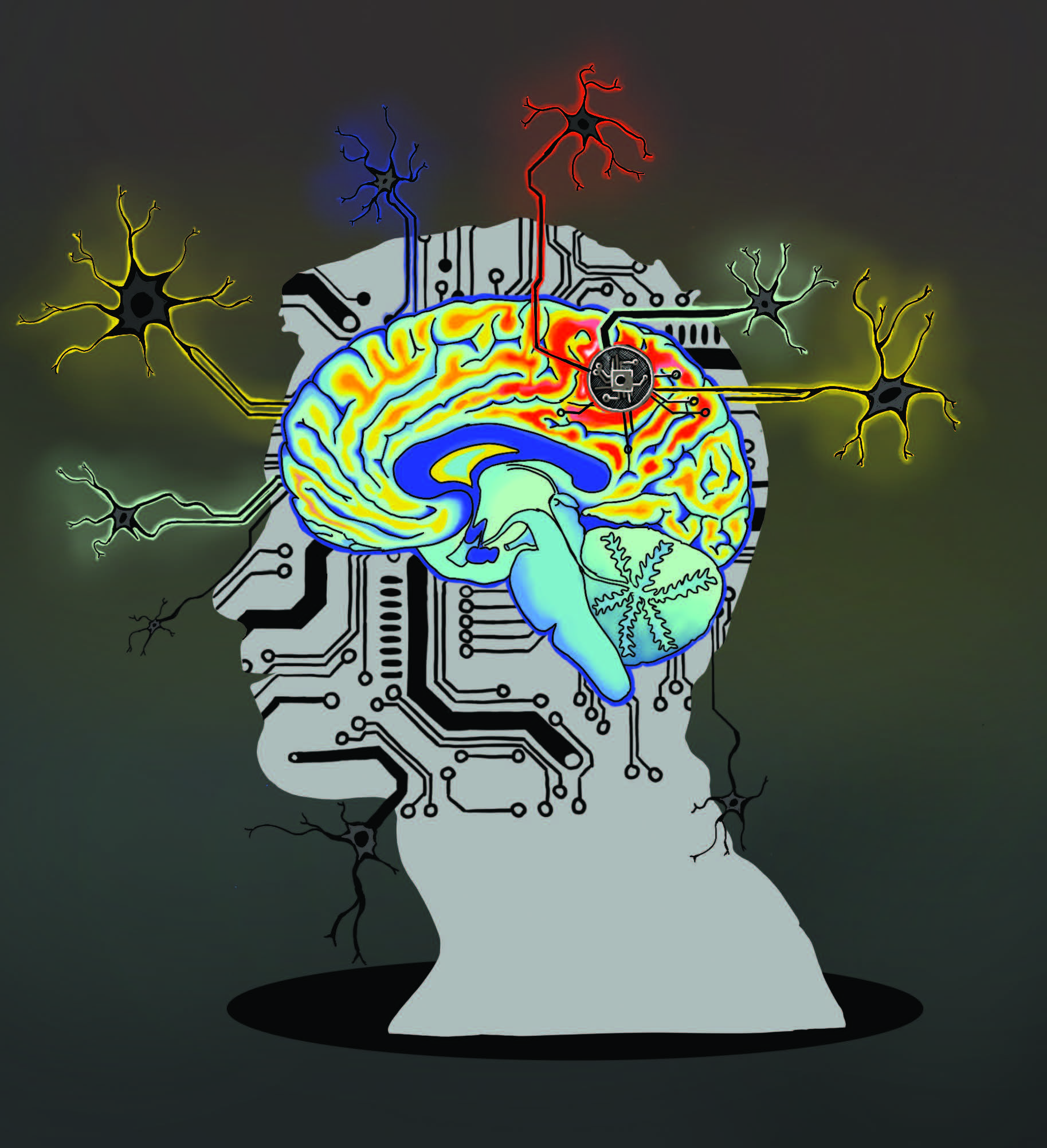
Written by Nick Jänne Edited by Jeremy Chen and Claire Shudde Illustrated by Jacquelyn Roberts
Humans are mystified by the brain—the software-hardware package behind every book worth reading, every song worth listening to, the start of civilization, and perhaps one day the end of it. Even today, we know very little about what goes on behind the average person’s eyes. And while we have uncovered some fundamental properties of cognitive function in the last 4,000 years, curiosity and incomplete understanding have led to science fiction-level fantasies of what might come to pass one more of the truth unravels. We know the popular ones: “The Force” from Star Wars, or people using tin-foil hats to block potential mind control technologies. Perhaps most recently you’ve heard of Elon Musk’s company Neuralink. To some, this company seems to promise an all-powerful computer implanted beneath your skull, enabling mind-reading control of the world around you. To the tinfoil crowd, the unthinkable possibilities of this technology prompts a shared vein of fear. However, Neuralink is a single runner in the decades-long race to create the next generation of brain-machine interfaces. What’s more, they’re beginning to change people’s lives for the better—perhaps in ways you might not expect.




 misciwriters.com