Lab Notebooks for Art: A Scientist Develops an Art Practice

Written and illustrated by Emma Thorton-Kolbe
Edited by Alex Ford, Paola Medina-Cabrera, and Sheila Peeples

I am a neuroscience PhD student. I spend my days in the lab thinking about how the cells in the fruit fly brain connect to one another during development. I take lots of pictures of those fly neurons. I spend hours staring at a computer measuring different parts of them. I read papers reporting on what other scientists have learned about brain development, and then write papers myself. I love that this is my job. I do it because I think brain development is really neat and because doing experiments requires a balance between creativity and protocol following that appeals to me. In a work day, I can spend mental energy thinking up new ways to visualize my data but also zone out a bit while I do a nice tactile task like brain dissection.

Continue reading “Lab Notebooks for Art: A Scientist Develops an Art Practice”
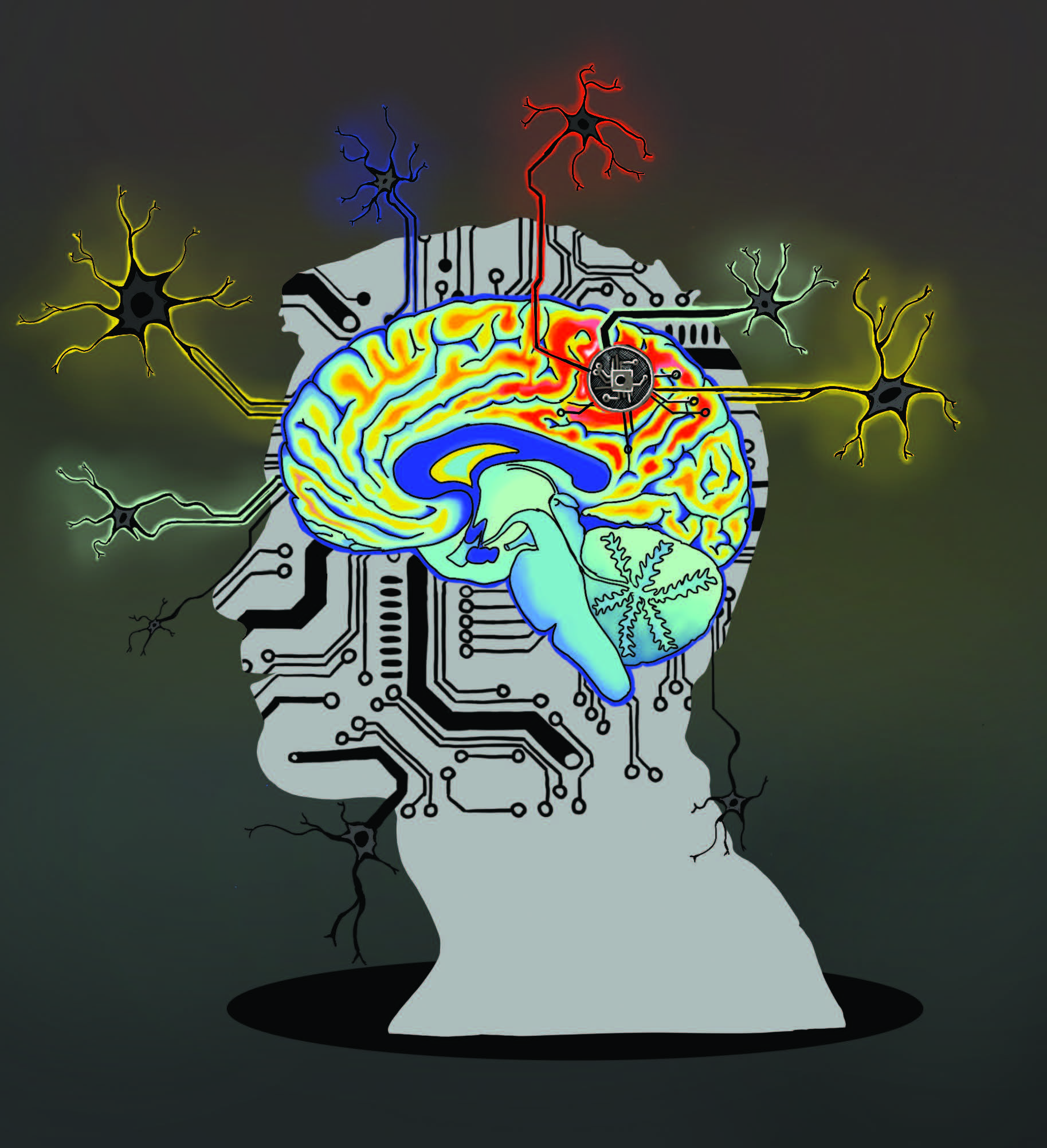
Cracking the Neural Code: Monkey Mind Pong and the Future of Brain – Machine Interfaces

Written by Nick Jänne
Edited by Jeremy Chen and Claire Shudde
Illustrated by Jacquelyn Roberts

Humans are mystified by the brain—the software-hardware package behind every book worth reading, every song worth listening to, the start of civilization, and perhaps one day the end of it. Even today, we know very little about what goes on behind the average person’s eyes. And while we have uncovered some fundamental properties of cognitive function in the last 4,000 years, curiosity and incomplete understanding have led to science fiction-level fantasies of what might come to pass one more of the truth unravels. We know the popular ones: “The Force” from Star Wars, or people using tin-foil hats to block potential mind control technologies. Perhaps most recently you’ve heard of Elon Musk’s company Neuralink. To some, this company seems to promise an all-powerful computer implanted beneath your skull, enabling mind-reading control of the world around you.  To the tinfoil crowd,  the unthinkable possibilities of this technology prompts a shared vein of fear. However, Neuralink is a single runner in the decades-long race to create the next generation of brain-machine interfaces. What’s more, they’re beginning to change people’s lives for the better—perhaps in ways you might not expect. 

Continue reading “Cracking the Neural Code: Monkey Mind Pong and the Future of Brain – Machine Interfaces”

Night Shift/Day Shift

Photographed and written by Julianne Armijo
Edited by Naomi Raicu and Claire Shudde

I worked many years as a night shift nurse. Insidiously, I began experiencing unusual elation, recklessness, and impulsiveness, often followed by depression. For years, this cycle continued, and I didn’t know why. I was finally diagnosed with bipolar disorder when a new antidepressant medication catapulted me into a manic episode. After several hospital visits, I stabilized on lamotrigine, a ketogenic diet, and regular sleep. I’m now stable and thriving.

Continue reading “Night Shift/Day Shift”

From Synapses to Symphonies: A Connection Through Sounds

Written by Charukesi Sivakumar
Edited by Sheila Peeples, Jeremy Chen, Kate Giffin, Kristen Schuh
Illustrated by Adriana Brown

The lights dim as we, the Life Sciences Orchestra, lift our instruments. With the wave of our conductor’s baton, the music swells across Hill auditorium and enters the audience’s ears, lighting up the brain.

Continue reading “From Synapses to Symphonies: A Connection Through Sounds”

Nematodes as Catalysts in Uniting Scientific Curiosity and Cultural Heritage

Designed and written by Mirella Hernandez Lima
Edited by Sheila Peeples and Kendall Dean
Illustrated by Mirella Hernandez Lima and Kendall Dean

El Día de Muertos es una celebración que honra la memoria de los seres queridos que han fallecido. Donde se rinde homenaje a la vida y a la muerte, porque sin vida no hay muerte.

The Day of the Dead is a celebration that honors the memory of loved ones who have passed away, paying tribute to both life and death. 

Continue reading “Nematodes as Catalysts in Uniting Scientific Curiosity and Cultural Heritage”

When the Immune System Goes Against the Grain

Written by Deanna Cannizzaro
Edited by Claire Shudde and Jessica Li
Illustrated by Jessica Li

Sitting down for a meal is a staple of being human. Memories and laughter are shared over food, allowing us to connect with friends and family. 

For me, food is no longer a simple part of everyday life; I’m forced to think about a chronic disease each time I want, or need, to eat something. It took months of severe abdominal pain and persistent fatigue in my early twenties to realize gluten had become my biggest enemy.

Continue reading “When the Immune System Goes Against the Grain”

Out of Many, One

Written by Alex Ford
Edited by Hector Mendoza and Zoe Yeoh
Illustrated by Zoe Yeoh

I. The Tower of Babel

In the beginning, there was a stone. A stone by itself is simple. Monolithic in concept and function. But introduce a second stone. Place it upon the first. Add another. A stack forms and they become more than the sum of their parts. Before there was life, there were simply stones longing for more. Patient stones that awaited the first tumble to start an avalanche. 

Somewhere in the infant Earth, at the grinding edge of a sunken continental plate, magma oozes into deep water. Volcanic fires churn in the darkness and spew black clouds into the crushing depths. In this energy-rich crucible, a lone carbon finds hydrogen, finds nitrogen, and the first organic molecules begin to assemble in the deep.

Continue reading “Out of Many, One”

Appreciating the Intricacies of Science Through Sculpture: The Powerhouse of the Cell

Written and Sculpted by Emily L. Eberhardt
Edited by Kate Giffin

Amidst the global pandemic in 2020, I began to explore science through art. In my research, I studied mitochondrial proteins (mitochondria are small structures in cells that produce necessary energy), but with lab closures, my hands were idle. With a box of beads, a freshly-passed candidacy exam, and limitless time, I sat and considered the power of mitochondria. Fascinated by their complexity, I began to craft sculptures. 

Continue reading “Appreciating the Intricacies of Science Through Sculpture: The Powerhouse of the Cell”

Letter from the Editors

Written by Kate Giffin and Kristen Schuh

Dear Readers,

In this edition of EquilibriUM, we delve into the intricate ways that science and art connect and enhance each other.

In a world that often compartmentalizes disciplines, it is necessary to bridge these gaps to discover fresh perspectives, foster innovation, and enrich our collective knowledge. Both of us work in interdisciplinary fields studying how the brain and body interact in sometimes strange and nonsensical ways – connections are one of our favorite parts about research. 

Continue reading “Letter from the Editors”

Neural Network Boogie

Cover Concept and Art: Naomi Raicu

In this piece, I explored  the neural network concept by connecting it to artistic and emotional aspects of the human experience: music, group dance, and a sense of community and interconnectedness. In the real world, a cognitive “dance” of changing neural connections not only determines who we are, but also inspires innovation in science and technology.

Continue reading “Neural Network Boogie”