
Written by: Emily Lecea
Edited by: Claire Shudde, Colter Giem, Hannah Kim, Ryan Schildcrout
Illustrated by: Jessica Li
Watch out for deer! It’s a common enough saying, one that’s a half-joking, half-serious warning for a legitimate danger on the road. Deer are overpopulated in many areas in North America, largely driven by a lack of predators, increasing the danger of an encounter on the road, causing the majority of the 1.8 million vehicle collisions each year attributed to wildlife. Venison is a common American meat, and hunting is popular, often seen as a method for population control, but not all meat is safe for consumption, thanks to the rise of a prion disease. Prions are essentially infectious misfolded proteins that can cause disease by accumulating in the brain, leading to cell death. In recent decades, a prion disease known as Chronic Wasting Disease (CWD) has become increasingly prevalent in deer populations – and could, potentially, cause disease in humans as well.
What are prions?
PrP, or prion protein, is a protein normally produced by neurons. Correctly folded, it causes us no harm, and is probably essential to normal cell function, though the details are not well understood. Through some unknown mechanism, this protein can fold incorrectly, changing its shape and function, turning it into a prion particle. These misfolded proteins are resistant to usual antimicrobial preventatives – meaning surfaces/objects contaminated with prions cannot be disinfected – and remain in the environment for years while remaining infectious. Not even autoclaving will destroy prions, as they are incredibly heat resistant. Temperatures of 1000 degrees Fahrenheit are recommended for the thorough destruction of infectivity. Even prion ash is known to still contain infectivity.
Prions will aggregate in the brain, causing cell death, which results in holes in the brain tissue, but there are still unanswered questions and more to uncover about prion replication and disease proliferation. Prion diseases are invariably and inevitably fatal, with no current cures or treatments available.
What is Chronic Wasting Disease?
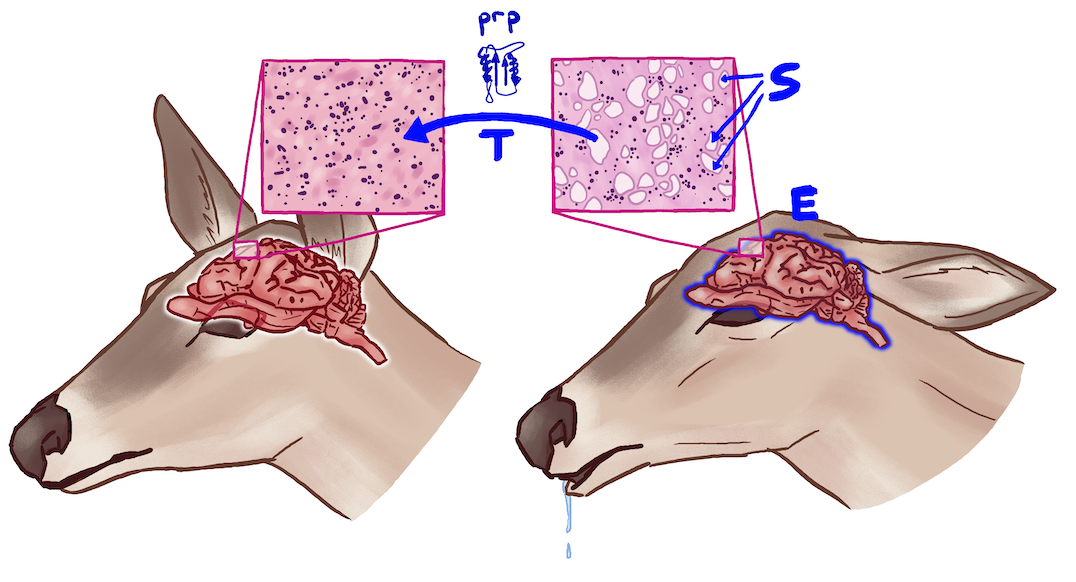
CWD is a prion disease that primarily affects cervids (deer family that includes moose and elk). While CWD was first observed in captivity in 1967, with the first wild case in 1981, the origins of CWD remain unknown. CWD, like all prion diseases, is known as a transmissible spongiform encephalopathy (TSE), which is a lot of syllables to say CWD is contagious (transmissible), causes sponge-like holes to form (spongiform), and primarily infects the brain (encephalopathy). Perhaps the most famous TSE, Bovine Spongiform Encephalopathy (BSE) – colloquially known as ‘Mad Cow Disease’ – is famous for causing human disease through infected beef in Britain in the 1990’s, resulting in over 200 recorded human deaths from the human form, Creutzfeldt-Jakob Disease (vCJD). vCJD was transmitted through the consumption of beef, and BSE was extremely prevalent in the British cattle industry. Only in recent years was a restriction to blood donations that prevented those who had lived in or traveled to Britain in the 1980-1996 time period from donating blood lifted, a ban which had stood for nearly 30 years.
CWD presents with rapid weight loss, uncoordinated movement, and lack of fear of people. Generally, deer with CWD will behave very strangely. You can look up videos on YouTube, it’s seriously weird. As of February of 2024, CWD has been identified in 36 US states. Some estimates put CWD prevalence at 1 in 10, but in some hotspots, it has been reported that as many as 1 in 4 wild deer are infected with CWD.

And ‘reported’ truly is the key word there: prion diseases are incredibly difficult to diagnose. Outside of brain biopsies or autopsies, there is no current singular method of diagnosis for prion diseases. Add into account that prion diseases are incredibly rare and have symptoms that mirror many other more common ailments, such as Alzheimer’s, and it’s easy to see why prion diseases are probably underreported. When you hear hoofbeats, think of horses, not zebras. While about 200 vCJD cases were diagnosed, it is impossible to know how many there truly were. It’s almost a certainty that some have been missed. The question is, how many?
Prions usually spread through consumption of contaminated meat. It’s currently unknown exactly how CWD is spreading- deer aren’t known for frequently munching on carcasses, after all – but the prevailing theory is through urine from infected animals, which would contaminate the soil and any grass that grows on it. When an uninfected deer eats the grass, they become infected.
What risk does CWD really pose to humans?
A human case of CWD has yet to be reported, but many researchers argue it is just a matter of time. A survey in 2011 found that 67% of Americans have eaten venison at some point, with 1.2% – or nearly 4 million people – having hunted deer or elk in a CWD affected area. That was 15 years ago – CWD has only spread since then, so these numbers have surely only increased.
This doesn’t mean that CWD is biologically capable of jumping to humans. So what threat does CWD realistically pose to us? Let’s put it another way: it’s been 40 years since CWD was initially identified in wild populations, and it has only become more widespread since. Even if it’s a million to one shot for human transmission, wouldn’t we have seen it already?
There are several possibilities. The simplest being that CWD in humans has never been found, so nobody looks for it. Diagnosing a case of human CWD today would almost be like hearing hoofbeats and skip over horses and zebras to declare that a unicorn was walking by. It would be an almost ludicrous declaration requiring an incredible amount of evidence. Prion diseases often have incredibly long incubation periods spanning multiple decades – perhaps no human CWD cases have presented. As mentioned earlier, prion diseases often present very similarly to dementia and Alzheimer’s and are extremely difficult to diagnose; a simple misdiagnosis could prevent any CWD cases from being discovered. Or perhaps it’s the simplest answer – CWD has not and cannot cross over into humans.
Some studies with monkeys show that they can acquire CWD after the consumption of infected meat or brain tissue. Which is worrying, since if other primates can become infected with CWD, why can’t we? But similar studies have instead shown no infection. Which results are more accurate? We’ve seen other prion diseases jump to humans before – looking at you, BSE – so we know that it’s theoretically possible. But again, only about 200 cases of vCJD were identified, when people are known to be consuming BSE-contaminated beef (likely for decades) before the first vCJD case was diagnosed. The fact that there were so few cases identified is, quite frankly, miraculous, and indicates that the infection rate is most likely incredibly small.
What do we do?
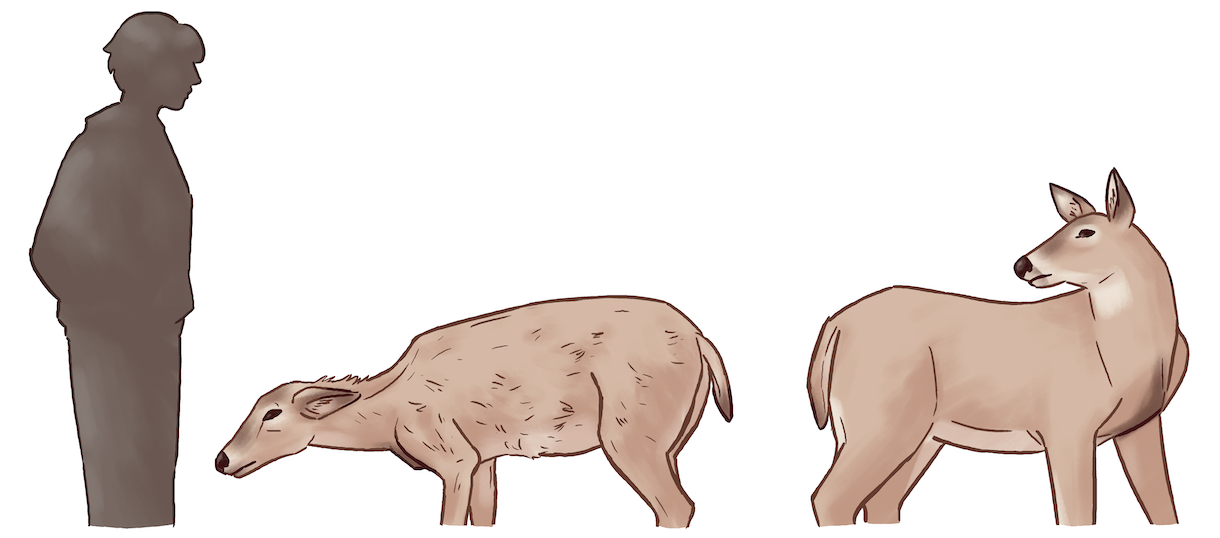
It’s important for hunters to be aware of CWD and avoid eating venison from deer that may be infected. Many states throughout the Midwest and Rocky Mountain regions offer testing services for any killed game, and you can report any sighting of deer or elk you think may be infected. Anyone hunting in areas where CWD has been reported should be aware of the symptoms and behavior of infected animals. In my opinion, hunters should send in samples of any deer they hunt, if only to help aid the surveillance efforts. Even if you are in a county or area where CWD has not been reported – deer populations are not restricted to county lines. It is impossible to assess the risk and make any efforts towards controlling the disease without help from hunters.
Hunting is a popular recreational activity, and in many areas, the start of the hunting season is basically a holiday. At the same time, deer are an incredibly common animal to the point of being a public nuisance, potentially containing a potential time bomb of a prion disease that continues to increase in case numbers. This is not a good combination, and there is ongoing research into how dangerous consuming infected meat really is. As CWD cases continue to rise, awareness among hunters is important to prevent any possible infection in humans. How do you prove that CWD poses no danger to humans? Does the lack of cases indicate that? It’s been said that you can’t prove a negative. In this case, that stands. For now, at least.

Emily Lecea is a recent graduate with a Masters degree in Microbiology and Immunology. She has a passion for infectious disease and science writing, and aspires for a career in science communication. She’s a huge fan of baseball and loves the Detroit Tigers.


