
Written by: Valkyrie Gibson
Edited by: Brenna Saladin, Camila Gonzalez, Kaitrin Freeland, Ryan Schildcrout
Illustrated By: Caroline Harms
My brother loved playing with Legos as a kid. He followed instructions to build the Millenium Falcon, Hogwarts castle, or the Statue of Liberty. But after completing a set, he’d take it apart and mix all the pieces up in bins, leaving them until he was ready to build something new; maybe the Millenium Falcon could be turned into a house, a tree, or a fantastical new city. He could build anything with a bit of interest and imagination. This natural curiosity I saw in my brother, and that many of us experience as kids, lives on in the minds of scientists.
Chemists investigate the world on a molecular level–they can manipulate atoms to build chemicals just as Legos are used as building blocks. Scientists often look to nature for inspiration as they build new things. Diamond, a naturally occurring material known for being incredibly strong, has a distinct structure where one carbon atom is bonded to four other carbon atoms. Chemists wanted to build strong structures made of metals and organic material as a mimic of the diamond structure. These materials came to be known as metal organic frameworks, or MOFs.
The 2025 Nobel Prize in Chemistry was awarded to Richard Robson, Susumu Kitagawa, and Omar Yaghi for discovering metal organic frameworks. Robson, the first to construct these materials before they were called MOFs, wanted to see if he could make a porous chemical structure with the rigidity of a diamond.
“I would say this is a good example of fundamental chemistry,” said Adam Matzger, Professor of Chemistry at the University of Michigan, during an interview. “So, this was discovered just [by] people trying to design structures, understanding how things could assemble, and it was then many years before people worried really about applications at all.”
The Nobel Prize recipients’ pioneering work has led to more extensive research. Today, MOFs have grown beyond initial curiosity and have many promising applications.
What are MOFs?
But what is a MOF and how does it work? MOFs are a crystalline cage made up of metal and organic material (carbon and hydrogen). The metals, typically transition metals like zinc, iron, or aluminum, are linked together by organic matter known as ligands. These metals and ligands are selected to make MOFs with specific properties for different applications. For example, iron might be used for MOFs with biomedical applications because it is less hazardous than other metals commonly used in MOFs. Just as a Lego brick must be chosen for structural integrity over a hook piece, metals and ligands must be selected based on the desired MOF properties.
MOFs have many interesting properties, including incredibly high porosity. Some of them have a surface area above 6000 m2/g, about the size of a soccer field, contained in just a gram of material. Matzger, who worked closely with Yaghi while he was developing MOFs at the University of Michigan, said to imagine this like a cube.
“You know the surface area of that cube is the six sides, the area, right? Now, cut that cube in half, and you’ve just introduced two new faces. So, you’ve increased the surface area, but you haven’t changed the mass. Now cut it again, 90 degrees to that, and 90 degrees to that. And now keep doing that down to the molecular level.”
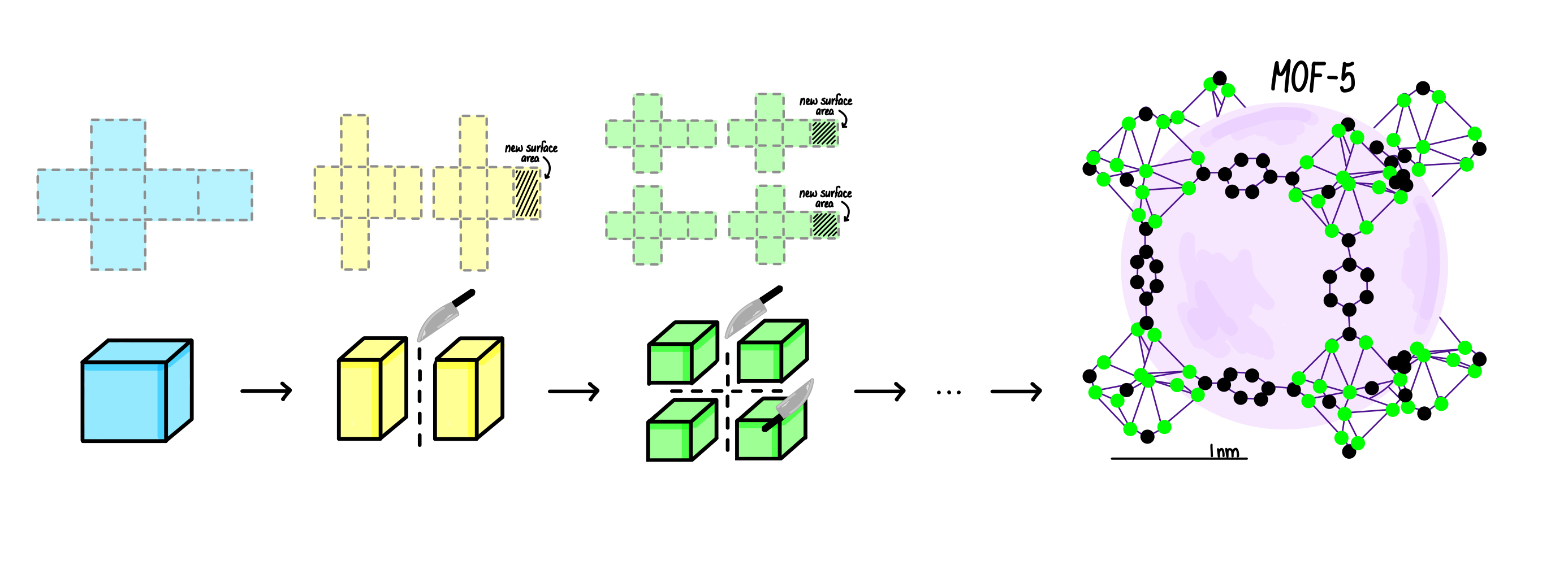
Since these MOFs are so porous, they’re capable of containing large amounts of gases or liquids. This type of material is known as a sorbent. There are many types of sorbents present in our lives. Silica packets found in beef jerky and the activated carbon in Brita filters are both sorbents that remove unwanted molecules. While these sorbents are incredibly useful, there’s a limit to how much they can absorb.
MOFs, however, can absorb significantly more than traditional sorbents. Scientists can customize MOF pore size, shape, and chemical properties for increased absorption. The reason researchers can do this with MOFs and not other sorbents, said Matzger, is because they form crystals in a repeating lattice that allow for visualization through X-ray diffractometry and understanding of the pore structure.
Think of it like this; say I build a cube out of Legos and I want to use it as a box for my Lego Minifigures. I’ve built the lid with hinges and the box is sturdy but when I open it, I see that there isn’t enough room inside for the figurines. By rotating the cube and looking inside, I notice it’s because the walls are too thick. To fix this, I remove Legos from the walls to make them thinner and create more room inside for the Minifigures. Similarly, scientists can use MOF structure visualization to customize their shapes and properties. Seeing the difference in pore size and the connection between metals and ligands can tell them what might need to change to optimize absorption and other properties.
Why do we care about MOFs?
MOF’s high surface area allows for applications in gas capture and storage, including carbon capture. Carbon dioxide is the most prevalent greenhouse gas and is off-gassed into the atmosphere from many sources. A variety of MOFs have been shown to adsorb CO2 with some showing selectivity so CO2 can be separated from other gases, which is especially important in industry where safe and harmful gases might be released into the atmosphere together. Once the CO2 is captured, it can be injected into the ground or deep into the ocean to mitigate its impact on the atmosphere.
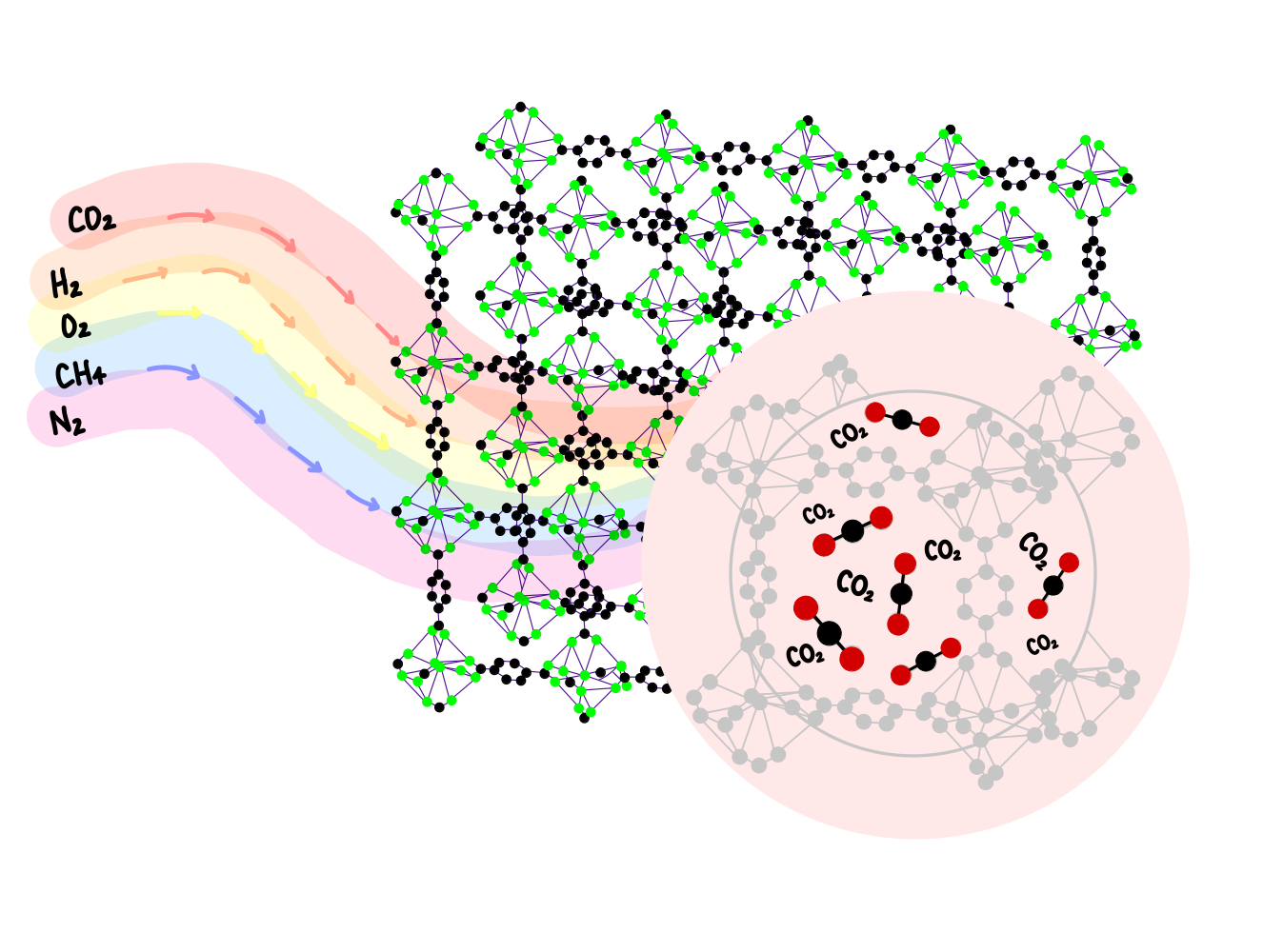
A few companies have started to mass produce MOFs for gas capture and storage. BASF, a global chemical producer, was the first company to produce MOFs on a multi-ton scale. Their first project involved collaboration with Svante Technologies Inc. to scale up MOF production for carbon capture. Now, BASF continues to mass produce MOFs and can customize them for customer needs.
While some companies are able to scale up MOF production for various uses, it’s not always in their best interest to do so. Materials to synthesize MOFs can be expensive and it’s difficult to maintain consistent results on a large scale.
“Getting new technologies in, unless they’re just obviously vastly superior, it’s always slow to get things adopted,” Matzger said. “I think the key is it starts with production; it starts with a few niche applications and then can expand from there.”
As the field of MOF study has expanded, more and more applications have been discovered and investigated. Hydrogen capture was one of the early applications discovered for MOFs. Hydrogen is a desirable gas for clean energy production. Currently, Toyota and BMW are working together on hydrogen drive technology which will be implemented in the BMW iX5 Hydrogen set to launch in 2028. This type of power requires a high-pressure fuel tank to store the hydrogen, and Matzger says MOFs could offer a lower pressure alternative. MOFs can adsorb a lot of hydrogen because of its high surface area, which could increase fuel cell capacity and make powering these vehicles more efficient. However, MOFs typically absorb more hydrogen at cryogenic temperatures, below -150 °C, which is a challenge for industrial implementation.
Outside of gas capture and storage, MOFs can be used for per- and polyfluoroalkyl substances, commonly known as PFAS or “forever chemicals” because of their long-lasting nature. These chemicals are found in everyday products like nonstick pans and waterproof jackets, and often remain in water streams for extensive periods of time. MOFs can be designed for PFAS adsorption and they’re easily regenerated, which allows for MOFs to be used repeatedly.
The Future of MOFs
Gas capture, gas storage, and PFAS separation are just the tip of the iceberg for MOF applications. Extensive research for the potential application of MOFs in sensors, catalysis for chemical synthesis, piezoelectric materials for turning mechanical energy into electrical energy, and in biomedical devices as possible drug carriers is ongoing.
While MOFs offer many exciting opportunities, there’s still a lot to discover and improve. The widespread application of MOFs in industry won’t be implemented until they’re clearly better than the current methods. It’s much more difficult to adopt new methods on a large scale because it requires disposing of previous technology and purchasing new equipment, says Matzger. Companies are reluctant to do this unless they completely trust the new technology and it’s cost effective. Most MOFs aren’t quite up to this level yet.
To get there, scientists are continuing their research and finding new ways to improve MOFs, including increasing hydrogen capacity at room temperature. It may take a while for these chemicals to get there, after all, I know my brother didn’t put together his own Lego creations on the first try. Sometimes it takes trying new Lego combinations, moving pieces around, or even taking it all apart and trying again. But scientists are persistent–with a little imagination and creativity they’ll continue constructing new MOFs that show promising applications for the future.

Valkyrie Gibson is a laboratory/classroom services technician for the chemistry teaching labs. She maintains, repairs, and stocks instruments and supplies for undergraduate student lab courses. Outside of work, Valkyrie enjoys reading, hiking, finding new music, and watching gymnastics! This is her first piece for MiSciWriters!


