
Written by Matthew Blacksmith
Edited by Emily Januck and Alex Ford
Illustrated by Danny Cruz
Imagine you are in a classroom, sitting at your desk, and it is the middle of winter. The teacher is giving a lesson and as you look around, you see red noses and tired eyes. As you listen, you hear sniffles and coughs. These sniffles and coughs represent a battle occurring on a scale too small to see. The cells of your body fight to keep you healthy, while viruses, bacteria, and other germs fight to use your cells to reproduce. Viruses exist on the spectrum between being alive and dead. Unlike living creatures, they are not able to reproduce on their own. Instead, they inject your cells with virus DNA and proteins. These viral components hijack the ordinary functions of your cells to turn them into a viral factory. Much like a double agent, these cells will copy virus genetic code, produce virus proteins, and assemble them together to generate new viral copies that are every bit as infectious as the original. From there, viruses can cause the cell to rupture, releasing the newly produced viral particles in a chain reaction to infect nearby cells.1

Off the top of your head, you can probably think of various diseases caused by viruses. The viruses that cause smallpox, chicken pox, and most recently, COVID-19 make humans sick as part of their viral “life” cycle. These and other viruses have been an enormous burden to society and human health across history. Smallpox alone was responsible for over 300 million deaths during the 20th century, and was considered such a public health emergency that the entire world banded together to eliminate smallpox entirely.2 Thanks to vaccine technologies developed to fight it, there have been no naturally occurring cases in nearly fifty years, making the smallpox virus the first and only human disease that has been eradicated from face of the planet.3,4
Human ingenuity may have utilized vaccines to eradicate smallpox, but there are many other diseases for which vaccines may not be effective that still require time, attention, and resources to combat effectively. One such example is the bacterium Mycobacterium tuberculosis, which is responsible for the disease tuberculosis.5 While it is frequently thought of as a disease of the past, over 10 million people contracted symptomatic tuberculosis in 2023. 6 Even more astoundingly, approximately one out of four people are infected with tuberculosis at some point in their life.6 While tuberculosis can be cured with antibiotics, the treatment is extensive and requires continuous medication for months or even years.7 Unfortunately, 450,000 people in 2021 were infected by strains of tuberculosis immune to the antibiotic rifampicin, a first-line anti-tuberculosis treatment.8 As more and more diseases grow resistant to antibiotics and other medicines, new treatment avenues must be explored.
Drug resistant tuberculosis is only one example of the growing wave of infectious diseases that are developing antimicrobial resistance. When they do, treatment becomes more difficult and the human cost of disease increases.9 Over a million deaths worldwide can be directly attributed to disease variants that are antimicrobially resistant. In addition to the loss of life, it is predicted that by 2050 between $330 billion and $1 trillion of additional healthcare costs will be incurred annually.10 The fighting of antimicrobial resistances is a priority worldwide, and many standard practices are being adopted, such as maintaining good hygiene, prescribing antimicrobials judiciously, and taking the full course of antibiotics.11 However, none of these factors matter when someone already has a disease caused by a pathogen with antimicrobial resistance. This conundrum has left scientists around the globe to ask: in this microscopic arms race, what new treatments can be developed to fight disease?
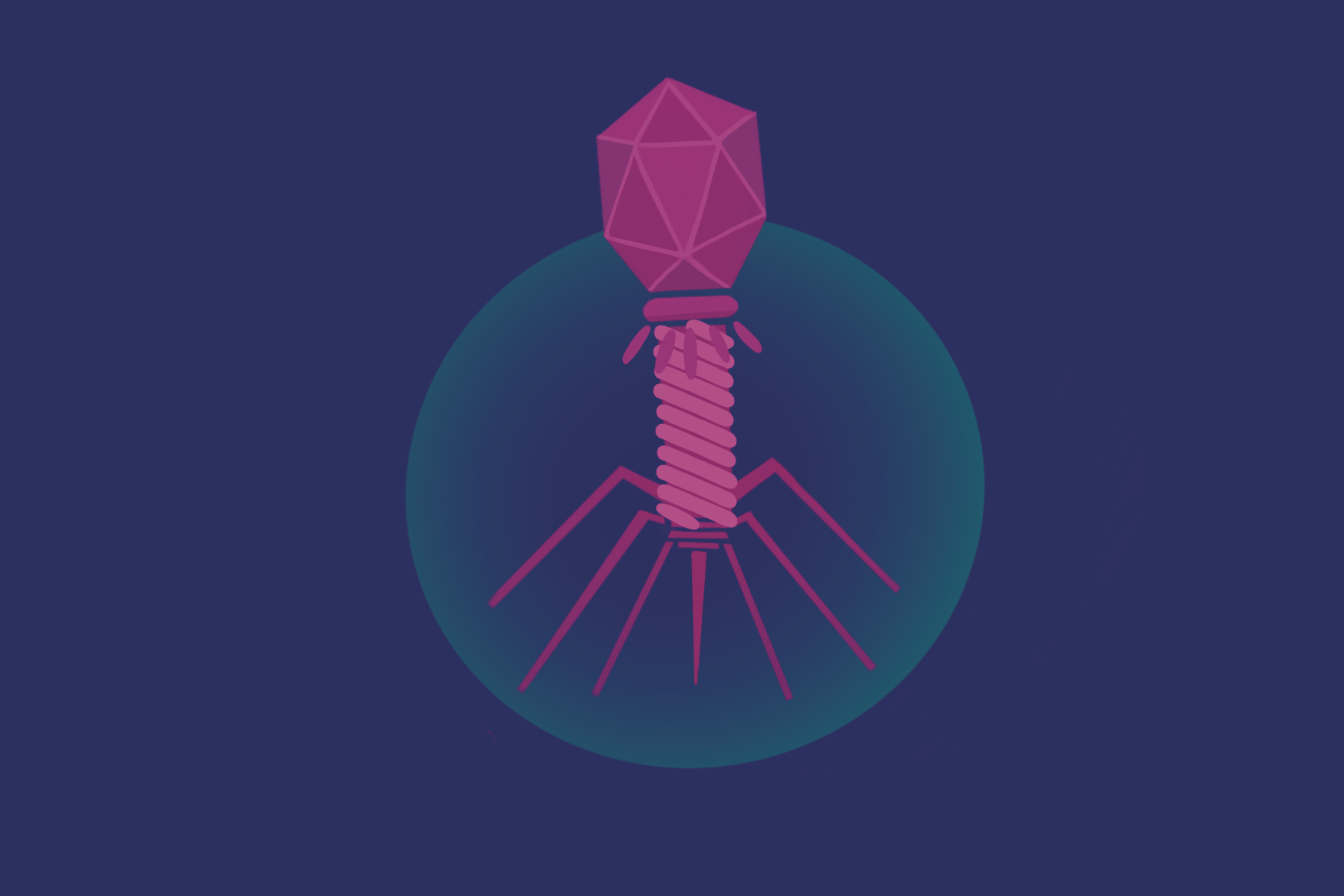
Enter: the bacteriophage. Unsurprisingly, not all viruses prefer human cells as targets. Some selectively infect animals, plants, fungi, and even bacteria. The scientific name for a virus that infects bacterial cells is a “bacteriophage.” Bacteriophages represent an important part of the microscopic world around us. Just as the varicella-zoster virus infects our cells to yield chicken pox, bacteriophages infect and kill bacteria such as tuberculosis. If it seems like a strange idea to weaponize viruses against disease causing bacteria, it may be worth remembering the saying: the enemy of my enemy is my friend.
Let’s put you in the shoes of a scientist looking for bacteriophages to treat tuberculosis. How would you start? One thing to remember is that most bacteriophages only infect a single species of bacterium, so not just any bacteriophage will do. A good first step is to take a Petri dish covered in a layer of bacteria food and cover it with purified Mycobacterium tuberculosis. This will create a bacterial “lawn”. You can then drop small amounts of bacteriophages onto the lawn until you find one or more that kill the bacteria on the plate. However, just because the bacteriophage works on cells in a dish doesn’t mean that they will work in the human body. In a 2024 study, two bacteriophages were found to kill Mycobacterium tuberculosis on bacterial lawns. When progressing to later experiments, one bacteriophage strain called DS6A showed continued promise in the testing of human immune cells. Even more interestingly, after exposure to Mycobacterium tuberculosis mice treated with bacteriophage DS6A showed more weight gain than those with no treatment, a sign that the treatment was at least partially successful.12 The DS6A bacteriophage makes an excellent candidate for further testing to improve human health.
While the FDA hasn’t yet fully approved any bacteriophage therapy, that isn’t to say that bacteriophages have never been used in humans. In 2015, Tom Patterson was enjoying a cruise while traveling with his wife, Dr. Steffanie Strathdee. While abroad, he became sick and ultimately developed a large abscess which was infected with a strain of antibiotic-resistant Acinetobacter baumannii. In a stroke of luck, his wife worked as an epidemiologist and used her expertise to acquire bacteriophages which might work against Tom’s condition. After receiving emergency special permission from the FDA, custom bacteriophage “cocktails” were prepared. Tom was on the verge of death when the bacteriophage cocktails were injected into his bloodstream and abscess. In a near miraculous turn of events, he awoke from his coma and has lived for years after being treated.13,14 Despite being only a single case, Tom’s amazing recovery serves as an example that bacteriophages can be used to treat infections, improve outcomes, and save lives.
Tom’s case is representative of a growing number of bacteriophage therapies that are personalized to the needs of a single patient. A review of one hundred patients who received personalized bacteriophage therapies found that over 75% of infections showed clinical improvement after bacteriophage treatment. Interestingly, bacteriophage treatments used in combination with antibiotics were more likely to be successful than bacteriophages alone, showing that bacteriophages can be used with existing treatments rather than solely as a replacement.15 However, before being ready for widespread use, bacteriophage therapies will have to pass through clinical trials. Clinical trials exist to prove that new treatments are safe and effective at treating a condition.16 Numerous trials are investigating if bacteriophages can treat ventilator associated pneumonia, diabetic foot osteomyelitis, urinary tract infections, acute tonsillitis, infections of prosthetics, and many other conditions. 17-18 In fact, over 40 clinical trials of bacteriophage treatments are currently underway in the United States and another 50 are ongoing around the world.19 Time will tell how many of these treatments will be successful enough for widespread use.
As with all medical treatment, bacteriophages have some limitations and potential side effects to consider as well. Bacteriophages do not infect human cells but our immune systems can still identify and attack them, potentially leading to inflammation.20 Furthermore, just as bacteria develop resistance to individual antibiotics, they can become resistant to one or more bacteriophages.15 And not all bacteria have known bacteriophages which can infect them.21 This means that at least for now, bacteriophage therapy has room to develop before it’s ready for the big leagues.
Keeping both the pros and the cons in mind, bacteriophages show great promise as an unlikely ally against bacterial diseases. In addition to being injected into the bloodstream, they may be used topically to treat skin infections and burn wounds, orally to treat gastrointestinal illnesses, or inhaled to treat respiratory diseases.22 In the arms race between humans and disease, bacteriophages represent a new weapon that may be available soon to continue the fight against bacterial infections. Medical treatments that haven’t been discovered or approved yet have the potential to keep kids healthy, combat antibiotic resistant diseases far into the future, pair with existing treatments to enhance their effectiveness, and ultimately save lives. What was a miraculous cure for Tom Patterson may one day be an everyday wonder in our medical arsenal against bacterial diseases.

Matthew Blacksmith is a PhD student in the Department of Human Genetics studying canine mobile elements in the labs of Drs. Jeffrey M. Kidd and John V. Moran. In his free time he enjoys board games, video games, and walking his dog at local parks.
References:
- Virus Definition. Scitable by Nature Education, Nature website
- Simonsen and Snowden. Smallpox. National Center for Biotechnology Information website (2023)
- About Smallpox. Center for Disease Control website (2024)
- Smallpox. World Health Organization website
- Delogu et al. The Biology of Mycobacterium Tuberculosis Infection. Mediterranean Journal of Hematology and Infectious Disease (2013)
- Tuberculosis. World Health Organization website (2025)
- Treating Tuberculosis. Center for Disease Control website (2025 )
- Global tuberculosis report. World Health Organization (2022)
- Antimicrobial resistance. World Health Organization website (2023)
- Drug-Resistant Infections: A Thread to Our Economic Future. World Bank (2017)
- Antibiotic Resistance. National Foundation for Infectious Diseases website (2024)
- Yang et al. Bacteriophage therapy for the treatment of Mycobacterium tuberculosis infections in humanized mice. Communications biology (2024)
- Lamotte. No antibiotics worked, so this woman turned to a natural enemy of bacteria to save her husband’s life. CNN website (2023)
- Schooley et al. Development and Use of Personalized Bacteriophage Based Therapeutic Cocktails To Treat a Patient with a Disseminated Resistant Acinetobacter baumannii Infection. Antimicrobial Agents and Chemotherapy (2017)
- Pirnay et al. Personalized bacteriophage therapy outcomes for 100 consecutive cases: a multicentre, multinational, retrospective observational study. Nature microbiology (20 24)
- Clinical Trial (Clinical Study). Cleveland Clinic website (2024)
- Sawa et al. Current status of bacteriophage therapy for severe bacterial infections. Journal of Intensive Care (2024)
- Hitchcock et al. Current Clinical Landscape and Global Potential of Bacteriophage Therapy. Viruses (2023)
- Balthazar. Phage therapy: Researchers sharpen another arrow in the quiver against antibiotic resistance. Statnews website ( 2024)
- Phage Therapy for Multidrug Resistant Bacterial Infections. Cleveland Clinic website (2019)
- Bacteriophages and their use in combating antimicrobial resistance. World Health Organization website (2025)
- Vila et al. Phage Delivery Strategies for Biocontrolling Human, Animal, and Plant Bacterial Infections: State of the Art. Pharmaceutics (2024)



































 misciwriters.com