
Written by: Antara Paul
Edited by: Courtney Myers
This piece was written in collaboration with the 2025 ComSciCon-MI Write-A-Thon.
The Big Bang created matter and antimatter in equal amounts at the beginning of the universe. Why then, after billions of years, do we see only matter around us? Physicists have been trying to find clues to this question for centuries.
The universe we live in is composed of atoms, which in turn contain tinier particles called protons, neutrons, and electrons. These particles were individually discovered by scientists during the early twentieth century. For the next few decades, it was believed that protons and neutrons were fundamental particles. However, in the 1960s, it was discovered that they were composed of groups of even smaller particles called quarks. At the time, only three types of quarks were discovered.
These particles make up the “matter” of the universe. But quantum mechanics point to the existence of antimatter as well – the anti-electrons, the anti-quarks that would form anti-protons, and so on. In fact, anti-particles are observed in particle physics experiments all the time! Anti-particles have properties opposite to that of particles. E.g., if an electron has electric charge -1, the anti-electron would have charge +1.
Particle interactions differ from real-world interactions. Heavier, unstable particles decay to lighter, more stable ones while respecting physical laws of certain particle properties (like charge conservation). Until the 1950s, most physicists believed that almost all particles that could exist were known and that the laws of physics were symmetric across all interactions. Yet, confusion brewed as two seemingly similar particles decayed to produce opposite values for a property called “parity” (P).
Parity is the inversion of space. It acts like a mirror, but inverts all three dimensions. So not only does it invert left to right or front to back, but also up to down! The laws of physics were thought to be symmetric under parity – particle interactions in the real and inverted worlds cannot be distinguished. But a famous experiment in 1956 disproved it. During the decay of radioactive Cobalt nuclei, which emit electrons, it was observed that the electrons preferred to decay in one direction over the other. The direction was set by the “spin” of the nuclei – spin in the quantum world can be imagined as the spin of a top – and electrons preferentially moved opposite to the spin direction. From the illustration, a right-handed spinning nucleus seems to emit electrons in the downward direction. Its mirror image is expected to have a left-handedly spinning nucleus emitting electrons upward, but in fact, that nucleus was also observed to emit electrons downward. The emission of electrons in one direction over the other meant the decays could be distinguished between the real space and mirror space, as shown in the illustration. This came as a surprise that parity did not follow the rules of symmetry in physics!
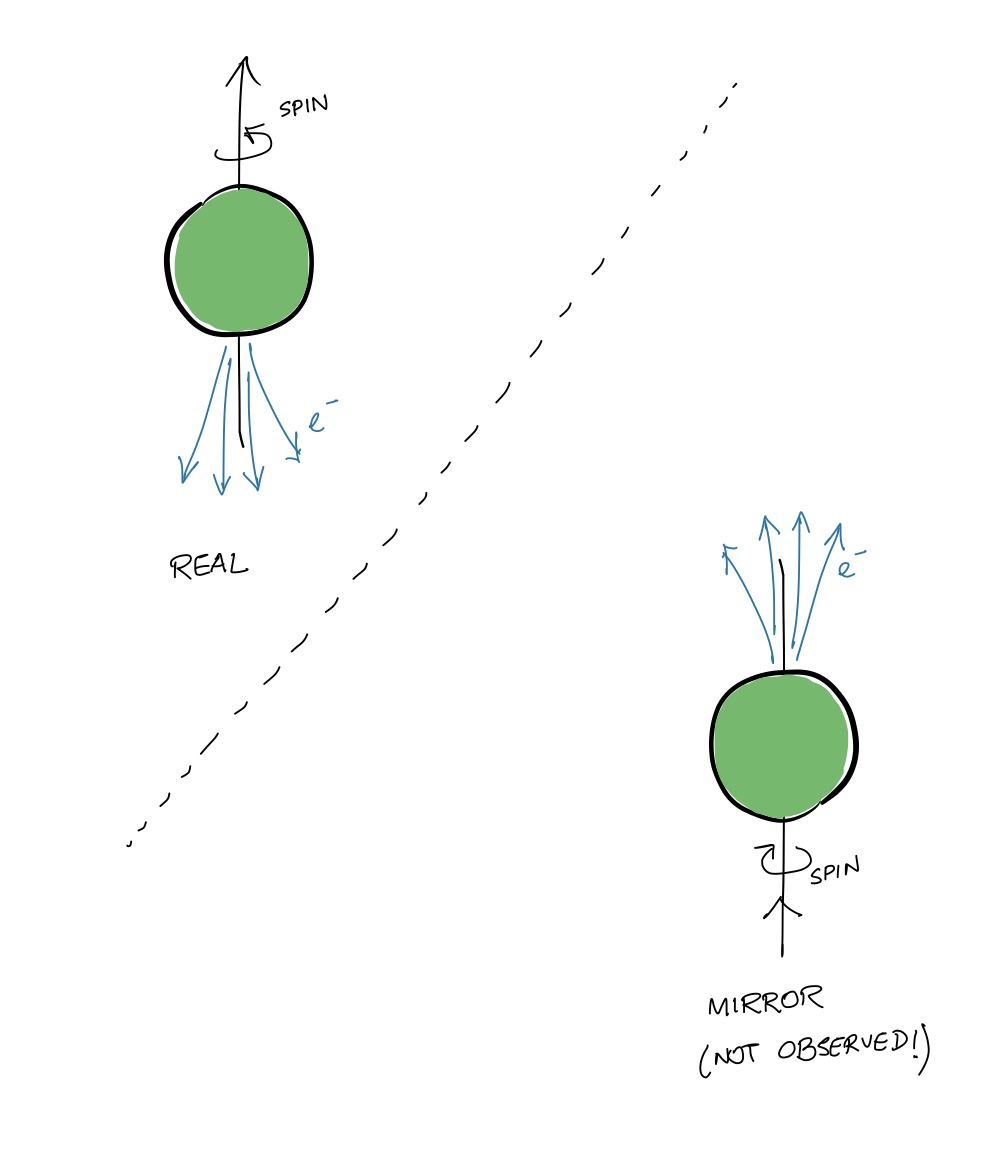
After the theory of parity conservation was disproved, scientists came up with additional theories. They thought that as long as the combination of charge and parity (commonly known as CP) remained symmetric, laws of physics, as they were currently understood, could still be upheld. A combination of charge and parity meant a left-handed electron was equivalent to a right-handed anti-electron.
To their utter shock, an experiment a few years later, in 1964, indirectly revealed that the CP conservation is also violated. This excited the physics community, for there were some interactions that distinguished between particles and anti-particles. The symmetry between the two was broken! Theorists came up with possible explanations of CP violation and concluded that six quarks should exist in what we now call the “Standard Model of particle physics”. In this model, the interplay between quarks leads to some sort of asymmetry. At the time of this prediction, only three types of quarks were known. But as experiments became more sophisticated, this led to the discovery of the remaining three quarks.
Physicists have been trying to observe CP violation in numerous particles containing combinations of the quarks, but this feat is like finding a needle in a haystack. In fact, it took about 30 years to observe this phenomenon for the first time in the later-discovered quark systems! To achieve such results, millions of particles, like protons, collide at high energies. A tunnel underground is usually built to accelerate these particles close to the speed of light. They are made to collide in front of huge detectors such that their decays can be captured and analysed later. These collisions lead to the creation of several other particles, and analysing how they are created can help identify physics events that might be CP-asymmetric. Multiple research laboratories across the world collaborate to make these experiments possible. Huge experimental collaborations across the world work together to make it possible.
While the exact mechanism remains unknown, each observation of CP violation in additional particle systems is a step closer to further refining the current knowledge of matter-antimatter asymmetry. Physicists continue smashing particles in hopes of uncovering this fundamental asymmetry in nature.


