
Written by: Camila Gonzalez Curbelo
Edited by: Emily Januck, Colter Giem
Illustrated by: Colter Giem
Memorizing the periodic table of elements is undeniably one of the (slightly dreadful) science class rites of passage. Although most of us weren’t expected to memorize the entire table, we had to learn enough of it to recognize what a few of the symbols meant. Growing up during the golden era of YouTube, I came to associate learning the elements with the iconic “The New Periodic Table Song” by AsapSCIENCE. The song consists of a rapid-fire list of the chemical elements in order, sung in an absurdly catchy melody. It is chaotic, distinctively nerdy, and unforgettable even a decade later.
Although I did enjoy singing along to the periodic table song as a student, I do remember wondering why we even had to memorize it when the chart was always with us in every science classroom. It’s similar to how we also had to learn the multiplication tables despite always having access to calculators. I now see that memorizing the table was not without a purpose… It was about becoming familiar with the patterns and relationships between all the elements. The more I have studied chemistry, the more I have grown to appreciate the periodic table as a collection of centuries of curiosity. It is a story built by many giants in chemistry, each contributing piece by piece to the chart I sang along to as a kid. Some of those scientists even walked the same university halls as many of us today.
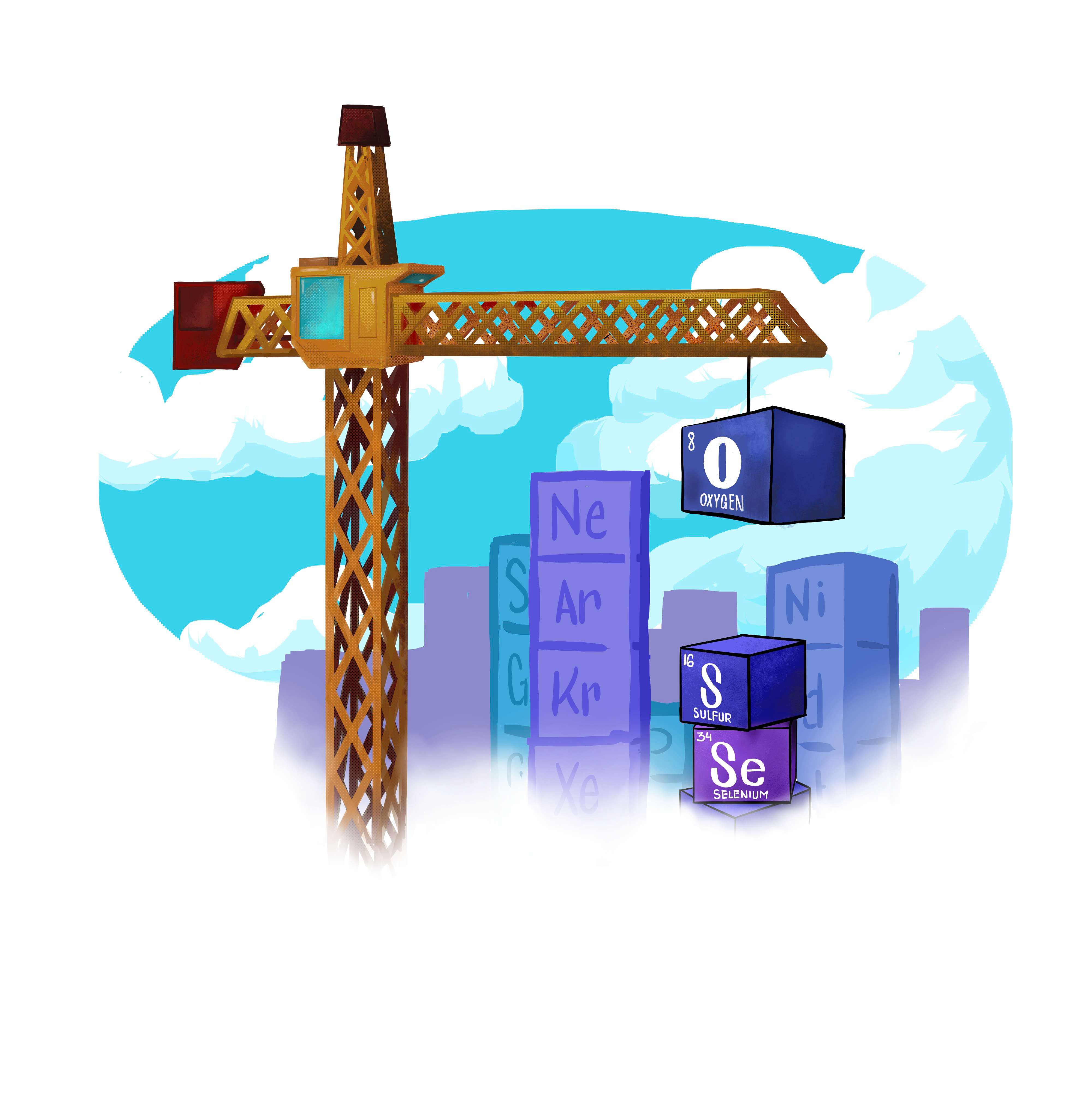
The earliest giants behind the construction of the periodic table can be traced back to ancient Greece, around 300 BC, where philosophers tried to make sense of the world by pure observation. They proposed that all matter in our universe was made of four elements: air, water, fire, and earth. I admit this classification does remind me of Avatar: The Last Airbender, but the simplicity was an admirable attempt to describe and categorize what makes up the world around us.
Fast forwarding to as early as the 8th century AD, early alchemists were discovering the first chemical elements as we know them today. Alchemists believed metals such as copper, lead, and iron could be turned into gold, which could be ingested as an elixir for immortality. While their goals were arguably not achievable, their labor still laid important groundwork. They developed early experimental practices to study how these metals would behave and transform, which shaped chemistry into a more methodological science.
As more elements were discovered, alchemists became interested in organizing them in relationship to one another to create a useful tool for future scientists to use. Many elements could all appear similar at first glance as shiny metallic substances, yet behave very differently when exposed to air, heat, or water. For example, we now know that iron rusts readily through reactions with oxygen and moisture, while silver slowly tarnishes by reacting with sulfur-containing compounds in air. However, during the medieval period, alchemists did not yet understand the detailed chemistry behind these reactions. What they could observe was that iron corroded far more quickly than silver. Observations like these were enough to show that although both of these substances could be broadly classified as metals, grouping elements based on appearance alone was not sufficient.
A few centuries later, a broader question emerged: what actually counts as an element? A more defined unifying system was needed, and one was created in the late 1700s by Antoine Lavoisier, often known as the father of modern chemistry. He introduced a clearer definition in his book, Elements of Chemistry, published in 1789. There, he described an element as a basic substance that cannot be broken down into anything simpler by any chemical means. Interestingly, the same book also helped popularize another pivotal scientific concept: the law of conservation of mass, which is the idea that matter cannot be created or destroyed during a chemical reaction. No matter how hard you try, you cannot take an element apart into something more fundamental. This concept may seem obvious to us now, but it brought much-needed structure to a field that was not yet well defined.
Throughout the 1800s, scientists continued to organize elements according to their chemical properties. Some of the more widely recognized scientists in piecing the puzzle together include John Dalton, who arranged elements based on their atomic weight*, and Johann Wolfgang Döbereiner, who instead focused on the shared chemical behaviors between elements. Döbereiner noticed that some elements with comparable properties could be arranged into groups of three, which he called “triads.” A notable example included lithium, sodium, and potassium, all of which react strongly with water. Döbereiner’s triads were one of the earliest signs that elements could be organized into families.
By 1869, chemists had identified 63 elements, which make up nearly half of the elements we see on the periodic table today. Around this time, a Russian chemist named Dmitri Mendeleev began arranging elements according to recurring physical and chemical properties, leading to what would become the first version of the modern periodic table.** Earlier scientists had already recognized similarities in how certain elements behaved chemically, but Mendeleev connected these repeating behaviors to trends in atomic weight. The recurring, or “periodic,” trends helped predict when certain expected behaviors were missing from the sequence.
Mendeleev was a true visionary. Rather than forcing his rendition of the table to appear complete, he intentionally left gaps where he believed undiscovered elements belonged. Gallium, scandium, and germanium were all found after Mendeleev published his table, and their properties closely matched his predictions. Big win for him. He even lived long enough to see some of those discoveries confirmed.
Unfortunately, other discoveries took much longer. One of the other gaps that Mendeelev anticipated lay between thorium and uranium. Filling that space turned out to be far more complicated, given some elements only exist for a very short time before transforming into something else. In 1913, Polish-Jewish chemist Kasimir Fajans identified a short-lived isotope*** of protactinium, the element which would eventually fill that gap. Because this element existed only briefly, he named it brevium, from the Latin word for “brief.” This particular form of protactinium decayed in just over a minute, making it extremely difficult to study.
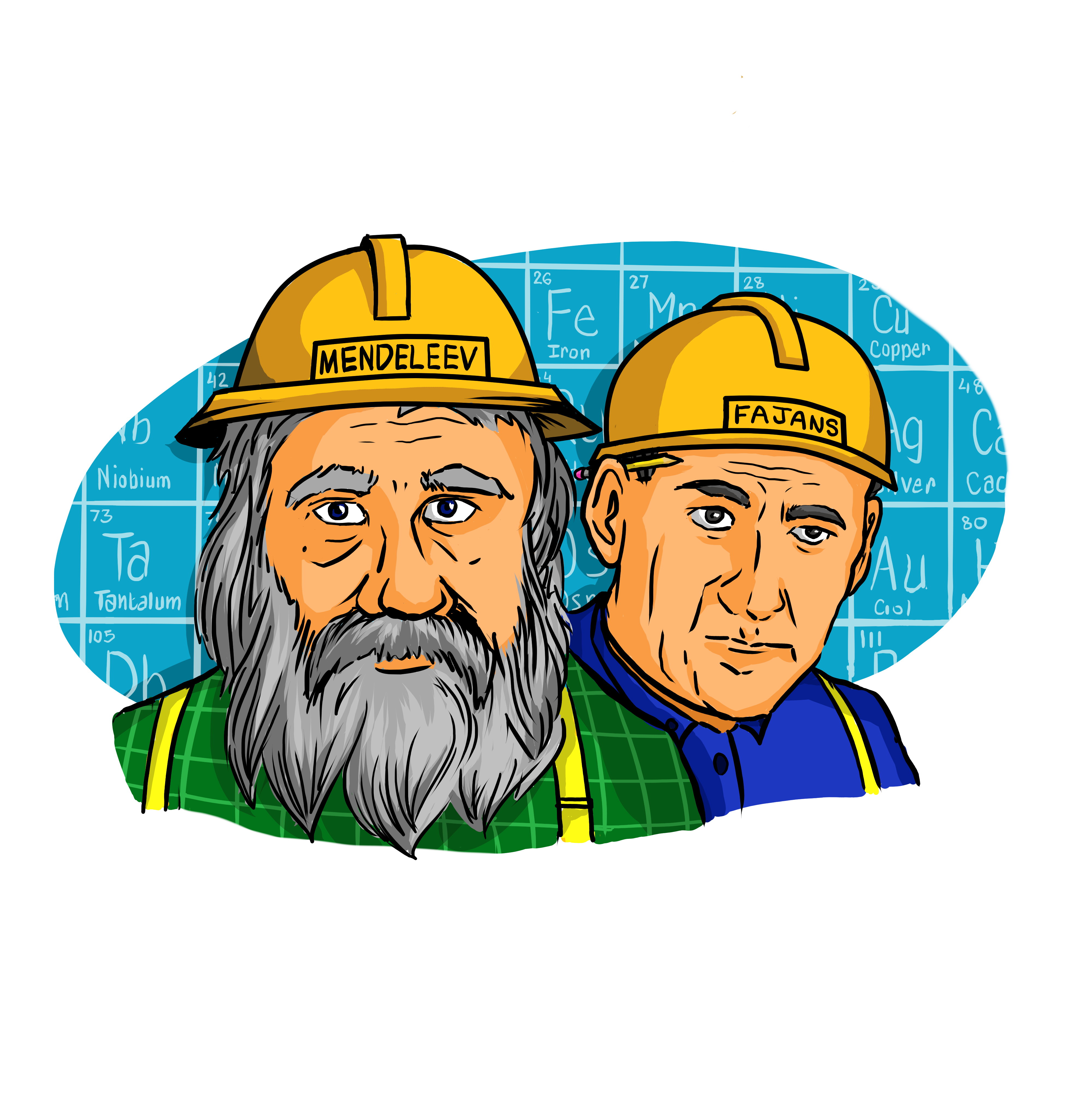
What makes Fajans’ story especially inspiring is that he helped discover protactinium only a few years after earning his doctorate degree. Two decades later, by the early 1930s, Fajans had become the director of the Institute of Physical Chemistry in Munich, building an internationally recognized scientific career. In 1936, however, he left Germany as the political landscape under the Nazi regime became increasingly dangerous for Jewish academics like himself. Around this time, University of Michigan dean Edward Kraus invited Fajans via a telegram to continue his work in Michigan. Fajans accepted the invitation to relocate to Ann Arbor (Go Blue!), becoming a professor at U-M and spending more than twenty years contributing to the field of chemistry before retiring in 1957. Despite the instability surrounding his early career, Fajans triumphed, and his work became part of how we understand the periodic table today.
At first glance, the periodic table can seem like a perfectly ordered progression, where elements have increasing mass when moving left to right, from one box to the next. In reality though, the modern periodic table is organized by atomic number****, rather than atomic mass. Interestingly, atomic number does not always correlate perfectly with atomic weight. Because of this, there are a few unusual cases where an element can appear after another element despite being slightly lighter. Protactinium [element 91] is one of those interesting exceptions. This rare, radioactive element appears after thorium [element 90] in the periodic table despite actually having a slightly lower atomic mass. Similar examples are potassium [element 19] and argon [element 18] – potassium is slightly lighter but comes later in the table. This is just one example of how the periodic table is not as straightforward as it appears. As a graduate student, I have come to understand chemistry less as a set of strict rules and more as a series of exceptions to patterns.
So is our current periodic table truly complete? Or are there still gaps waiting to be filled? The answer will likely not come from a single breakthrough, but from many small contributions. The most recently discovered element, tennessine, was officially recognized in 2016. In the grand scheme of scientific discovery, that was not very long ago.
The history of science has an amusing way of reminding us that what feels complete now might not stay that way. I have no doubt that someone, somewhere, is already working on filling the next gap in our table. Stay tuned, because the periodic table we learn for class today may not yet be its very final version. Future generations of students may have a few more periodic table song verses left to memorize.
Footnotes:
*How heavy the atoms of an element weigh as compared to those of other elements.
**According to later accounts, Mendeleev’s arrangement of the periodic table came to him in a dream after falling asleep at his desk. Upon waking, he immediately wrote it down, requiring only one later correction.11
***An isotope, in this case, refers to a version of an element with the same number of protons but a different number of neutrons, often affecting its stability.
**** The number of protons in the nucleus.
About the Author:

Camila Gonzalez Curbelo is a Chemistry Ph.D. student at U-M, where she studies how microfluidic tools can be applied to detect heavy metals in water. She is passionate about science communication and believes scientists have a responsibility to make knowledge accessible to everyone. In her spare time, Camila enjoys playing tennis and planning her next travel adventure with friends and family.


