Hira is a neuroscience graduate student researching how memories get stabilized during sleep. She is passionate about communicating science to the broader public and making STEM pathways more accessible to all.
Anjesh is a neuroscience graduate student researching whether the memory processes the brain uses to learn and store memories also play a role in forming strong social bonds. He loves his work, his friends and family, skiing, and he is perpetually struggling to keep his plants alive.
The first neuroscientists were artists. Using clever chemistry, they developed ways to stain brain tissue and then drew what they saw. Here, I have carved a block print based on one of the first published drawings of microglia, the immune cells of the brain. In a series of four 1919 papers, Pío del Río-Hortega described these cells and clearly showed that they were a different cell type from the other glial cells in the brain, astrocytes and oligodendrocytes. His conclusions about microglia, based almost solely on observations about how they look under different conditions, were startlingly accurate. For example, he noticed that microglia rapidly migrate to a site of injury and transform in shape, even becoming, in his words, “monstrous.” He accurately hypothesized that they clean up debris through a process called phagocytosis. He also speculated that microglia have a different developmental origin than other brain cell types, a conclusion that wouldn’t be verified for over 100 years and which required the development of sophisticated genetic fate mapping techniques.
Benches shook. Monitors clattered off uneven tables. Reagents jangled and tumbled, spilling down the giant’s mile long limb. The scientists, so enthralled in their thoughts and experiments, had forgotten how high up they really were! They buzzed around the ivory towers encrusted like pale honeycomb along the giant’s monstrous shoulders.
Where is Uncle Sam going now… one scientist wondered, looking over the foggy mountain range. Villagers stirred like ants as the giant lumbered closer. Some admonished the giant, some welcomed the intrusion. Others went along with their day.
Ancient hands pulled strings taut on bows beneath the young sun. Calloused hands spread tar across rooftops under summer heat. Tanned hands scrubbed grime from grout beneath crystal chandeliers. Now, gloved hands pipette beneath fluorescent laboratory lights.
Humanity has come a long way since Lucy, one of our earliest known human ancestors. Lucy, like many of our ancestors, had to put survival and instinct first; there was room for nothing else. Every hour was spent hunting, gathering, building, and enduring. Survival was not a choice. Before humanity could advance, our ancestors first had to withstand the brutality of the world around them.
Memorizing the periodic table of elements is undeniably one of the (slightly dreadful) science class rites of passage. Although most of us weren’t expected to memorize the entire table, we had to learn enough of it to recognize what a few of the symbols meant. Growing up during the golden era of YouTube, I came to associate learning the elements with the iconic “The New Periodic Table Song” by AsapSCIENCE. The song consists of a rapid-fire list of the chemical elements in order, sung in an absurdly catchy melody. It is chaotic, distinctively nerdy, and unforgettable even a decade later.
The first question I ever thought to ask of the Universe was not how it came into being, not when it decided to be, nor even why it wanted to become. No, my questions were concerned with my own how, when, and why: ‘How did it come to be that I existed only in the liminal spaces?’ ‘Why was I relegated to them?’ and ‘When, if ever, could I escape into permanence and stability?’ In other words, my original motivations for studying the Universe were selfish. It seemed to me the source from which I could draw meaningful truths about my existence uncorrupted by mankind’s falsehoods it tried to project onto me.
Written by: Alexander Ford, Jessica Li, and Julia Kravchenko
To those outside of science – our progress appears in bursts. Nothing nothing nothing, and suddenly you can take penicillin for your pneumonia. Nothing, nothing, nothing, and now the first internal combustion engine lets you travel farther and faster. Nothing, nothing, nothing, and then they’ve suddenly split the atom.
Yet “nothing” is never truly nothing. Each of these discoveries is an amalgam of countless smaller discoveries, countless stories, countless journeys, and countless scientists tenaciously repeating the cycle of the scientific method. Science is the means by which we humans expand our knowledge of cause and effect in the physical world. It is the process by which we create wonders and terrors, save lives and destroy them. It is – fundamentally – a framework that we never stop building upon, the path our species has travelled along to get us to today, and the path that spirals out ever outwards into the future.
The title of this 5th anniversary edition is drawn from the famous quote by Isaac Newton in a 1675 letter, “If I have seen further it is by standing on the shoulders of Giants”, a metaphor for the great discoveries he himself had come to, from calculus to gravity, and how even these accomplishments are derived from a lineage of work stretching back thousands of years to the ancient mathematicians. It emphasizes humility, and acknowledgement of that long lineage of scientific advancement under the surface of every discovery.
It’s fitting that this quote itself stands upon literary shouldersgoes back even further – originating in the 12th century with the French philosopher Bernard of Chartres who wrote:
“We are like dwarfs perched on the shoulders of giants, so that we can see more than they, and things at a greater distance—not by virtue of any sharpness of sight on our part, or any physical height, but because we are carried high and raised up by their giant stature.”
Within this edition, we cover some scientific discoveries that have helped us see farther than ever before. and take time to explore our connections to our scientific giants, and how much we build on their legacies when we create our own. John Donne perhaps said it best, “No man is an island, Entire of itself; Every man is a piece of the continent, A part of the main” – and the institution of scientific discovery is no different in the reciprocal connections to the lives of nearly every human being and every discovery.
As we look ahead to the future, we must also look down – and remember that we all – in our own ways – stand on giants of our own.
Alex Ford is a student and neuroscientist who researches how the brain processes sensory information in the visual system. He has a tendency to seek out the absurd, and frequently attempts to create art. In his free time, he is with friends, family, or a good book under a tree.
Jess Li is a Ph.D. student in the Department of Microbiology & Immunology. Though their research interests have evolved toward an environmental microbiology focus, they remain fascinated by the gut microbiome and the many ways microbes affect human health. They aim to make science more engaging through fun illustrations.
Julia Kravchenko is a neuroscience graduate student studying the relationship between sleep and Alzheimer’s disease. She is passionate about making academia accessible to the general public. Outside the lab she can be found reading fantasy novels amidst her growing collection of gnomes.
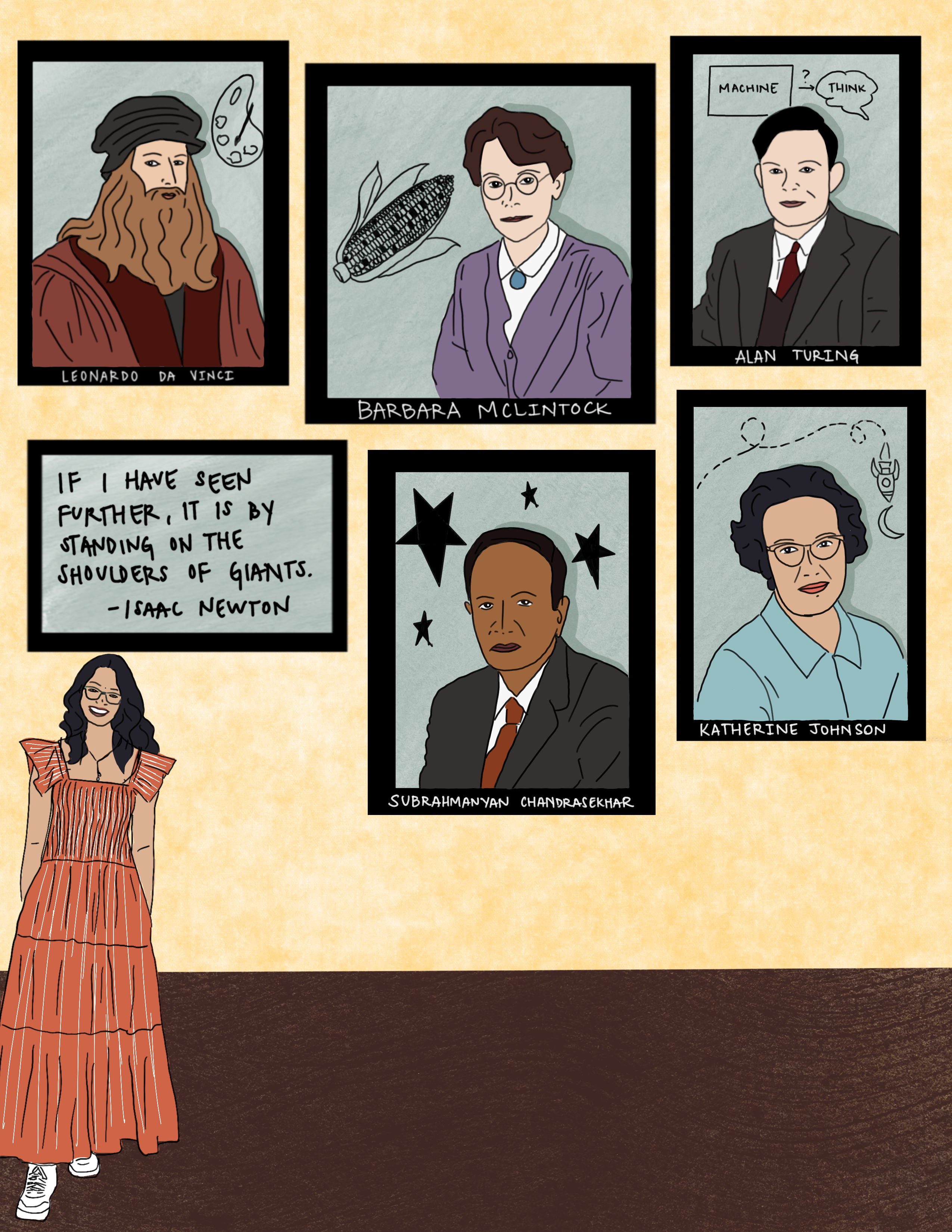
This piece is of a family at an art museum looking up at an exhibit titled “on the shoulders of giants” featuring portraits of influential people within the field of STEM. To me, this is a visualization of how the people today look upon giants of the past resulting in a never-ending cycle of inspiration and influence for future generations who are still unaware of the impact they will have. Together, this shows the cycle of influence that the giants of the past have on us in the present, as well as those of our future.
Charukesi Sivakumar is a 5th year PhD Student in the Molecular and Cellular Pathology Program. She is in the Rajesh Rao Lab, studying the mechanisms of early eye development. She hopes to pursue a career where she can find new and creative ways to bridge the gap between patients and scientists. Outside of the lab, you can find her playing the violin with the U of M Life Sciences Orchestra, reading, singing, cooking, listening to music and podcasts, doing art, or spending time outdoors.
Five hundred years before the Renaissance, a Muslim polymath shattered the paradigm of optics while practicing elements of what we now call the scientific method. In 1021, Ibn al-Haytham, Latinized as Alhazen, completed his magnum opus, the Book of Optics, a seven-volume treatise with a revolutionary claim: vision occurs because light falls into the eye, not out of it.