
Written by: Hy Do
Edited by: Lauren Heinzinger, Naomi Raicu
Illustrated by: Naomi Raicu
Five hundred years before the Renaissance, a Muslim polymath shattered the paradigm of optics while practicing elements of what we now call the scientific method. In 1021, Ibn al-Haytham, Latinized as Alhazen, completed his magnum opus, the Book of Optics, a seven-volume treatise with a revolutionary claim: vision occurs because light falls into the eye, not out of it.
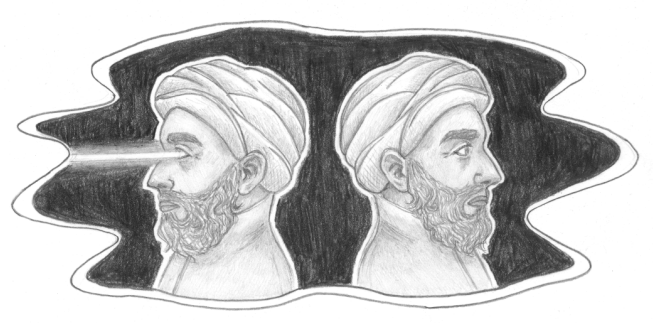
Throughout human history, the eye has been the subject of imagination and inquiry, as well as an enduring symbol in diverse cultures. To the ancient Egyptians, the Eye of Horus symbolizes protection. Amulets against the evil eye have been found in many cultures dating thousands of years ago. Interests in the eye naturally led to vision: how humans perceive the physical world. In the West, multiple theories of vision abounded. The emission theory, advanced by ancient Greek philosophers such as Empedocles, Plato, and Galen, stated that the eye emits beams of light to produce sight. While this may seem counterintuitive in hindsight, the emission theory might actually be a commonly-held belief. As recently as 1996, a study found that when participants were asked to draw whether something comes in or out of the eyes when a person sees a balloon, 69% of adult participants drew arrows pointing out from the eyes.
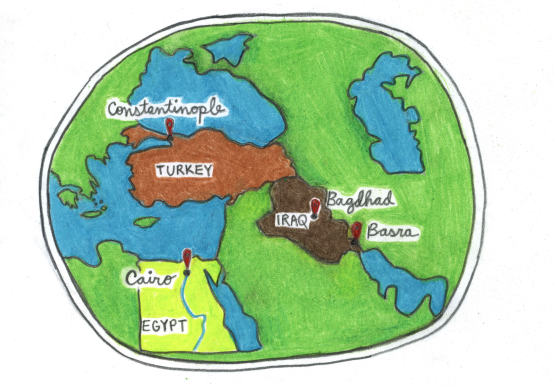
Ibn al-Haytham was versed in this intellectual tradition. Hailing from Basra, in present-day Iraq, he conducted his work during the Islamic Golden Age, a period of intellectual and cultural flourishing across the Islamic world. During this era, many scientific and philosophical works of classical antiquity, including those by Plato, Euclid, and Ptolemy, were translated from Greek into Arabic and Syriac in major centers of learning such as the House of Wisdom in Baghdad and Cairo. Ibn al-Haytham moved to Cairo and lived near Al-Azhar, one of the oldest and most prestigious institutions of Islamic education. It is easy to imagine Ibn al-Haytham consulting Euclid’s or Ptolemy’s Optics as he investigated the mechanisms of vision. Ibn al-Haytham was an extremely productive scholar, authoring more than 200 works, at least fourteen on optics. He was hardly alone in his brilliance; his contemporaries included Ibn Sina, the author of The Canon of Medicine, which remained a standard textbook in European universities until the early modern period, and al-Biruni, who penned encyclopedias on Indian culture.
The Book of Optics presented empirical evidence in support of the intromission theory of vision, which states that vision is produced when light enters the eye. Ibn al-Haytham argued that if rays come out of the eyes as the emission theory claimed, then the eyes should not be damaged by those rays. Yet no one can stare directly at the sun for more than a few seconds without sustaining extensive eye damage. He concluded that objects themselves emit or reflect light in all directions and that only the light beams entering the eyes produce vision.
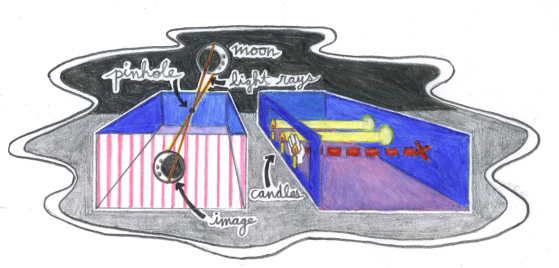
A corollary of the intromission theory, Ibn al-Haytham argued, is that light travels in straight lines. Since humans see objects with defined shape, he proposed that each point on an object corresponds to a single point in the eye. In an experiment, he set up candles in front of a wall with a window that opens to a dark room. When he blocked one candle, only the light opposite that candle along a straight line through the window was extinguished. This phenomenon is called a camera obscura, which is produced when light passes through a small hole of a dark chamber. The hole restricts the paths that light can take. For example, moonlight from the top of the Moon passing through a pinhole will appear at the bottom of the image. However, Ibn al-Haytham was not the first person to describe a camera obscura; in the Mozi, a text from the 5th-3rd century BCE, the Chinese philosopher Mozi had described an image being inverted by a pinhole.
The shifting tides of science brought Ibn al-Haytham’s works to a wider audience in Europe. The Book of Optics was first translated into Latin in the late 12th to early 13th century. By this time, scientific activity in parts of the Islamic world had begun to decline due to a combination of factors, including the Mongol invasion of the Abbasid Caliphate, destruction of centers of learning like the House of Wisdom, conservative backlash against rationalist thinking, and political fragmentation and instability leading to loss of patronage for science and the arts. In 1453, the Ottoman Empire captured Constantinople, resulting in an exodus of scholars carrying Arabic, Greek, and Latin works to Western Europe.
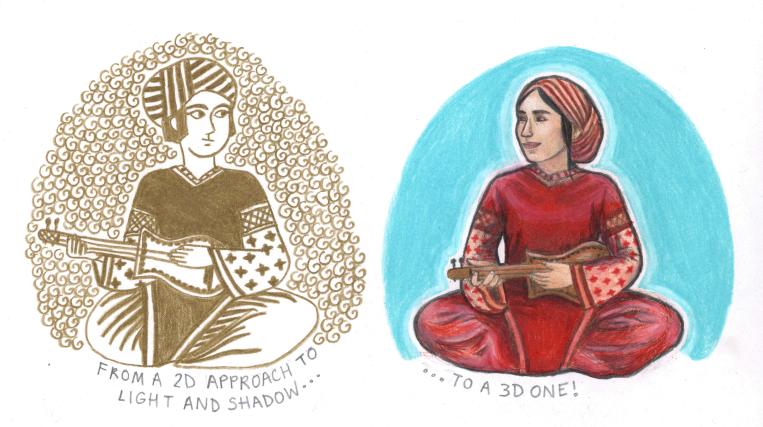
The Book of Optics influenced diverse fields such as art, astronomy, and philosophy. Many luminaries of the Renaissance and Scientific Revolution had access to the Book of Optics, including Leonardo da Vinci, Galileo Galilei, René Descartes, and Johannes Kepler. Leonardo originally subscribed to the emission theory of vision, writing in his notebook that “the eye transmits through the atmosphere its own image to all the objects that are in front of it and receives them into itself.” By 1492, however, Leonardo began to accept the intromission theory of vision as argued by Ibn al-Haytham and other scholars. Leonardo’s thinking can be seen in his paintings, which demonstrate complex representations of light and shadow. The Last Supper, one of Leonardo’s most famous works, showcases his understanding of vision: Jesus’s right cheek is placed on the vanishing point of the painting, directing the viewer’s attention toward him. Kepler built his studies based on some of Ibn al-Haytham’s ideas such as the one-to-one correspondence between points on the object and points in the eye. Kepler demonstrated that the eye functioned as a camera obscura itself because every image must be inverted on the retina, much like the candles in Ibn al-Haytham’s experiment.
Ibn al-Haytham died in 1040, but his legacy continues into the 3rd millennium. His work on refraction and lenses contributed to the development of the telescope and microscope. In 1935, an impact crater on the Moon was named Alhazen. In 2015, the UN International Year of Light celebrated Ibn al-Haytham’s works to optics. In 2021, researchers published novel solutions to Alhazen’s problem, which Ibn al-Haytham formulated concerning reflection in a spherical mirror based on Ptolemy’s works.
Arguably, the focal point of his legacy is not any particular work or his empirical approach to science, but the insight that scientists are not infallible and that doubt is the only measure of truth. In Doubts concerning Ptolemy, where he critiqued Ptolemy’s astronomy, Ibn al-Haytham admonishes those who toil for discovery thus:
Therefore, the seeker after the truth is not one who studies the writings of the ancients and, following his natural disposition, puts his trust in them, but rather the one who suspects his faith in them and questions what he gathers from them, the one who submits to argument and demonstration, and not to the sayings of a human being whose nature is fraught with all kinds of imperfection and deficiency. Thus the duty of the man who investigates the writings of scientists, if learning the truth is his goal, is to make himself an enemy of all that he reads, and, applying his mind to the core and margins of its content, attack it from every side. He should also suspect himself as he performs his critical examination of it, so that he may avoid falling into either prejudice or leniency.
About the Author:

My name is Hy Do and I am a rising 3rd year graduate student in Dr. Lois Weisman’s lab. My thesis project focuses on the regulation on myosin V motor transport using Saccharomyces cerevisiae as a model organism. I come from Vietnam. In my free time, I enjoy reading, jogging, and other outdoor activities.


