Blog

Center for RNA Biomedicine holds 7th annual symposium

Written by: Zoe Yeoh

Editors: Stephanie Palmer and Jennifer Baker

The University of Michigan’s Center for RNA Biomedicine hosted its 7th annual RNA symposium on March 23rd, 2023. The theme of this year’s symposium was “From Molecules to Medicines,” and it featured an impressive lineup of RNA experts who shared fascinating research on a wide range of RNA topics.

Continue reading “Center for RNA Biomedicine holds 7th annual symposium”

Joseph Wedekind: Redefining Riboswitches

Live blogger: Varsha Shankar

Editors: Sadie Gugel and Jennifer Baker

This piece was written live during the 7th annual RNA Symposium, “From Molecules to Medicines,” hosted by the University of Michigan’s Center for RNA Biomedicine. Follow MiSciWriters’ coverage of this event on Twitter with the hashtag #umichrna.

You may recall learning in high school biology that ribosomes are the smallest organelle. Despite their miniscule size, these organelles are one of the most critical – that’s why they, unlike some organelles, are present in both eukaryotes and prokaryotes. The site of protein synthesis in the cell, ribosomes are responsible for building proteins that dictate our bodily metabolic activity, and ultimately, who we are. 

Continue reading “Joseph Wedekind: Redefining Riboswitches”

Amy Gladfelter: Encoding temperature sensitivity in biomolecular condensates

Live blogger: Sadie Gugel 

Editors: Varsha Shankar and Jennifer Baker

This piece was written live during the 7th annual RNA Symposium, “From Molecules to Medicines,” hosted by the University of Michigan’s Center for RNA Biomedicine. Follow MiSciWriters’ coverage of this event on Twitter with the hashtag #umichrna.

The nucleus, the endoplasmic reticulum, and the mitochondria are organelles likely familiar to many of us from biology class. These structures are separated from the rest of the cell by membranes and are used by eukaryotic cells to compartmentalize and organize molecules that support specific cell functions. While these organelles are certainly important, Dr. Amy Gladfelter and her group are interested in a different kind of cellular organization: biomolecular condensates. 

Continue reading “Amy Gladfelter: Encoding temperature sensitivity in biomolecular condensates”

Geraldine Seydoux: Regulation of biomolecular condensates by interfacial protein clusters

Live blogger: Paul Dylag

Editor: Jennifer Baker

This piece was written live during the 7th annual RNA Symposium, “From Molecules to Medicines,” hosted by the University of Michigan’s Center for RNA Biomedicine. Follow MiSciWriters’ coverage of this event on Twitter with the hashtag #umichrna.

Biomolecular condensates are found throughout plant and animal cells in various organelles that lack membranes, such as the nucleolus and RNA granules. Normally, membraneless organelles would be an issue, as mixing their components with cytoplasm or extracellular fluid may result in mutations. However, there must be some chemical agents that prevent this, as otherwise life would not have evolved to such complex levels. Researchers are still investigating what prevents these issues from occurring, but one category of molecules called pickering agents have been determined to play a key role in this process.  

Continue reading “Geraldine Seydoux: Regulation of biomolecular condensates by interfacial protein clusters”

Jody Puglisi: The Choreography of Translation Initiation

Live Blogger: Jennifer Baker 

Editor: Eilidh McClain

This piece was written live during the 7th annual RNA Symposium, “From Molecules to Medicines,” hosted by the University of Michigan’s Center for RNA Biomedicine. Follow MiSciWriters’ coverage of this event on Twitter with the hashtag #umichrna.

The “central dogma” of biology – that DNA is transcribed into RNA is translated into proteins – is a scientific tenet that haunts many American 10th graders during high school biology class. You might recall seeing diagrams like this one of an mRNA molecule sandwiched between the two halves of a ribosome as a new strand of amino acids unfurls from the exit site. 

However, it’s likely that your teacher didn’t spend much time on the how and why of this process – why does the ribosome bind to the mRNA? How does it find the start codon, the location on the mRNA that marks the spot where the ribosome starts translating? 

Continue reading “Jody Puglisi: The Choreography of Translation Initiation”

Steve Henikoff: Genome-Wide Mapping of Protein-DNA Interaction Dynamics

Live blogger: Eilidh McClain

Editors: Paul Dylag and Jennifer Baker

This piece was written live during the 7th annual RNA Symposium: From Molecules to Medicines, hosted by the University of Michigan’s Center for RNA Biomedicine. Follow MiSciWriters’ coverage of this event on Twitter with the hashtag #umichrna.

In response to multiple external factors, chromatin in chromosomes is able to dynamically shift in order to facilitate gene regulation. Gene expression is altered in part by the use of RNA-protein interactions within the chromatin. However, study of these interactions features many experimental requirements that are not optimized for studying chromatin dynamics as a whole and its role in gene regulation. Dr. Steve Henikoff and coworkers at the Basic Sciences Division of the Fred Hutchinson Cancer Center have tackled this RNA-protein interaction problem by developing new and powerful tools for studying those interactions. Now that these tools have been developed, they can provide interesting insights to the role of chromatin dynamics in regulation of gene expression and silencing with relative ease compared with previous methodology.

Continue reading “Steve Henikoff: Genome-Wide Mapping of Protein-DNA Interaction Dynamics”

Elemental damage: When oxygen makes you short of breath

Written by: Jennifer Baker

Edited by: Christina Del Greco, Jessica Li, and Andrew Alvarez

Illustrated by: Katie Bonefas

Take a deep breath in … (it’s okay, I’ll wait) … aaaannnnndddd release. Feel better? While breathing deeply is relaxing and has psychological benefits, it also has a fundamental physiological function.

Unless you are reading this atop Mount Everest where gas concentrations deviate from those at sea level (congrats on your successful ascent!), about 21% of the air you just inhaled is oxygen, a vital resource your cells need to survive. This oxygen is used by cells all over your body for chemical processes such as generating energy for cellular functions like building proteins, fixing cell membranes, and repairing DNA.

Continue reading “Elemental damage: When oxygen makes you short of breath”

With experiments, comes waste: Scientific waste and where it ends up

Written by: Lirong Shi and Manaswini Sarangi

Editor: Sarah Kearns and Alyse Krausz

Introduction

As a scientist working around scientists, we may not realize how much scientific waste we and our colleagues produce every day, just like everyone else who may not pay attention to how much household waste we produce in our kitchen. We are so used to the waste in the lab, and compared to the large garbage bin outside, we might think the small plastic bucket in the lab should be negligible. But that is not true. Accounting for only 0.1% of the population, scientists create approximately 5.5 million tons of plastic waste annually in life science alone, which accounts for approximately 2% of the plastic waste produced worldwide [1]. The large amount of plastic waste wandering around the oceans can disrupt carbon balance, poison fish, and end up on humans’ tables. Through experiments, scientists are attempting to improve everyone’s life while also literally contributing to the detriment of the world.

Continue reading “With experiments, comes waste: Scientific waste and where it ends up”

Myelin Matters: Understanding Oligodendrocyte Dysfunction in a Rare Neurodegenerative Disease

Written by: Alexandra (Alexa) Putka

Edited by: Colter Giem

This piece was written in collaboration with the 2025 ComSciCon-MI Write-A-Thon.

         In 2019, rare diseases in the United States cost almost $1 trillion in direct and indirect costs to patients and caregivers, according to the National Economic Burden of Rare Disease Study. This astronomical number emphasizes that research on rare diseases not only benefits patients and their families, but it also stands to make a considerable societal and economic impact. I am a graduate student researching a rare genetic disease called Spinocerebellar ataxia type 3, or SCA3, which affects one in every 50,000 to 100,000 people. Ataxia means loss of coordination, and symptoms appear similar to drunkenness: stumbling, falling, incoordination, and slurred speech. Symptoms are relentlessly progressive and result in death, usually 10 to15 years after symptom onset. Unfortunately, SCA3 has no known cures or treatments to halt or reverse disease progression. This emphasizes the need for ongoing research to better understand the disease and provide answers for this fatal disease.

Continue reading “Myelin Matters: Understanding Oligodendrocyte Dysfunction in a Rare Neurodegenerative Disease”

Evolution in Plain Sight: The Simple Observations Explaining Nature

Written by: Elena Renshaw

Edited by: Courtney Myers

This piece was written in collaboration with the 2025 ComSciCon-MI Write-A-Thon.

Natural selection is happening all around us, shaping the living world and our future; we just need to observe. When Charles Darwin published The Origin of Species in 1859, he proposed a revolutionary idea: organisms within the natural world actually change over time, through a process he called adaptation by natural selection. What made his work so groundbreaking was not any specific discovery, but how he applied what he saw to explain how species adapt and diversify. Darwin demonstrated that by carefully observing the natural world, we can trace how small differences in individual beings accumulate into significant transformations over generations.

Continue reading “Evolution in Plain Sight: The Simple Observations Explaining Nature”

Sensory Neurons: A New Target for Treating Peripheral Neuropathy in SCA3

Written by: Juan Mato

Edited by: Brenna Saladin

This piece was written in collaboration with the 2025 ComSciCon-MI Write-A-Thon.

Spinocerebellar ataxia type 3 (SCA3) is the most common inherited form of ataxia– a disordered loss of motor coordination. This rare, progressive disorder stems from a genetic error in the DNA sequence encoding the ATXN3 protein. Instead of functioning normally, this mutant protein becomes toxic, gradually damaging nerve cells.

Continue reading “Sensory Neurons: A New Target for Treating Peripheral Neuropathy in SCA3”

Dr. Shelley Berger: Epigenetic pathways as targets in human disease

Live Blogger: Camila Gonzalez Curbelo

Editor: Paola Medina-Cabrera, Ryan Schildcrout

This piece was written live during the 10th annual RNA Symposium, “RNA Frontiers: From Mechanisms to Medicine” hosted by the University of Michigan’s Center for RNA Biomedicine.

Doesn’t everyone want to increase their memory?” asks Dr. Shelley Berger. 

Understanding the mechanisms that drive memory loss and aging is precisely the motivation for Berger’s ongoing and exciting research. Dr. Shelley Berger is a scientist in the epigenetics field – the type of science that studies how genes can be regulated without altering the DNA sequence. Authoring high-impact publications in Nature, Science, and Cell, Dr. Berger is undoubtedly a world-renowned expert who has advanced our understanding of many basic biological pathways and has worked to translate this knowledge into applications in medicine and beyond. 

Continue reading “Dr. Shelley Berger: Epigenetic pathways as targets in human disease”

Dr. Nils Walter: Life in Flux: Dynamic RNA:Protein Complex Assembly Shapes Biomolecular Function

Live blogger: Ryan Schildcrout

Editor: Brenna Saladin

This piece was written live during the 10th annual RNA Symposium, “RNA Frontiers: From Mechanisms to Medicine” hosted by the University of Michigan’s Center for RNA Biomedicine.

Dr. Nils Walter opens his keynote speech by acknowledging the 10th annual RNA symposium. As a co-founder of the Center for RNA Biomedicine here at the University of Michigan, his excitement for the innovations proposed here is palpable. We feel similarly here at Michigan Science Writers for our 10th year celebration. Walter goes on to say that RNA biomedicine is unique–it offers the fastest path from fundamental discovery to medicine. He emphasizes that this symposium is all about collaboration in working towards swift translation from discovery to medicine. 

Continue reading “Dr. Nils Walter: Life in Flux: Dynamic RNA:Protein Complex Assembly Shapes Biomolecular Function”

Dr. Erik Sontheimer: Prime Assembly with Linear DNA Donors Enables Large Genomic Insertions

Live Blogger: Paola Medina-Cabrera

Editors: Camila Gonzalez Curbelo, Ryan Schildcrout 

This piece was written live during the 10th annual RNA Symposium, “RNA Frontiers: From Mechanisms to Medicine” hosted by the University of Michigan’s Center for RNA Biomedicine.

What if doctors could fix a genetic disease the same way we fix a typo? All cells in our bodies contain DNA–an instruction manual that tells our cells how to function. But that manual contains mistakes. For decades, scientists could read these instructions but struggled to change them effectively. This changed with the discovery of CRISPR, a revolutionary gene-editing technology that allows researchers to identify and edit specific DNA sequences. At the 10th Annual 2026 RNA Symposium at the University of Michigan, Dr. Erik Sontheimer, a biomedical researcher at the University of Massachusetts Chan Medical School, discusses an exciting new step forward in this field: a technique called Prime Assembly, which allows scientists to insert large pieces of DNA into the genome more efficiently. 

Continue reading “Dr. Erik Sontheimer: Prime Assembly with Linear DNA Donors Enables Large Genomic Insertions”

Dr. Karla Neugebauer: Co-transcriptional RNA processing yields unexpected versatility in gene regulation

Live Blogger: Lauren Heinzinger

Editors: Ryan Schildcrout, Brenna Saladin

This piece was written live during the 10th annual RNA Symposium, “RNA Frontiers: From Mechanisms to Medicine” hosted by the University of Michigan’s Center for RNA Biomedicine.

The flow of genetic information is a fundamental concept in biology, and it’s one of the first major topics that most biologists learn in school. DNA is first transcribed into RNA and then RNA is translated into protein. However, the process is far more complicated than this simple framework suggests. Dr. Karla Neugebauer begins her talk by diving into the hidden complexities of this process. She asks us to recall that the average human gene contains 30,000 base pairs and each gene typically takes 30 minutes to transcribe. As RNA transcripts become longer, more RNA-binding proteins (RBPs) can bind and other activities (e.g., RNA editing, RNA splicing) can occur. This means there is roughly a 30-minute window of opportunity to influence nascent RNA, or the newly synthesized immature RNA transcripts, making them dynamic moving targets for regulation. This is an important step in translation, as RNA processing can have far-reaching biological consequences.

Continue reading “Dr. Karla Neugebauer: Co-transcriptional RNA processing yields unexpected versatility in gene regulation”

Dr. Sarah Woodson: Slip stick folding of CAG repeat drives aggregation of expanded HTT RNA

Live Blogger: Lauren Heinzinger

Editors: Ryan Schildcrout, Brenna Saladin

This piece was written live during the 10th annual RNA Symposium, “RNA Frontiers: From Mechanisms to Medicine” hosted by the University of Michigan’s Center for RNA Biomedicine.

Huntington’s Disease (HD) is a fatal hereditary neurodegenerative disorder that typically emerges between the ages of 30 and 50. It’s a progressive disease that damages neurons in the brain that control voluntary body movement, resulting in uncontrolled dance-like movements called chorea and abnormal postures. Other symptoms of HD include changes in behavior, emotion, personality, and thinking. Despite modern medicine and all of our amazing medical advancements, there is still no cure for HD. This makes it especially important to understand the mechanisms underlying how HD damages these important neural cells. 

Continue reading “Dr. Sarah Woodson: Slip stick folding of CAG repeat drives aggregation of expanded HTT RNA”

Dr. Madeleine Oudin: A splice-switching antisense oligonucleotide approach for pediatric epilepsies

Live Blogger: Brenna Saladin

Editor: Ryan Schildcrout

This piece was written live during the 10th annual RNA Symposium, “RNA Frontiers: From Mechanisms to Medicine” hosted by the University of Michigan’s Center for RNA Biomedicine.

Michelle Hasting introduces the third Keynote Speaker at the RNA symposium by saying Madeleine Oudin has an incredible story to tell. While Dr. Oudin is well known for tumor resistance and tumor microenvironment research, her lab recently switched gears to an entirely new subject matter. Michelle concludes her introduction noting that she believes Oudin qualifies as one of the strongest scientists she knows in terms of the rigor she exercises within her research.

Continue reading “Dr. Madeleine Oudin: A splice-switching antisense oligonucleotide approach for pediatric epilepsies”

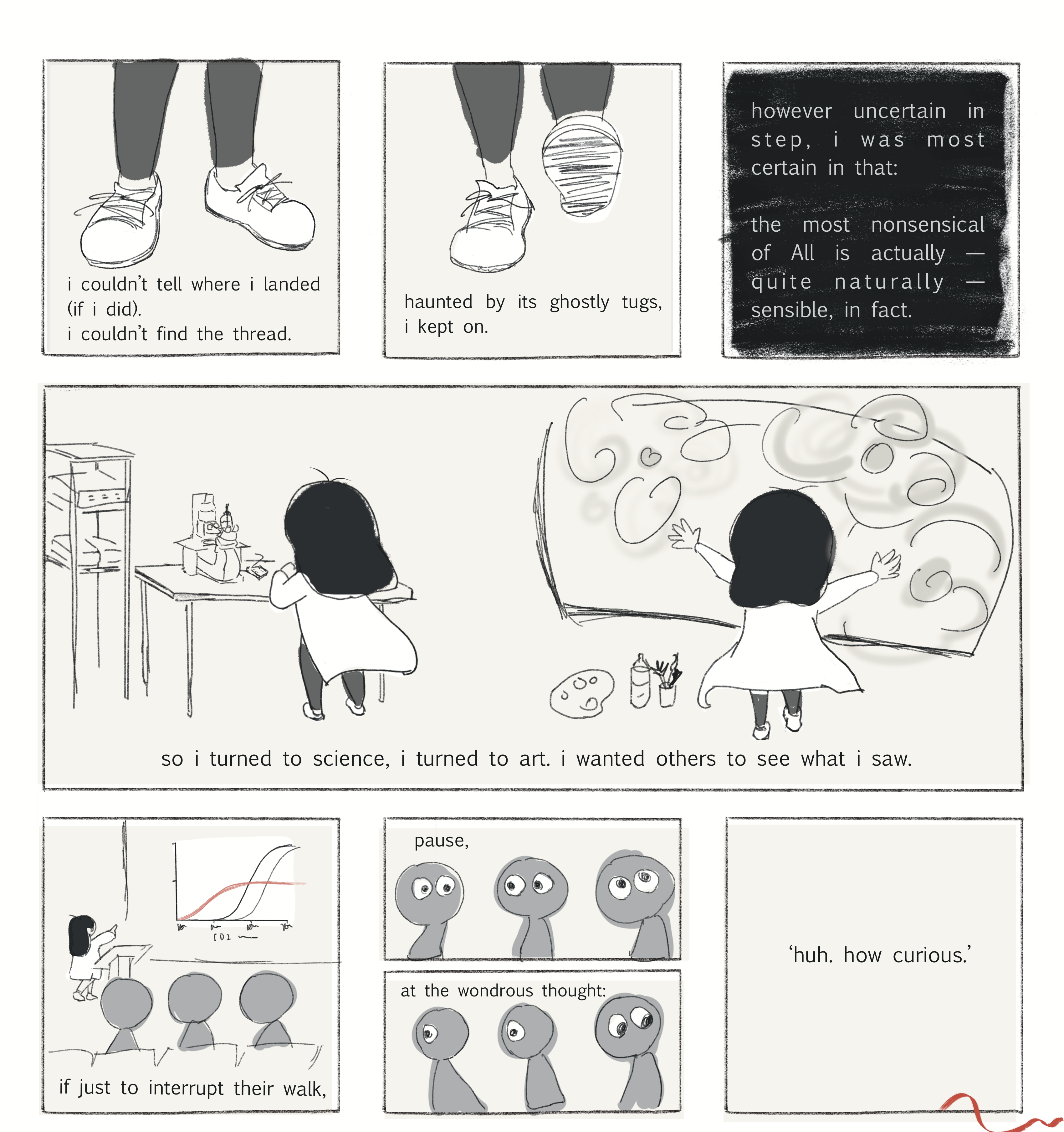
Natural Lines of Fracture

Written and Illustrated by Oanh Luc
Edited by Alex Ford and Deanna Canizzaro

Some inspirations:

  • Title: B. F. Skinner (1935) in The Generic Nature of the Concepts of Stimulus and Response.
  • Thread (pg 2): Top: An ode to our laboratory friends. Left: Cardiac action potential. Middle: Graphs of platelet aggregation (e.g., Michael Holinstat lab in Pharmacology). Right: Ionic current trace. Bottom left: Cumulative records for fixed ratio and fixed interval schedules of reinforcement.
  • ‘the most nonsensical of All…’ (pg 4): Albert Einstein wrote in 1936, “The very fact that the totality of our sense experiences is such that by means of thinking (operations with concepts, and the creation and use of definite functional relations between them, and the coordination of sense experiences to these concepts) it can be put in order, this fact is one which leaves us in awe, but which we shall never understand. One may say ‘the eternal mystery of the world is its comprehensibility.’”
  • Bottom left panel (pg 4): Dose-response curve

Oanh Luc is a graduate student in pharmacology. She is keeping on.