Dr. Nils Walter: Life in Flux: Dynamic RNA:Protein Complex Assembly Shapes Biomolecular Function

Live blogger: Ryan Schildcrout

Editor: Brenna Saladin

This piece was written live during the 10th annual RNA Symposium, “RNA Frontiers: From Mechanisms to Medicine” hosted by the University of Michigan’s Center for RNA Biomedicine.

Dr. Nils Walter opens his keynote speech by acknowledging the 10th annual RNA symposium. As a co-founder of the Center for RNA Biomedicine here at the University of Michigan, his excitement for the innovations proposed here is palpable. We feel similarly here at Michigan Science Writers for our 10th year celebration. Walter goes on to say that RNA biomedicine is unique–it offers the fastest path from fundamental discovery to medicine. He emphasizes that this symposium is all about collaboration in working towards swift translation from discovery to medicine. 

Continue reading “Dr. Nils Walter: Life in Flux: Dynamic RNA:Protein Complex Assembly Shapes Biomolecular Function”

Dr. Erik Sontheimer: Prime Assembly with Linear DNA Donors Enables Large Genomic Insertions

Live Blogger: Paola Medina-Cabrera

Editors: Camila Gonzalez Curbelo, Ryan Schildcrout 

This piece was written live during the 10th annual RNA Symposium, “RNA Frontiers: From Mechanisms to Medicine” hosted by the University of Michigan’s Center for RNA Biomedicine.

What if doctors could fix a genetic disease the same way we fix a typo? All cells in our bodies contain DNA–an instruction manual that tells our cells how to function. But that manual contains mistakes. For decades, scientists could read these instructions but struggled to change them effectively. This changed with the discovery of CRISPR, a revolutionary gene-editing technology that allows researchers to identify and edit specific DNA sequences. At the 10th Annual 2026 RNA Symposium at the University of Michigan, Dr. Erik Sontheimer, a biomedical researcher at the University of Massachusetts Chan Medical School, discusses an exciting new step forward in this field: a technique called Prime Assembly, which allows scientists to insert large pieces of DNA into the genome more efficiently. 

Continue reading “Dr. Erik Sontheimer: Prime Assembly with Linear DNA Donors Enables Large Genomic Insertions”

Dr. Karla Neugebauer: Co-transcriptional RNA processing yields unexpected versatility in gene regulation

Live Blogger: Lauren Heinzinger

Editors: Ryan Schildcrout, Brenna Saladin

This piece was written live during the 10th annual RNA Symposium, “RNA Frontiers: From Mechanisms to Medicine” hosted by the University of Michigan’s Center for RNA Biomedicine.

The flow of genetic information is a fundamental concept in biology, and it’s one of the first major topics that most biologists learn in school. DNA is first transcribed into RNA and then RNA is translated into protein. However, the process is far more complicated than this simple framework suggests. Dr. Karla Neugebauer begins her talk by diving into the hidden complexities of this process. She asks us to recall that the average human gene contains 30,000 base pairs and each gene typically takes 30 minutes to transcribe. As RNA transcripts become longer, more RNA-binding proteins (RBPs) can bind and other activities (e.g., RNA editing, RNA splicing) can occur. This means there is roughly a 30-minute window of opportunity to influence nascent RNA, or the newly synthesized immature RNA transcripts, making them dynamic moving targets for regulation. This is an important step in translation, as RNA processing can have far-reaching biological consequences.

Continue reading “Dr. Karla Neugebauer: Co-transcriptional RNA processing yields unexpected versatility in gene regulation”

Dr. Sarah Woodson: Slip stick folding of CAG repeat drives aggregation of expanded HTT RNA

Live Blogger: Lauren Heinzinger

Editors: Ryan Schildcrout, Brenna Saladin

This piece was written live during the 10th annual RNA Symposium, “RNA Frontiers: From Mechanisms to Medicine” hosted by the University of Michigan’s Center for RNA Biomedicine.

Huntington’s Disease (HD) is a fatal hereditary neurodegenerative disorder that typically emerges between the ages of 30 and 50. It’s a progressive disease that damages neurons in the brain that control voluntary body movement, resulting in uncontrolled dance-like movements called chorea and abnormal postures. Other symptoms of HD include changes in behavior, emotion, personality, and thinking. Despite modern medicine and all of our amazing medical advancements, there is still no cure for HD. This makes it especially important to understand the mechanisms underlying how HD damages these important neural cells. 

Continue reading “Dr. Sarah Woodson: Slip stick folding of CAG repeat drives aggregation of expanded HTT RNA”

Dr. Madeleine Oudin: A splice-switching antisense oligonucleotide approach for pediatric epilepsies

Live Blogger: Brenna Saladin

Editor: Ryan Schildcrout

This piece was written live during the 10th annual RNA Symposium, “RNA Frontiers: From Mechanisms to Medicine” hosted by the University of Michigan’s Center for RNA Biomedicine.

Michelle Hasting introduces the third Keynote Speaker at the RNA symposium by saying Madeleine Oudin has an incredible story to tell. While Dr. Oudin is well known for tumor resistance and tumor microenvironment research, her lab recently switched gears to an entirely new subject matter. Michelle concludes her introduction noting that she believes Oudin qualifies as one of the strongest scientists she knows in terms of the rigor she exercises within her research.

Continue reading “Dr. Madeleine Oudin: A splice-switching antisense oligonucleotide approach for pediatric epilepsies”

From Printer Inkjets to Diagnostic Tests: The Promising World of Microfluidics

Written by: Camila Gonzalez Curbelo

Edited by: Nick Janne, Hector Mendoza, Jessica Li, and Ryan Schildcrout

Illustrated by: Caroline Harms

Like many students, I enjoy trivia nights at my local university bar. This past winter, during a Family Feud-style event, I found myself intrigued by a stirring bonus question round. The task was to name the most underestimated technologies regularly used by students. Among the top five answers displayed on the projector was the printer–an unassuming contender overshadowed by the likes of the laptop–yet a worthy candidate whose evolution has been critical for scientific discovery. 

Continue reading “From Printer Inkjets to Diagnostic Tests: The Promising World of Microfluidics”

基础亦可致害:氧气也能让人呼吸困难

Elemental damage: When oxygen makes you short of breath

Written by: Jennifer Baker

作者:詹妮弗·贝克

Edited by: Christina Del Greco, Jessica Li, and Andrew Alvarez

编辑:克里斯蒂娜·德·格列柯,李锦湘,安德鲁·阿尔瓦雷斯

Illustrated by: Katie Bonefas

插图:凯蒂·博内法斯

Translated by: Yuezhong Zhang

中文翻译:张月钟

Edited by: Tao Zhang and Zhiying Yang

中文编辑:张涛,杨知颖

来,听我口令:慢慢地深吸一口气……(没关系,我会等的)……慢慢呼出。是不是感觉大脑和身体松弛下来了?深呼吸不仅有益于心理健康,也是我们的生理机能的基础保障。

除非你是在珠穆朗玛峰顶上读到这篇文章(恭喜你成功登顶!),通常你吸入的空气中约有 21% 是氧气。从海平面到珠穆朗玛峰顶,氧气浓度会逐渐降低,你很可能会由于缺少生存必须的这种元素而逐渐产生缺氧反应。它们被全身的各种细胞用于生物化学反应,例如为细胞内的生物功能(如蛋白质构建)供应能量,并修复细胞膜和DNA。

Continue reading “基础亦可致害:氧气也能让人呼吸困难”

Behind the Peel: The Chemical Complexities of Apples

Written by: Emily L. Eberhardt

Edited by: Olivia Pifer Alge, Jessica Li, Jeremy Chen, and Ryan Schildcrout

Illustrated by: Paola Medina-Cabrera

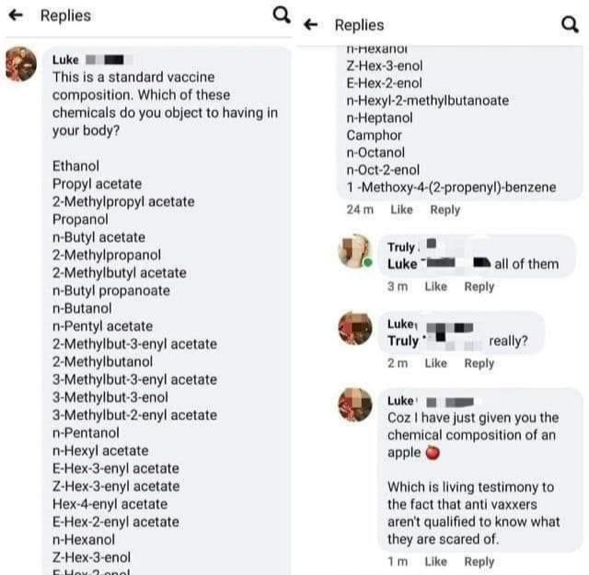
“Vaccines are full of chemicals! Wait… so are apples?” While scrolling through social media the other day, I came across an old meme where a cheeky individual attempts to pass off the chemical makeup of an apple as that of a vaccine. While looking at the list of hyphenated, long-winded names, I fact-checked the chemical composition of an apple, expecting to find a simple source. Instead, I discovered decades of research dedicated to thousands of species of apples and their chemical complexities. Surprisingly, the study of apples happens to be a (don’t mind the pun) fruitful field of study.

Continue reading “Behind the Peel: The Chemical Complexities of Apples”

¿Pueden las plantas aprender? Un sorprendente debate académico.

Autor: Kate Giffin 

Editores: Henry Ertl, Sarah Bassiouni, Sophie Hill y Jennifer Baker

Traducción: Ilka Rodriguez-Calero, Maria Dolores Sanchez Ruiz y Rocio Cisneros  

En el año de 1633, Galileo Galilei se encontraba en arresto domiciliario por una idea herética: que la Tierra da vueltas alrededor del sol. A pesar de que en la actualidad es considerado como uno de los padres de la ciencia moderna, la Inquisición Romana de la Iglesia Católica de aquel tiempo lo declaró como un “sospechoso de herejía con vehemencia”; ya que la idea desafiaba la visión geocéntrica de la Iglesia Católica en ese momento.

Continue reading “¿Pueden las plantas aprender? Un sorprendente debate académico.”

当你动起来的时候,我也会跟着做:家长如何影响孩子的体育活动和运动技能发展

When you move, I move: How parents can influence children’s physical activity and motor skill development

Written and Illustrated by: Stephanie Palmer

图文作者:斯蒂芬妮·帕尔默

Edited by: Chloe Rybicki-Kler, Emily L. Eberhardt, Sarah Bassiouni, and Jennifer Baker

编辑:克洛伊·瑞比基-克勒,艾米莉·L·艾伯哈特,莎拉·巴西奥尼,詹妮弗·贝克

Translated by: Tao Zhang

中文翻译:张涛

Editor: Zhiying Yang

中文编辑:杨知颖

嗨,亲爱的读者!这是“儿童体育活动决策和行为”两篇系列博客中的第二篇文章。本文探讨了监护人可能影响儿童的基本运动技能发展和体育活动行为。如需了解更多影响儿童体育活动的发展因素,请点此阅读第一部分!

https://lh3.googleusercontent.com/-xpWCm_7FfZumOohDf5tsz-NHG8w6QCo0W2lFjcJNltNzfmXcubXUgJo2xLCFWsEQBfs2TDg2HtuYFi0zyBpHS8K9jl1oiEX78vG86d1NOcbKO0wIKta-bezlIgTLsLpUBhQPpZ4XelkQOiRzXVyjQ

现在我邀请你回忆童年时的体育活动经历:你家中或后院有玩耍的空间吗?你有在车道或街上玩耍过吗?你的家长是鼓励你在外面玩,还是让你在家老实看电视?结束和朋友在公园的玩耍后,你是匆忙骑车回家吃晚饭,还是你所在社区不够安全到让你在外玩耍?你的那些回忆,无论与上述类似或是不同,积极或消极,都反映了家庭环境对体育活动的影响。家庭环境在推动儿童体育活动决策和行为,以及体育活动中的运动技能发展方面起着重要的作用。

Continue reading “当你动起来的时候,我也会跟着做:家长如何影响孩子的体育活动和运动技能发展”